Do you really need a custom app if you sell on Swiggy or Zomato?
You do not need a custom app if you are just starting out. Swiggy and Zomato charge 18 to 28% and 18 to 25% per order as of 1 September 2026. These fees cut deep into margins, especially on low-ticket items. A custom app helps only when you can drive enough direct orders to cover its cost.
Direct orders skip commission, so you keep more per sale. For example, on a ₹200 biryani order, a 25% fee means ₹50 goes to the platform. With a direct order, that ₹50 stays with you. Over time, this improves cash flow and profit.
Most successful cloud kitchens aim for a 70/30 split, 70% from aggregators, 30% direct, within the first year. Reaching 30% direct orders can justify building an app or website. Until then, focus on branding and customer service to build loyalty.
Flat-fee platforms like ChowNow exist but are not yet in India. For now, Indian owners must choose between high-commission platforms or building their own path. If you have repeat customers, a simple website with WhatsApp ordering may be enough to start.
Build or buy a cloud kitchen app: custom, white-label or platform?
App or website: which should you build first?
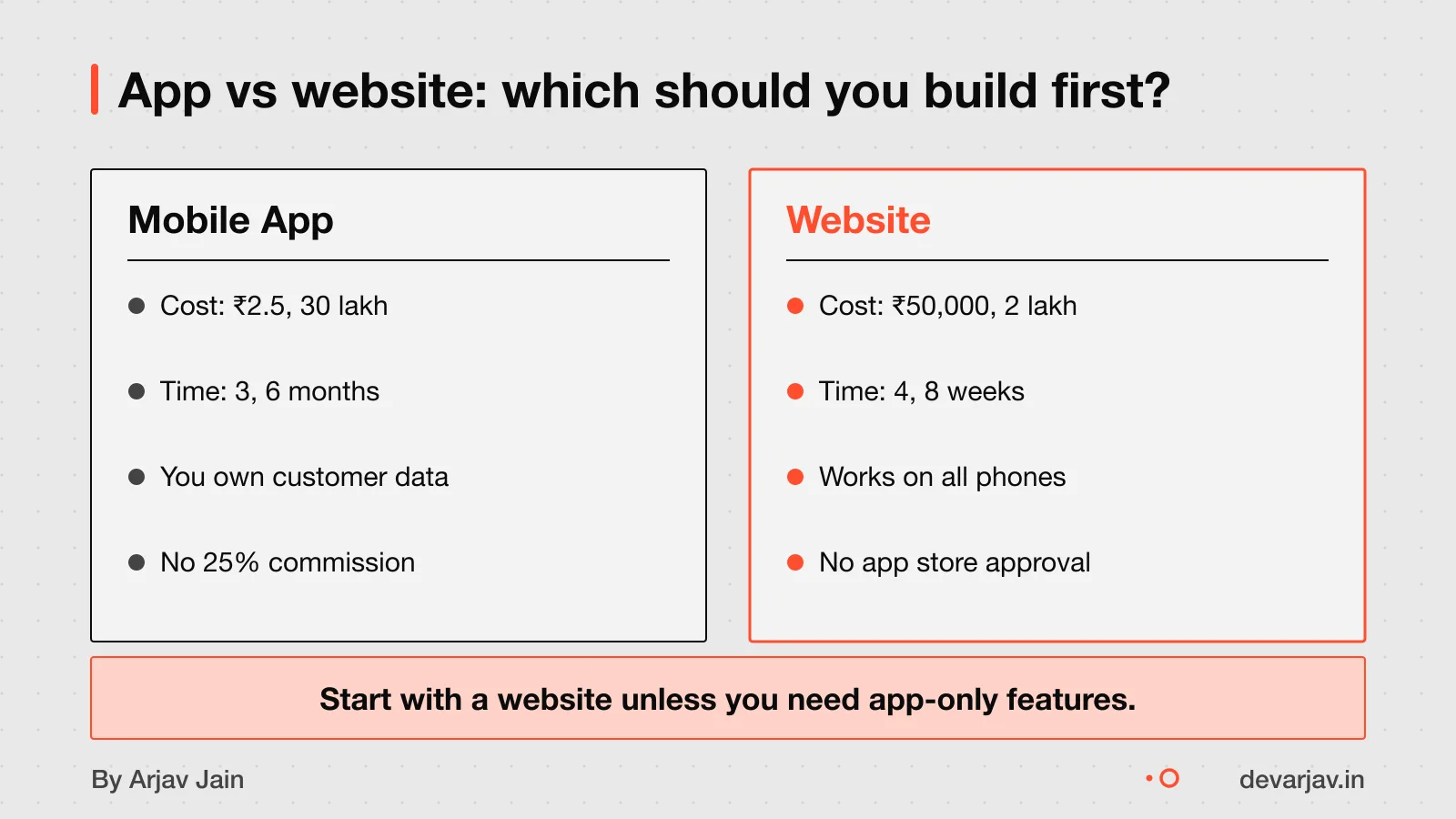
A website is cheaper and faster to launch than an app. Start with a website unless you need app-only features like offline access or background notifications. Building a custom app costs more than a website. A responsive design works well on all screen sizes, so your customers get a good experience without an app.
Choose a mobile app only if you plan to offer features like saved menus. Order tracking, or loyalty rewards that work even when the phone is offline. Apps also let you send push notifications, which can bring back past customers. But for most small cloud kitchens, a website is enough to start.
Yes, Flutter can build both the app and the website from one codebase. You save time and cost if you later add an app. This means your developer writes the logic once and deploys it across platforms. See how app and website compare in the diagram below.
Best tech stack for a cloud kitchen app in India
What features make the cost go up or down?
Complex backend tools like Docker and self-hosted monitoring with Prometheus and Grafana are part of some cloud kitchen app setups. These add development time and need skilled engineers. Some cloud kitchen apps are built with a MERN stack and deployed on AWS EC2.
A basic minimum viable product (MVP) includes menu display, cart, checkout, order history, and basic admin access. As an estimate, such an app costs ₹3.5 to 6 lakh to build. This assumes no advanced features like real-time tracking or promo code engines.
Backend complexity increases cost. For example, using Docker for containerization and self-hosted monitoring adds setup, debugging, and运维 effort. Features like promo codes and Cloudinary uploads are part of some cloud kitchen app setups.
As an estimate, assuming ₹10,000/month for hosting, updates, and minor fixes, you may pay ₹1.2 lakh per year. This depends on your provider and usage. Confirm with your developer.
See which features add cost in the isometric view below.
What features does a cloud kitchen app need?
Want a number for your idea? Send one line on WhatsApp. I reply with what drives the cost and what to cut.
Message me on WhatsApp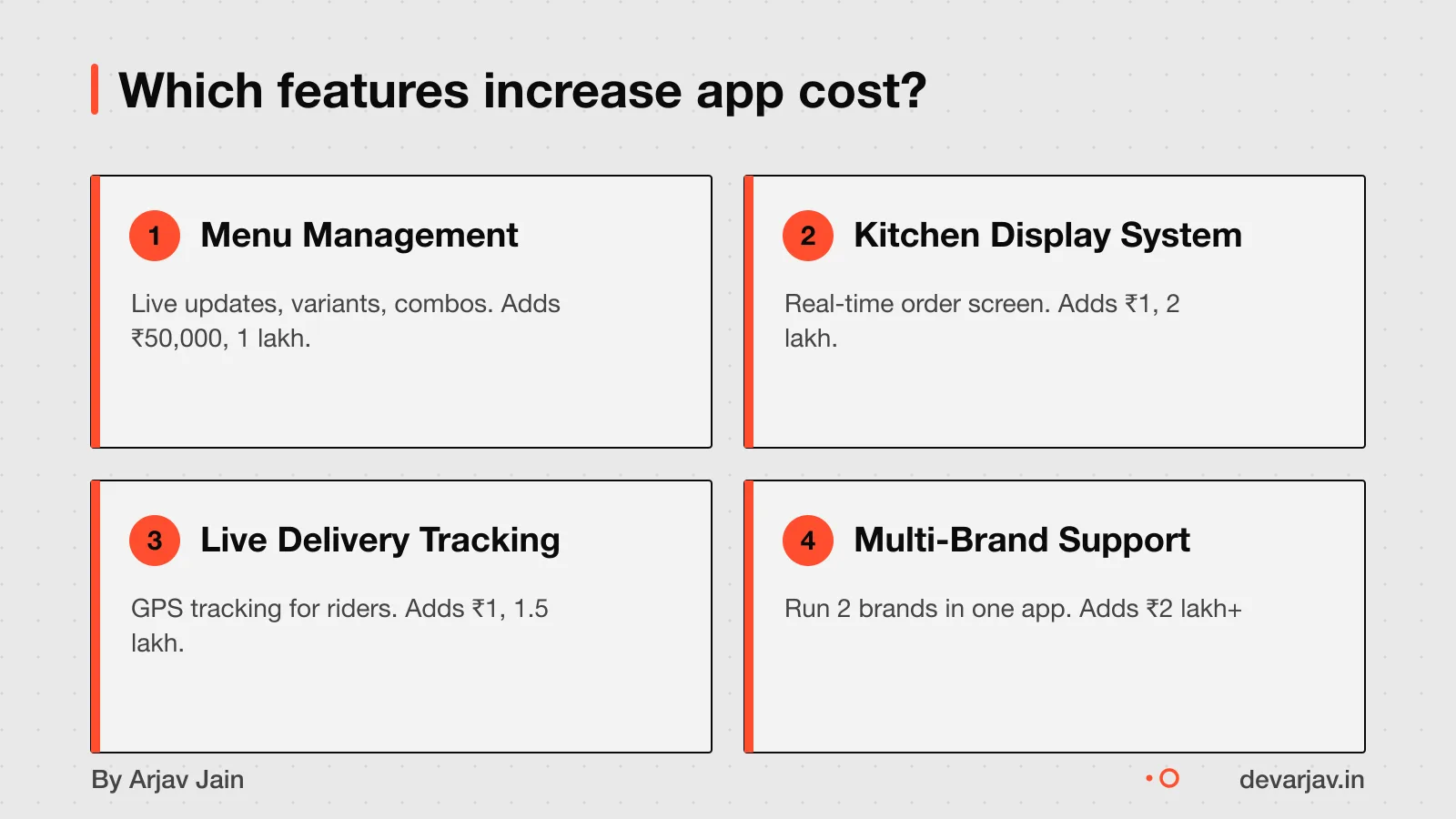
Is GST charged on app development? Can you claim input credit?
Yes, 18% GST is added to the quote if the developer is in India. This is standard for IT services under SAC code 998311. You can claim input tax credit (ITC) only if your business is registered under GST and the app is used for business purposes. Keep the tax invoice with the developer’s GSTIN and your own GSTIN listed.
If the developer is outside India, the service is treated as an import. You must pay Integrated Tax under the reverse charge mechanism. However, if you are exporting the app or related services and the payment is in foreign currency, then GST is 0%. This is called zero-rated supply.
Always check the developer’s invoice. It should show GST separately at 18% or clearly state zero rating for exports. For cross-border cases, talk to your tax advisor to confirm compliance and ITC eligibility. The rules depend on your registration, use, and payment terms.
What is the cheapest way to start taking direct orders?
A website lets you take orders, show your menu, and work with delivery staff by phone or WhatsApp. It can be ready in 2 to 4 weeks and works well on phones too.
A white label app costs ₹1.5 to 5 lakh. It looks like a custom app but uses a shared codebase. You get basic features like ordering, payments, and a dashboard. But you cannot add unique tools later, and some charge monthly fees.
No-code tools can build simple sites fast, but they often fail to connect with your kitchen’s billing system or POS. They also limit design and data control.
Free listing on platforms like Cloud Kitchen Adda is another low-cost start. You can reach local customers without paying per order. This works if you already have a way to take orders by phone or social media.
Start with a website if you want low cost and fast launch. Move to an app only when you have steady orders and need features like live tracking or loyalty programs.
How to build a cloud kitchen app: features, stack and timeline explains how to grow from a website to a full app in steps.
How long does it take to build a cloud kitchen app?
Custom features like live order tracking or kitchen display systems add time. Just Kitchen completed its full JKOS platform in May 2022. A white label app, which uses pre-built templates and shared code, can go live in 7 to 14 days. These are faster because most features are already developed and tested. If you need only minor branding changes, a white label option saves months. A fully custom app takes longer because every screen, workflow and backend rule is built for your kitchen alone. For a faster start, launch a website first in 2 to 4 weeks, then add an app later.
How long does it take to build a cloud kitchen app?
What are the risks of building a cloud kitchen app?
If your developer vanishes mid-project, you could lose time and money. To avoid this, sign a contract that includes milestones and source code handover. Work with a developer who provides regular updates and uses shared tools like GitHub. A clear agreement reduces the risk of abandonment.
An overpriced quote may include features you do not need. Compare line items against your must-have list. Watch for charges for basic tools like JWT-based authentication or bcrypt password hashing, which are standard and should not cost extra. Ask for a breakdown and check it against market rates.
If the app fails during peak orders, you could lose sales and trust. Just Kitchen saw orders jump 10X overnight during the pandemic, which tested their system. Your app must handle sudden traffic. Use scalable cloud hosting and stress-test before launch. Plan for peak loads, not just average use.
Security flaws can lead to data leaks. Ensure your app uses strong practices like JWT for login and bcrypt for password storage. Do not skip security to save money. A breach can cost more than the app.
Not sure if your project has this risk? Tell me the plan in two lines and I will say yes or no.
Message me on WhatsAppDo you own the app and source code after paying?
By default, the developer owns the app and source code, even after you pay for it. This is how copyright law works unless changed by a contract. To own the code, your agreement must clearly state that full ownership transfers to you once the project is complete. Without this, you may not be able to update, move, or sell the app later.
A fair contract includes clear ownership terms for the source code and the Apple and Google developer accounts. It should list deliverables, payment milestones, and what happens if the developer stops working. Ask for the source code to be shared with you at the end, preferably in a private GitHub or GitLab repository.
If the contract does not mention code ownership, you could lose control if the developer becomes unresponsive. For your protection, always get these terms in writing before paying. Consult a legal professional to review the agreement, as this affects your long-term control.
What legal and data rules apply to your cloud kitchen app?
FSSAI registration may be required for cloud kitchens. Consult a food safety expert for your case. The Digital Personal Data Protection (DPDP) Act applies to your app if you collect customer data. The DPDP Rules were last updated on 06-05-2026. You must get informed and specific consent before collecting names, phone numbers, or addresses. This means showing a clear checkbox or popup that explains what data you collect and why. For example, a prompt like "We store your phone number to send order updates. Tap 'Allow' to continue" meets the rule. The DPDP Act: consent flows an Indian app actually needs guide shows how to design these screens. Without proper consent, you risk fines or being ordered to delete data.
How do you handle payments and what fees will you pay?
You accept payments through gateways like Razorpay or Stripe, and pay 1 to 2% MDR per credit card transaction. UPI is cheaper and better for recurring orders, with UPI AutoPay now the main way for payments under ₹15,000.
For one-time orders, credit cards cost more in fees, so most small cloud kitchens rely on UPI. UPI AutoPay lets customers save their payment method for faster reorders, like a meal subscription. This cuts failed payments and saves time.
As an estimate, if you get 100 orders a day at ₹300 each, and 70% are paid by UPI. Your monthly transaction cost will be lower than if you used only cards. The exact savings depend on your gateway’s pricing.
You must reconcile every payment in your books. GST rules require proper invoices and UPI transaction matching. Ask your developer to build auto-reconciliation or use tools like Razorpay Reports.
Talk to your payment provider about lower rates if your volume grows. Some offer discounts after ₹10 lakh in transactions. Never assume fees stay the same, check every six months.
Worked example: cost of a cloud kitchen app for a biryani shop in Indore
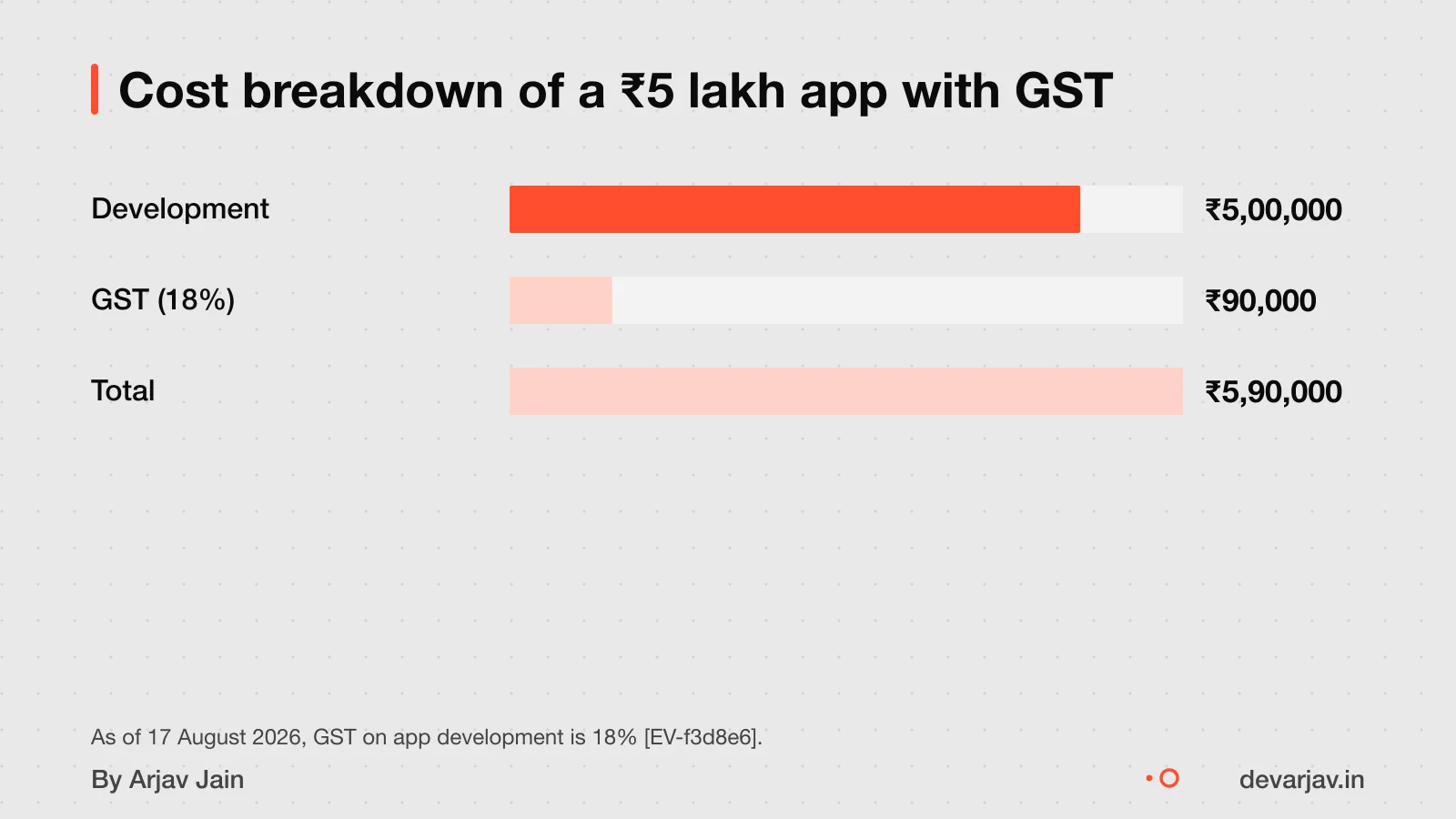
As an estimate, assuming 40 screens, MERN stack, 16 weeks, team of 4, ₹2,500/day rate per developer. A cloud kitchen app for a biryani shop in Indore costs ₹5 lakh before GST. This includes user registration, menu display, cart, checkout, order tracking, promo codes, image uploads via Cloudinary, and basic analytics. It assumes no live delivery map, kitchen display system (KDS), or AI-based recommendation engine.
GST at 18% adds ₹90,000 to the ₹5 lakh development cost. This is because custom software development is a service under SAC 998311 and attracts 18% GST when billed by an Indian developer.
The total estimated cost is ₹5.9 lakh. This assumes the team works full-time without major delays. It does not include domain, hosting, app store fees, or ongoing maintenance. If you add live delivery tracking or a KDS, costs could rise by ₹1 to 2 lakh. The estimate is based on common market rates and project scope, not a published price list.
When this advice is wrong: who should not build a cloud kitchen app?
- If 95% of your orders come from Swiggy or Zomato, stick with them. Paying for a custom app is not worth it when most sales are on these platforms.
- A simple website is enough if you only want to show your menu and take orders by phone or WhatsApp. It costs less and launches faster than an app.
- Do not build an app if you cannot manage updates, security fixes, or downtime. Apps need regular tech upkeep, and without a developer on call, small bugs can stop orders.
Next step: message me on WhatsApp with what you want to build. No forms, no sales team.
Message me on WhatsAppAssumptions behind the numbers
- Assumed team size is 2 developers and 1 designer
- Assumed average developer rate is ₹750/hour
- Assumed design rate is ₹600/hour
- Assumed 40-hour work week
- Assumed 18% GST applies to all development costs
Work out your own number
I won't hand you a number that pretends to be the market. Instead, here is the working: set the weeks, the people and the rate, and see where the money goes.
Your working total
₹4,40,00011 weeks × 2 people × 5 days × ₹4,000- Scope and design18%
- Build55%
- Testing and fixes18%
- Launch and stores9%
The weeks shown are an example of a small app, there to be changed. Fees you pay others (store accounts, cloud, SMS) are not in this total.
What moves the price
- Kitchen display system (KDS)
A digital order board for the kitchen increases complexity and cost.
- Live order tracking
Real-time location sharing adds design and testing time.
- Multi-brand support
Managing multiple menus and brands needs more logic and screens.
- Cutting to one platform first
Starting with one clear flow can be half the work.
- Using managed services
A managed backend for login and data removes weeks.
- A clear scope up front
Changes mid-build are the most expensive weeks.
Fees that go to someone else
Google Play developer account
A one-time registration fee, paid to Google. Check the current amount.
Apple Developer Program
A yearly fee paid to Apple. Check the current amount.
Cloud, SMS, maps, payments
Usage-based, billed by the provider to you.
Ask for these before you sign
- How many weeks per phase, and with how many people?
- What is not included?
- Which fees do I pay to others directly?
- What happens to the price when I change my mind?
- What does the first month after launch cost?
Questions people ask
How much does it cost to build a cloud kitchen app in India?
Custom apps are more expensive because they are built from scratch for your needs.
What makes the cost go up?
Live delivery tracking, kitchen display systems (KDS), and support for multiple brands raise the cost. These features need complex backend tools and more development time.
How long does it take to build?
The timeline depends on whether you start from scratch or use an existing template.
Is GST charged on app development?
Yes, 18% GST applies to app development in India under SAC code 998311. If the service is exported and paid in foreign currency, GST may not apply. Check this for your case with a chartered accountant.
Can I start with a website?
Yes, a mobile-friendly website is cheaper and faster to launch than an app. It can take orders, show your menu, and work with delivery staff via phone or WhatsApp. See how to build a cloud kitchen website.
Do I own the source code?
Only if your contract says so. By default, the developer owns the source code even after you pay. To own it, you must agree in writing before work starts.
What ongoing costs will I have?
As an estimate, ongoing costs are ₹5,000 to ₹20,000 per month for hosting, updates, and support. This includes server bills and minor feature changes. Confirm exact costs with your provider.
Is it worth it for a small business?
Yes, if you aim for 30% of orders through your own app or website.
What legal rules apply?
You likely need FSSAI registration and GST compliance. Rules depend on your city and menu. Check this for your case with a lawyer.
How do I check a developer's quote?
Ask for itemised work, named deliverables, payment milestones, and who owns the code and app store accounts. A fair quote lists all assumptions.