How much does a simple app cost?
A simple app in India costs ₹4 to 8 lakh. This covers a basic app with login, user profiles, and static content like text or images. It assumes one platform (Android or iOS), not both. The cost includes setup, design, and core features but not GST or long-term maintenance. GST at 18% is added to the bill. Yearly maintenance, if needed, costs 15 to 20% of the build price. For a ₹6 lakh app, that is ₹90,000 to ₹1.2 lakh per year. This range is for apps built by Indian developers or agencies. If you need more features like payments or real-time chat, the price goes up.
Want a number for your idea? Send one line on WhatsApp. I reply with what drives the cost and what to cut.
Message me on WhatsApp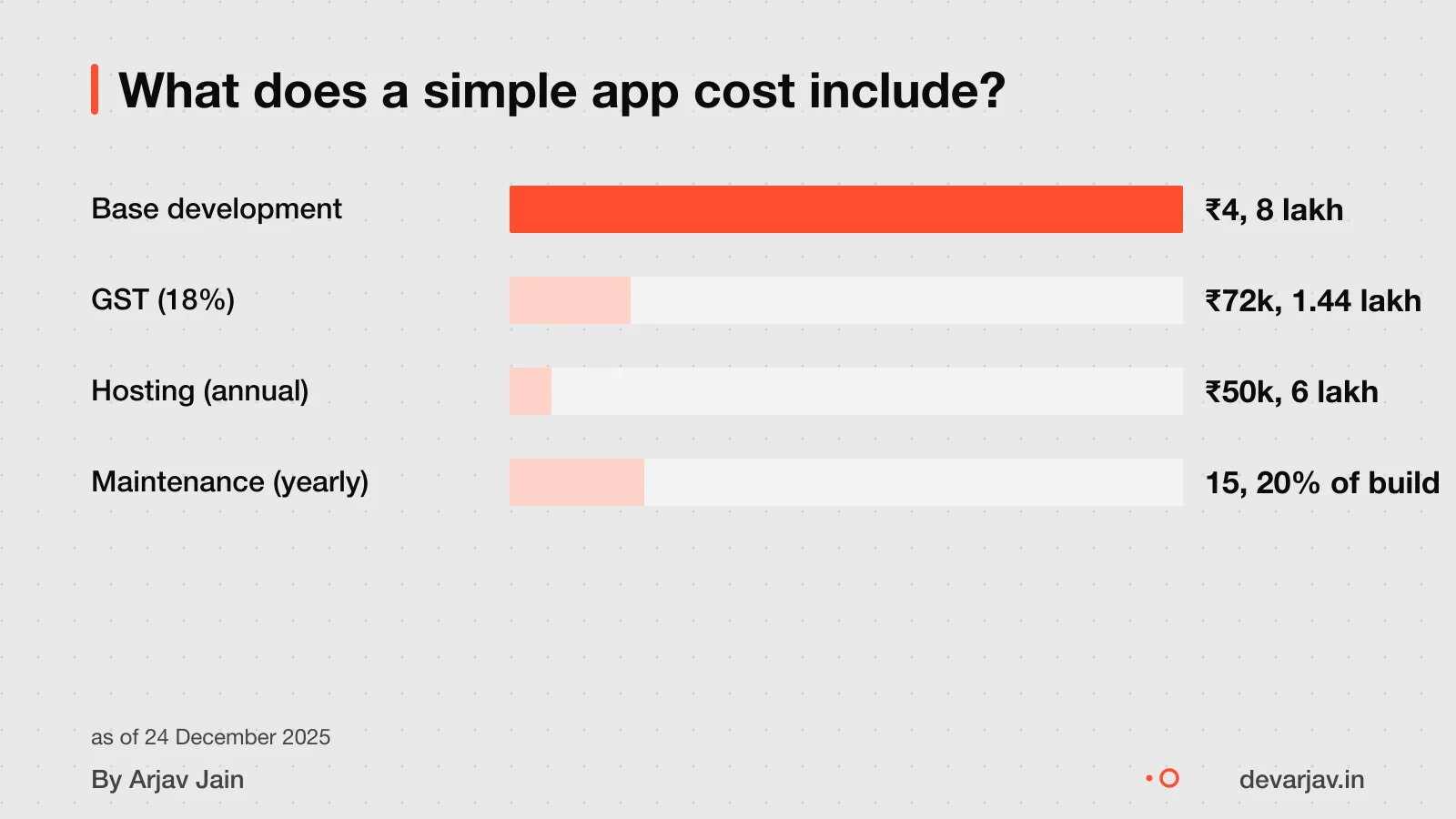
What makes the price go up or down?
The biggest cost jump comes from the type of app you build. A fintech app costs 2 to 3 times more than a basic booking app. This is due to security, compliance, and complex data handling. For example, storing user money or personal documents requires strict rules and checks that simple booking apps do not need.
Design choices also raise the price. Custom animations and a unique design system can add ₹50,000 to ₹2,00,000+ to your cost. If your brand needs a distinct look and feel, expect to pay more for skilled designers and extra testing.
Platform choice affects cost too. Building separate native apps for iOS and Android costs the most. Using cross-platform tools like Flutter or React Native cuts cost by 30 to 40 percent. These share one codebase for both phones. For most small businesses, cross-platform is the smarter choice.
A clinic appointment app would cost less than a loan-tracking app. The first needs basic forms and calendar sync. The second needs KYC checks, audit logs, and secure storage. Each added layer increases time, testing, and skill needed.
Freelancer, agency, or co-founder: which should I pick?
For most small businesses in India, an agency is a common choice for their first app for 80%+ of such businesses. Agencies have a team including a designer, developer, project manager and tester, which helps keep work moving if one person is unavailable. You pay more, but get a working app on time.
Freelancers cost less per hour and can work on simple, well-defined apps like a shop website or a basic delivery tracker. But if they stop replying or miss deadlines, you have no backup. Delivery risk is higher.
A technical co-founder is best if you want to build a product you can scale and sell. They take less money now for a share of the business later. This path needs trust, clear equity terms and a shared vision. It is not just hiring, it is starting a partnership.
Agencies suit most first-time founders who want a reliable result. Freelancers fit tight budgets with clear, small goals. A co-founder works when you are building a tech product, not just a tool for your shop.
If you are still unsure, start with a small paid task, like a one-page website, to test both freelancers and agencies. See who communicates well and delivers on time. Then scale up.
How can I check a developer is good, without knowing code?
Ask to see proof of past work that is live and working. A good developer may show a willingness to document everything they do. This shows they communicate clearly and plan properly. Use our flow diagram template for non-technical founders to judge if their explanation makes sense.
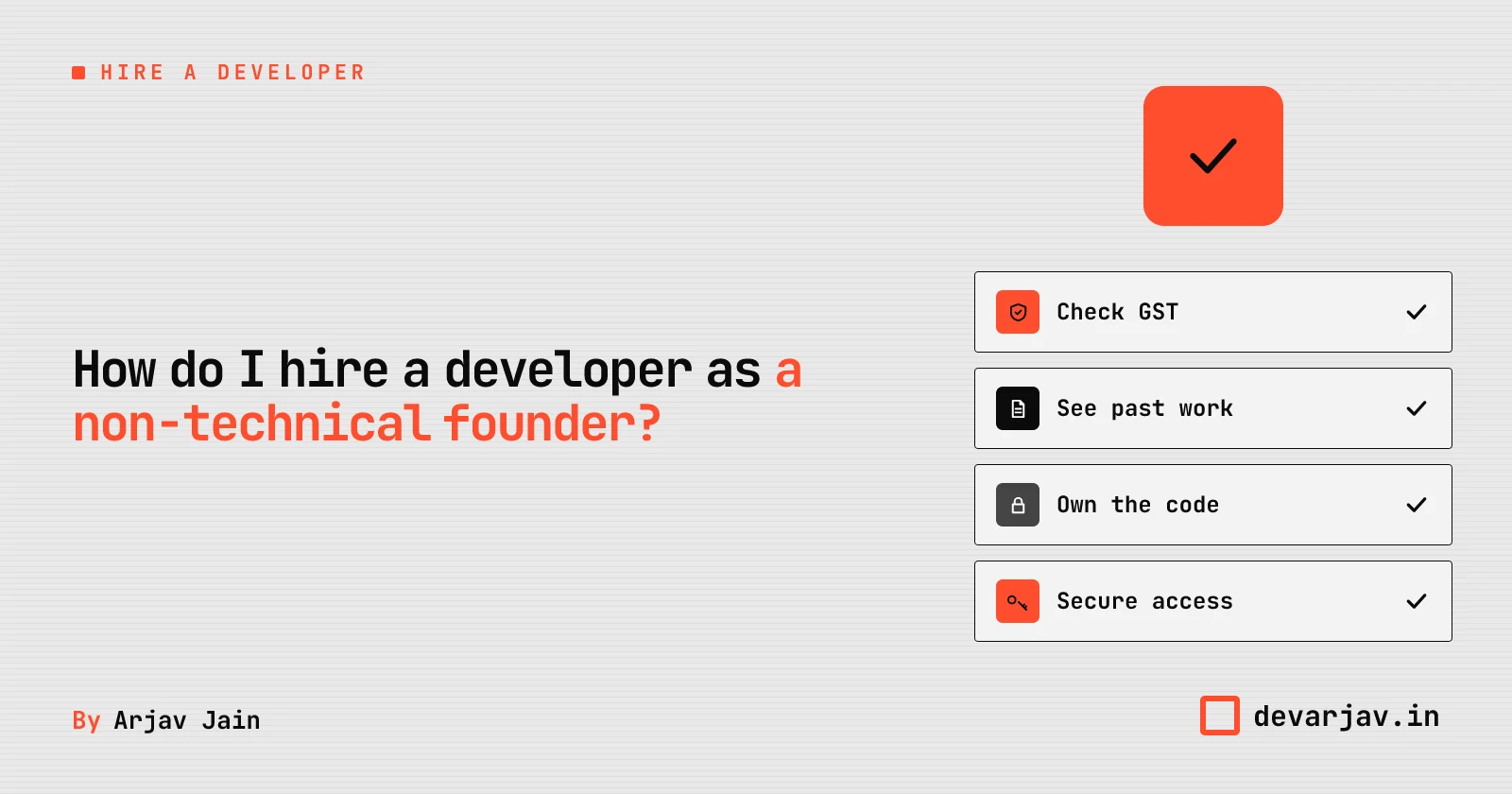
Check if the developer or agency is a registered business. Go to the GST portal and use the *Search Taxpayer* tool to verify their GSTIN. You can confirm their legal name, when they registered, and where they operate. This step stops fake firms or one-person freelancers pretending to be a full team.
Look at their GST Compliance Rating. This score shows how regularly they file returns and pay taxes. A high compliance rating means they run a serious, rule-following business. A low or missing rating is a red flag. You should also ask if they have a contract, invoice system, and clear ownership terms. These are signs of a real business, not a side gig.

What questions must I ask before hiring?
Ask a developer how they handle transitions from a previous developer. This tells you if they plan for handovers or leave you stuck. A good answer includes clear code documentation and a plan to bring new developers up to speed. For example, they might use shared tools or write step-by-step setup guides.
Ask to see a draft of the contract before signing. This reveals if they protect your ownership of the code and data. A fair contract lets you walk away with your work at any point. Avoid anyone who refuses or delays this.
Ask how they vet their own team. Some firms absorb the cost of technical checks so you don’t pay for mismatched skills. You should also interview the actual developer who will work on your project. This ensures the person you approve is the one who starts.
These questions expose hidden risks like skill gaps, poor handover plans, or ownership traps. They also show if the developer respects your role as the business owner.
Have a quote in hand? Send it to me and I will mark what is missing.
Message me on WhatsAppWhat are the red flags when hiring a developer?
A quote that is much lower than market rates is a red flag. It often means key parts like quality testing, backend systems, or ownership of the source code are not included. You may face extra charges later when these are added.
Never accept a contract that does not include a non-disclosure agreement (NDA) and clear assignment of intellectual property (IP) rights from day one. Without this, you may not own the code built for your business, even after full payment.
A request for 100% advance payment is another warning sign. It reduces the developer’s accountability and puts your money at risk if work stops halfway.
If a developer refuses to sign an NDA, avoid them. Your business idea and customer data must stay protected.
how to handle app security as a non-technical owner
Who owns the code after the app is built?
You own the code only if your contract says so in writing. By default, the developer keeps ownership of the software they write, even if you paid for it. To transfer ownership, your contract should include a clause that uses clear words like 'hereby assign'. This assignment must be in writing and signed by both parties, as required under Section 19 of the Copyright Act, 1957.
For example, if a developer builds a shop inventory app for you, they legally own the code unless the contract states otherwise. Without a proper clause, you may not be able to update, sell, or reuse the app later. Even with ownership, Indian law recognises moral rights, the developer can still be named as the creator. But they cannot block your use of the software.
Not sure if your contract protects you? Send the clause and I will say yes or no.
Message me on WhatsAppWhat if the developer stops working halfway?
If your developer stops responding, your app or website can be left unfinished and hard to fix. You must act early to protect your work. First, make sure you have control of your own assets. These are your assets, not the developer’s. Make sure you have the login details or can regain control through the provider. Without access, you cannot update or move your site.
Next, make a complete copy of your website. This should happen before development starts, but if it hasn’t, ask for it at once. A backup lets another developer take over without starting from scratch. Store it safely, like on a locked USB drive or private cloud folder.
To stay safe, plan for handover from day one. Use a flow diagram template for non-technical founders to map out who controls what. This helps you spot risks early. If the developer refuses to share access or backups, that is a red flag. Walk away before paying.

When should I not hire a developer yet?
When should I not hire a developer yet?
Do not hire a developer if you have not tested your idea with real customers. Try a WhatsApp group, a Google Form, or a paper sign-up sheet in your shop to see if people will use your service. If no one signs up or pays, the problem is not the app, it is the idea.
Building is too early if you can use free tools instead. Many small businesses start well with a WhatsApp number, a Google Site, or a no-code tool like Tally or Typeform. These cost little and let you learn fast.
You do not need custom software until you have clear demand and a process that breaks without it. Wait until you are turning away customers or spending hours on manual work.
Want to test your idea before coding? Try one of these no-code tools first: when a no-code tool beats a developer.
Message me on WhatsAppAssumptions behind the numbers
- Budget and timeline are working assumptions provided by the reader.
- App type, key features, platform, and design needs affect cost but are not priced individually in this summary.
The chapters
A protective, step-by-step guide for a first-time buyer. It takes about ten minutes and can save you months.
10 min read, in 6 chapters.
01 · Start here
Write what you need, in one page
Most hiring problems start before the first conversation. If you cannot say who the product is for and what they will do with it in two sentences, no developer can price it, and every quote will be a guess.
Write one page: who it is for, the problem it solves, the three things that must work on day one, and two or three apps you like. You do not need designs or a feature list. Working out what to leave out is part of the job you are hiring for.
Do this One page. Three must-haves. No more.
02 · Decide
Choose the kind of help
There are three common shapes: a freelancer, a small studio, and a larger agency. A freelancer is usually the fastest and most direct for a clear, small scope. A studio gives you a few people with complementary skills. An agency carries process and breadth, at a price.
A fourth option is hiring in-house, which only makes sense when software is the core of your business and there is work for years.
Do this Ask who exactly writes the code, whichever you pick.
03 · Find
Find and shortlist three
Look where proof is visible: shipped apps in the stores, a portfolio with real names, a profile with a history of work, and people your own network can vouch for.
Shortlist three, not ten. Three conversations are enough to see how people differ in how they ask questions.
Do this Prefer people who ask about your users before your budget.
04 · Verify
Verify before you trust
Open two shipped apps on your own phone. Ask them what they would defend in that app and what they would change. Speak to one previous client, by phone.
A portfolio of screenshots proves nothing by itself. A shipped, running app and someone willing to be called is a different level of evidence.
Do this Call one past client. It takes ten minutes.
05 · Agree
Put it in writing
A fair agreement states: what is included and what is not, milestones with something you can test at each one, how changes are priced, who owns the code and accounts, and what happens if either side stops.
Make sure the repository and the Apple and Google store accounts are created in your name from the start. It is the single easiest thing to do and the hardest to fix later.
Do this If it isn't written down, it isn't included.
06 · Finish
Pay, test and take it over
Pay against milestones you have tested, not against time passing. At the end, you should receive the source code in your repository, the accounts and keys in your name, and a short document on how it fits together.
Plan for the first month after launch. Bugs show up when real people use real data, and it helps to know in advance what fixing them costs.
Do this Keep one backup of everything, somewhere you control.
Quick answers
How much should I pay up front?
Tie payment to milestones you can test. A small first payment to start is common, but avoid paying the whole amount before you have seen working software.
Do I need a technical co-founder?
Not to build a first version. You do need someone technical to ask hard questions of your vendor, which can be a paid hour with an independent advisor.
What if the developer quits halfway?
If a developer disappears, your app is at risk. Secure access to domain, hosting, and accounts. Make a full backup early. Transitions can happen without downtime if planned.
Can I build it myself using a tool?
Yes, if your goal is simple and you have time to learn. But for custom features or growth, hiring a developer is faster and more reliable.
How do I check if a quote is fair?
Compare it to the published ranges: ₹4–8 lakh for a simple app. Watch for hidden costs like backend, QA, or maintenance left out.
Should I sign an NDA first?
Yes. A good developer will offer one. It protects your idea and sets a professional tone.
Who owns the code after it’s built?
By law, the developer owns the code unless a contract assigns it to you. Use 'hereby assign' in writing to transfer rights.
Questions people ask
What if the developer stops working midway?
Your app or website is at risk if the developer stops responding. Secure access to your domain, hosting, and all accounts, and make a full backup early. Also, get a written handover plan before work starts.
How do I know if I need a developer or a no-code tool?
Use a no-code tool if your needs match a template and you do not need custom logic. Choose a developer if you need unique features or integrations. See when a no-code tool beats a developer for more checks.
What legal clauses protect me as a non-technical founder?
Include an NDA, IP assignment, and a 'hereby assign' clause in your contract. This ensures you own the code and protects your idea. Under Indian law, IP assignments must be in writing and signed.
How do I verify a developer's GST and business status?
Use the GST portal's 'Search Taxpayer' tool to check their GSTIN, legal name, and return filing status. Also, review their GST Compliance Rating for timeliness in filing returns and tax payments.
Can I switch developers later without losing my app?
Yes, if you have the source code, access to all accounts, and full documentation. A smooth transition is possible without downtime when these are in place. Back up everything early.
What should I include in the contract?
List clear deliverables, payment milestones, IP assignment, NDA, and post-launch support terms. Under Indian law, IP assignments must be in writing and signed.
How much should I pay upfront?
Pay no more than 30% to 50% upfront. Tie payments to clear milestones like design approval or feature completion. Avoid full advance, as low quotes often exclude key costs like QA or code ownership.
Do I need to pay GST when hiring a developer?
Yes, GST at 18% applies to freelance or agency developer services. If your business is GST-registered, you may claim input credit. Check this for your case with a chartered accountant.