What is a flower and gifting app?
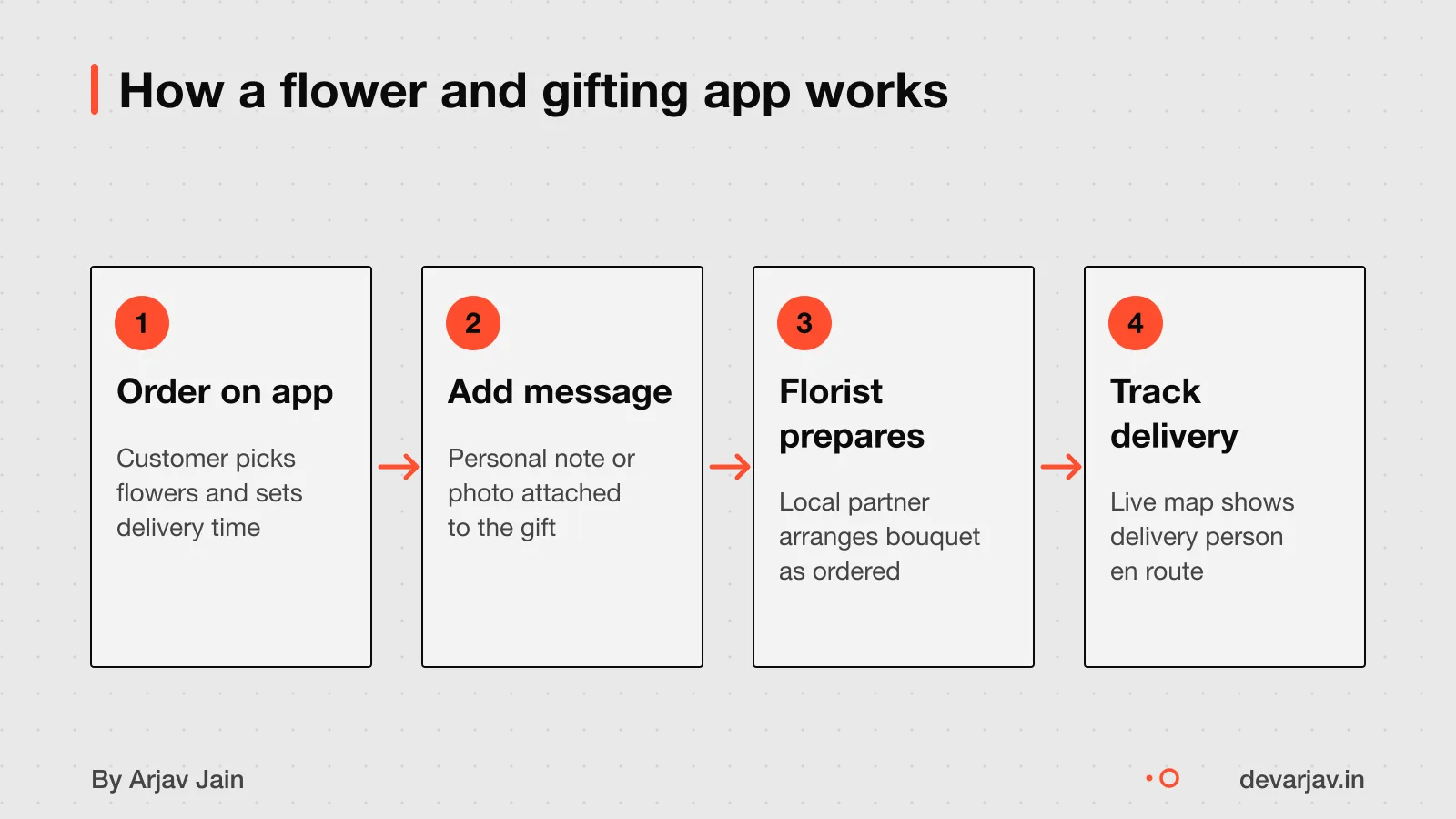
A flower and gifting app lets customers pick bouquets, add personal messages or photos, and schedule deliveries for occasions like birthdays, anniversaries or Diwali. It is different from a food delivery app because it focuses on curated gifts. Not meals, and often includes emotional touches like voice notes or custom cards. Klaviyo supports personalisation in email marketing. If a flower is out of stock, the app can allow florists to substitute a similar bloom or vase, just like real florists do. For example, if red roses are sold out on Valentine’s Day. The app can let the shop send deep pink ones instead, with a note explaining the change. This keeps the gift on time and the customer happy.
Having a mobile showcase for your gifts, much like a digital version of your shop window, helps customers browse even when you are closed.
Must-have features for a flower and gifting app
Do you need an app if you already sell on WhatsApp?
Yes, you can showcase products on WhatsApp. The WhatsApp Business app lets you create a mobile storefront to display your flowers and gifts. You can list items, add prices, and share the link with customers. This works well for small shops with a simple catalog.
But an app can do things WhatsApp cannot. It can store customer addresses and preferences, send automatic reminders for occasions like anniversaries, and let users schedule deliveries weeks in advance. It can also support offline browsing and faster image loading, which helps in areas with slow internet.
An app adds real value when you want to save time on order entry. Reduce missed sales during peak days, or offer features like gift personalisation with voice notes or custom cards. If most of your orders come from repeat customers, an app helps build loyalty through a smoother experience.
However, if your sales are mostly one-off and you already reply fast on WhatsApp, an app may not be worth the cost right now. Many small shops start with WhatsApp and only build an app when they see a clear need for automation or growth.
How to build a flower and gifting app explains the next steps if you decide to go ahead.
What features add the most cost?
Third-party integrations, custom designs, and real-time features add the most cost to a flower and gifting app. Each integration with payment gateways, maps, or WhatsApp Business API can cost ₹50,000 to ₹2,00,000. Custom animations and branded design systems increase the design budget by 20% to 40%. Real-time features like GPS tracking or live notifications raise server costs by 25% to 50%.
For example, if you add UPI payments, Google Maps for delivery tracking, and WhatsApp order updates. That could add ₹1.5 lakh to ₹6 lakh in total integration costs. Custom design and animations can increase design costs by 20% to 40%.
Here is how these features affect cost:
| Feature | Cost Impact | Reason |
|---|---|---|
| Payment, maps, WhatsApp, CRM integrations | ₹50,000 to ₹2,00,000 per integration | Needs secure setup, testing, and compliance |
| Custom design and animations | +20% to +40% on design cost | More time and skill than standard UI |
| Real-time chat, tracking, notifications | +25% to +50% on server cost | Requires scalable backend and constant uptime |
The best tech stack can reduce some of these costs Best tech stack for a flower and gifting app.
Want a number for your idea? Send one line on WhatsApp. I reply with what drives the cost and what to cut.
Message me on WhatsApp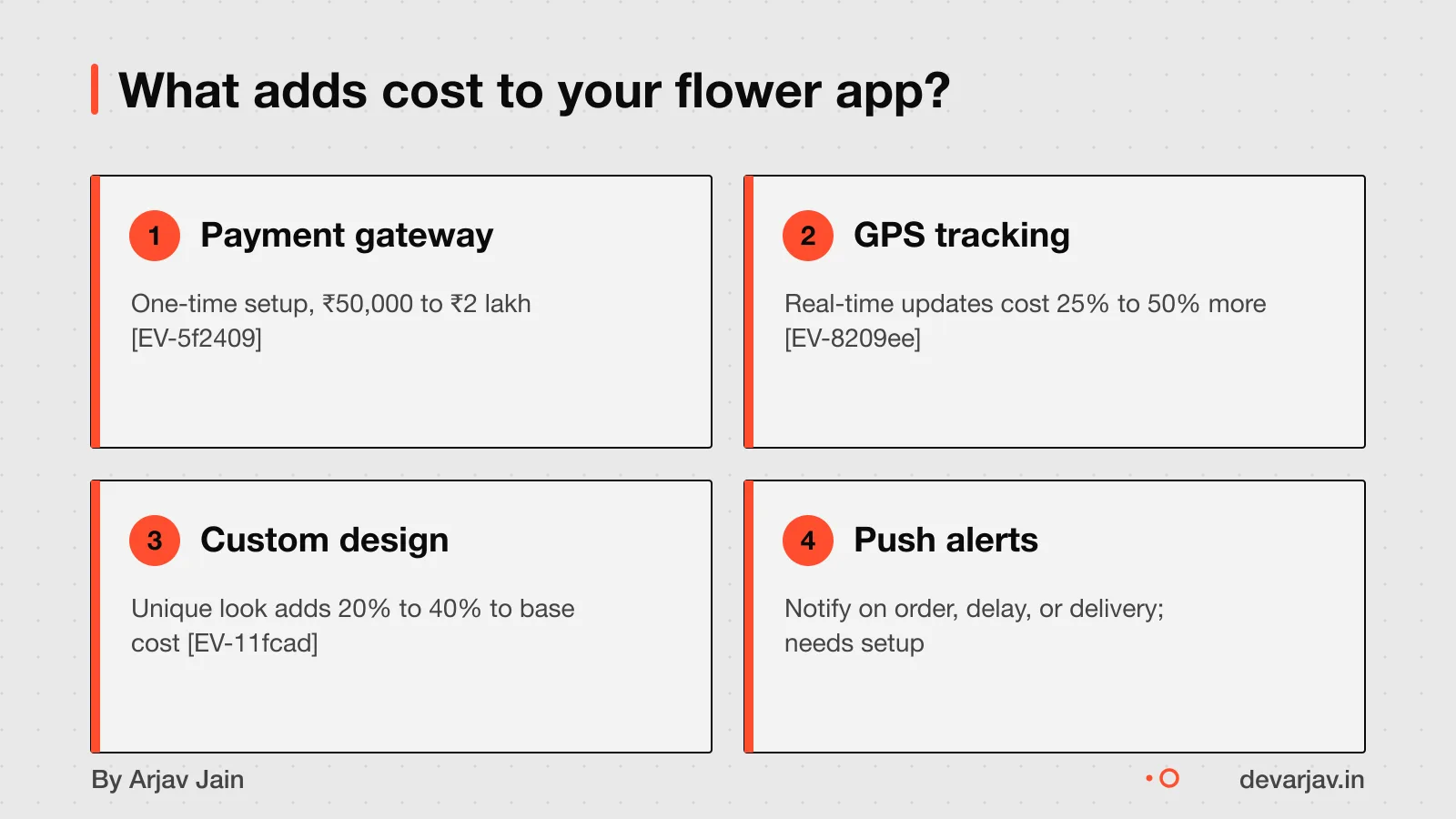
Is same-day delivery expensive to support?
Same-day delivery does raise costs, mainly due to real-time tracking and tight logistics. It works by linking your app to delivery staff through GPS and push notifications. Orders must be processed and dispatched the same day, so the system needs live updates on rider location and delivery status. As a result, server costs go up by 25 to 50% because of the added load from GPS tracking and live alerts.
The cutoff time for same-day orders is usually 3pm in the local delivery area. This gives your team enough time to prepare the bouquet and assign a delivery person. Beyond that, next-day delivery becomes the only option.
Adding GPS tracking increases server-side complexity. It does not add a fixed cost but raises your cloud and bandwidth bills based on how many deliveries happen each day. In bigger cities with high order volume, this cost grows faster. For smaller towns with fewer orders, the impact is lower but still present.
Planning around peak days like festivals or Valentine’s Day will also affect delivery costs. These are not covered in standard estimates and require separate scaling. For help planning your occasion calendar, see the guide on how to prepare for peak gifting seasons.
How much does personalisation add to the cost?
This feature lets customers write notes or upload images to go with their gift. As of now, the exact cost to build this into your app is not known [unknown].
The cost to add voice notes is not known [unknown]. One way to offer voice messages without building from scratch is to use Voicenotes. Which has a free Basic plan that includes 100 minutes per week of transcripts and summaries. You can link this as an external tool instead of coding it into the app.
There are tools that can make personalisation cheaper. For example, Klaviyo helps with personalised email marketing using AI to predict customer behaviour. While it is meant for emails, you can adapt it to send follow-up messages with custom content after a gift is ordered.
Building full personalisation into the app raises the cost, but using ready-made tools can reduce it. Since the exact cost is not published, ask your developer to break down this line item in the quote. If they do not, compare it with the cost of adding a third-party service like Voicenotes or Klaviyo.
How long does it take to build?
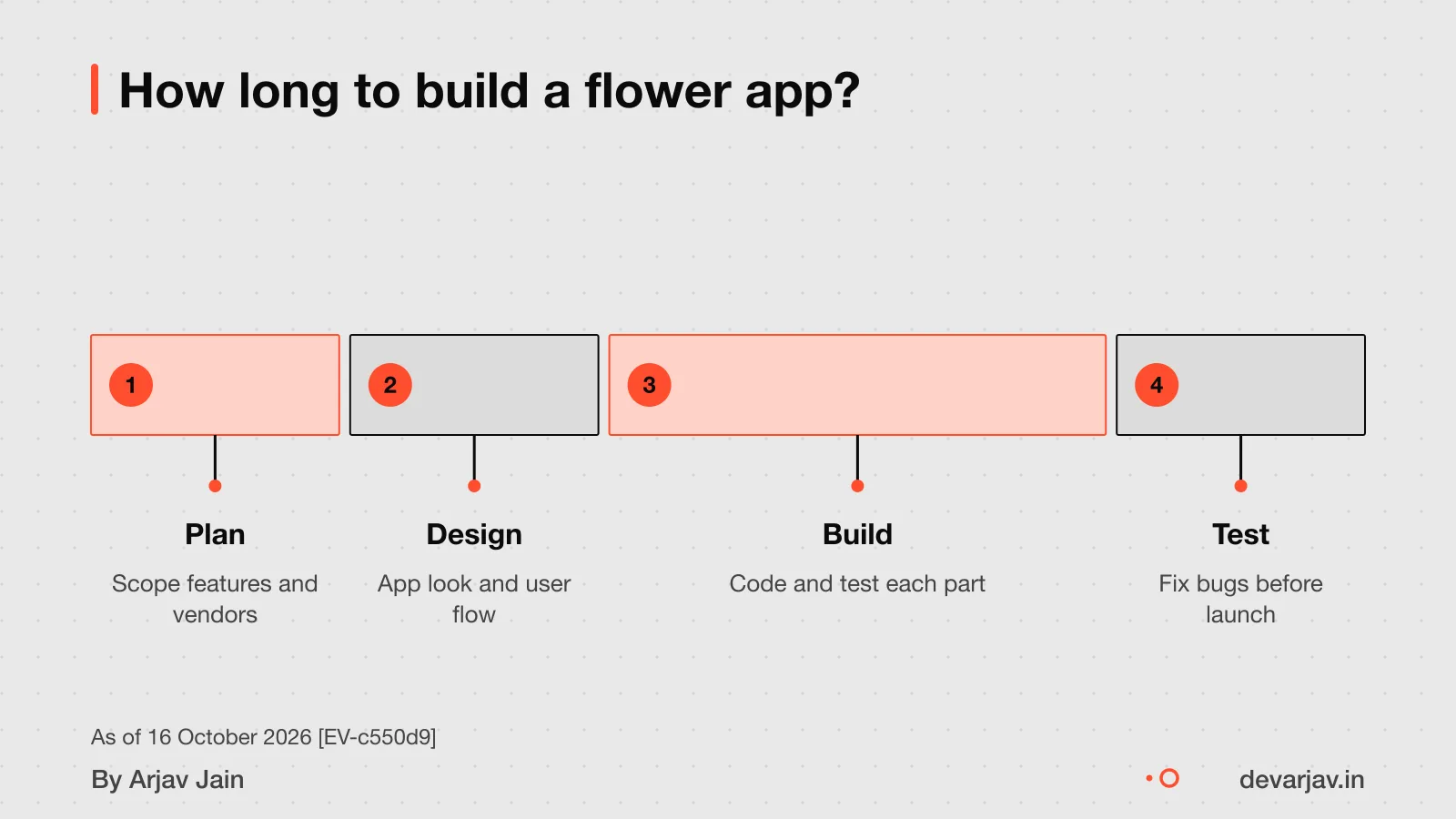
A simple app takes 4 to 6 weeks to build. This timeline assumes clear goals, like letting customers pick bouquets, add messages, and schedule local deliveries. Medium apps with extra features like vendor networks or AI-based gift suggestions take 2 to 3 months.
Vague requirements and unchecked scope creep are a leading cause of delays. For example, if you say “make it look nice” instead of “show 3 large photos per bouquet on the home screen,” your developer may guess wrong. This can waste time. Scope creep, adding new features mid-way, also slows progress.
Regular communication through daily stand-ups and weekly demos can help reduce blockers. These meetings help catch issues early. If you plan to launch before Valentine’s Day or Diwali, start at least 8 weeks ahead. That gives time for testing and last-minute fixes.
How long does it take to build a flower and gifting app?
Build, buy or use a no-code platform?
You can build a flower and gifting app without coding using no-code platforms like GoodBarber, Bubble, or FlutterFlow. These tools let you drag and drop features to create an app. They work well for simple stores that sell a few bouquets and gifts online. As an estimate, the GoodBarber Content App Premium plan costs $70 per month billed monthly.
No-code builders save time and cost less up front. You can launch in weeks, not months. Passion.io says its drag-and-drop interface needs zero coding. But these platforms have limits. Adalo and FlutterFlow make native apps, but lack built-in support for retail, food, and service workflows. You may not add deep custom features like AI-based bouquet suggestions or multi-vendor tracking.
Custom development is worth it when you need control. If you want to personalise gifts with voice notes, support cash on delivery, or manage a network of local florists, a custom app fits best. It also helps if you plan to scale across cities or add new services later. A custom app runs on your own code, so you own all the data and can change anything.
For small shops just starting out, a no-code platform can be enough. But if your business grows, you may hit limits and need to rebuild later. That can cost more in the long run.
Build or buy a flower and gifting app: custom, white-label or platform?
Still unsure between custom, white-label or no-code? Tell me your budget and timeline and I will say which fits.
Message me on WhatsAppWho owns the app after it is built?
Yes, you own the code and design once the app is built, as long as your contract says so. The developer must hand over all source files and grant you full rights. This is your asset.
You can switch developers later. App stores allow ownership transfers. For example, Apple lets you move an app to another App Store Connect account. Google Play does too. Just follow their transfer process.
Your design is protected under Indian law if registered. IP India states that registered designs give you exclusive rights to use it on your products. This stops others from copying your look.
Always sign a contract that includes IP transfer and source code delivery. Without it, you may not fully own the app. For safety, read How to protect your app ownership.
How can I check if a developer's quote is fair?
Ask for a feature-by-feature breakdown of the quote. A fair quote should list hours for each phase: design (40 to 60 hours). Development (120 to 200 hours), and testing (20 to 30 hours). These ranges assume clear requirements and no scope creep, which is the top cause of delays.
If the developer refuses to share this breakdown, be cautious. Vague quotes often hide hidden work or unclear goals. You have the right to know what you are paying for. Without a shared plan, small changes can become costly disputes.
Compare the hours they quote against these averages. If their design phase is over 80 hours, ask what extra work is included. If development is below 120 hours, check if core features like cart, checkout, or notifications are missing.
A developer who avoids details may not be ready for accountability. Clear communication, like weekly demos, helps catch problems early. If they won’t share timelines or tasks, it could mean they lack a real plan.
What must you provide during development?
You must supply product photos, pricing, delivery rules, and a list of vendors. Without these, the app cannot show what you sell or how and when it reaches customers. Provide clear, high-quality images of your bouquets and gifts, along with accurate prices and any restrictions like minimum order value or delivery zones.
You also need to define your delivery rules. This includes whether you offer same-day delivery, which areas you cover, and if there are extra charges for holidays like Valentine’s Day or Diwali. List all your vendors, such as local florists or gift packers, so the app can track inventory and assign orders correctly.
Your input directly affects the timeline. Delay in sharing content or approving design drafts can push the project back by weeks. Test the app thoroughly when ready, especially order flow and payment, to avoid last-minute fixes. The developer cannot move fast without your timely feedback.
When this advice is wrong for you
- If your monthly sales are under ₹50,000, an app may not pay for itself. Focus on growing demand first through WhatsApp or local ads. Most small shops in tier-2 cities start there.
- If your customers already order via WhatsApp, an app adds little value. WhatsApp is free, familiar, and supports photos, payments, and quick replies. Over 80% of small florists in smaller towns use it as their main channel.
- If you sell mostly on festival days like Diwali or Holi, an app may sit idle the rest of the year. A one-page website or social media store is cheaper and easier to update.
- If you cannot provide clear images, pricing, and delivery zones during development, the app will stall. You must supply these within the first 10 days.
- If your staff are not comfortable with smartphones or order tracking, the app will not work. Training takes 2 to 3 weeks and must be done before launch.
Next step: message me on WhatsApp with what you want to build. No forms, no sales team.
Message me on WhatsAppAssumptions behind the numbers
- Base cost assumes 3–5 core features on one platform
- Each major feature toggle adds measurable cost as per evidence
- Annual maintenance is 15–20% of initial cost
- Developer rates and third-party costs are as stated in knowledge
Work out your own number
I won't hand you a number that pretends to be the market. Instead, here is the working: set the features, see what adds cost, and uncover what’s left out.
Your working total
₹3,20,0008 weeks × 2 people × 5 days × ₹4,000- Base app (one platform)38%
- Custom design13%
- Integrations25%
- Real-time features25%
The weeks shown are an example of a small app, there to be changed. Fees you pay others (store accounts, cloud, SMS) are not in this total.
What moves the price
- Add payment gateway
Adds ₹50,000 to ₹2 lakh to setup and test
- Enable GPS tracking
Raises server-side cost by 25–50%
- Add custom animations
Adds 20–40% to design cost
- Vendor or rider management
Each role is close to building another app
- Personalisation features
Custom messages, images or AI-driven suggestions
- Start with one platform
Half the work of iOS + Android together
- Use pre-built templates
No-code tools reduce early costs but limit later changes
- Clear scope up front
Avoids mid-build changes, the costliest weeks
Fees that go to someone else
Google Play registration
One-time ₹2,000 approx. fee
Apple Developer Program
₹8,000 approx. per year
Cloud, SMS, maps, payments
Usage-based, billed by provider to you
Ask for these before you sign
- What features are must-haves vs nice-to-haves?
- Which third-party services will I pay for directly?
- How much does upkeep cost each year?
- Can I start small and add features later?
- Who owns the code and data once it’s done?
Questions people ask
How much does a flower and gifting app cost in India?
A tightly scoped MVP with 3 to 5 core features, a single platform. No complex backend can cost ₹3 to 5 lakhs to build. For more features, the cost will rise.
What makes the cost go up?
Third-party integrations like payments, maps, or WhatsApp Business API add ₹50,000 to ₹2,00,000 each. Real-time features like live chat or GPS tracking increase server costs by 25 to 50%.
How long does it take to build?
A simple app takes 4 to 6 weeks to build. Apps with more features or complex workflows take 2 to 3 months. Clear goals and fast feedback help meet the timeline.
Do I need GST for app development billing?
Yes, if you are GST-registered, you must issue a GST invoice for app development. The invoice must include the SAC code for software services. Check this for your case with a chartered accountant.
Can I transfer the app to another developer later?
Yes, you can transfer the app to another developer or organisation. The app keeps its reviews, ratings, and unique ID. Apple and Google both support this process.
How much does app maintenance cost per year?
Plan to spend 15 to 20% of the initial build cost each year on maintenance. This covers updates, bug fixes, and server costs. It does not include new features.
Is a no-code app builder good enough for a flower shop?
Yes, for basic features like product display and orders. Platforms like GoodBarber or Passion.io need no coding. GoodBarber's Content App plan costs $55 per month when billed yearly.
Can the app handle Valentine’s Day rush?
Yes, if you plan ahead. You must scale servers and delivery staff before the event.