What does a D2C app developer do?
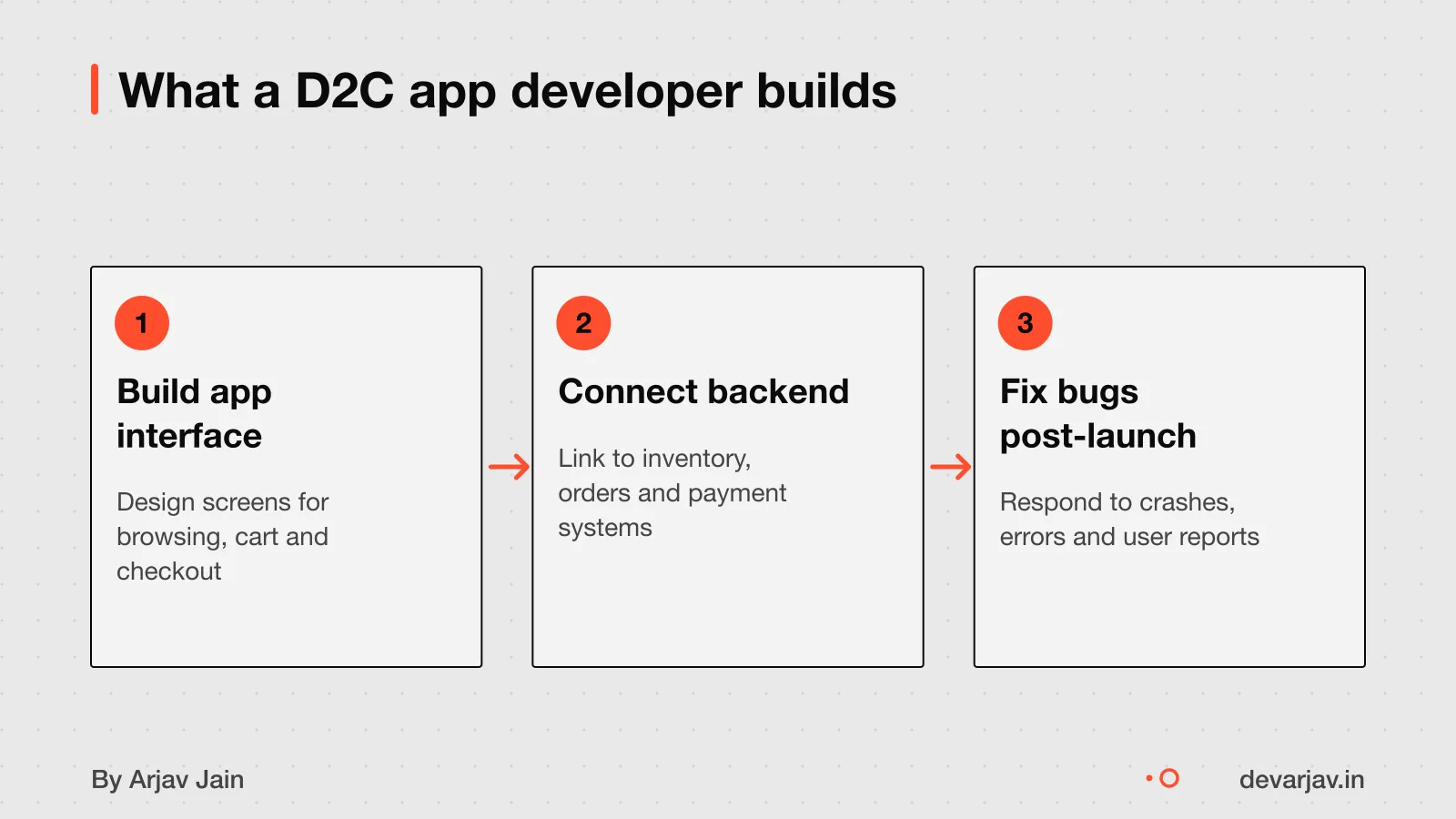
A D2C app developer builds and maintains your mobile app so it runs smoothly on phones and tablets. They write code, design screens, and connect your brand’s features like product listings, cart and checkout. They use platform tools such as Apple SDKs and APIs. Which are software kits from Apple that let apps work on iPhones and iPads. For example, they use the In-App Purchase API to let users buy extra features or content inside the app.
After launch, their job is not done. They must fix bugs, update for new phone versions, and improve performance. This ongoing work is called perfective maintenance. It includes adding new features, tuning speed, and improving user experience. As of March 2026, perfective maintenance makes up 25 to 30% of total maintenance costs. So, updates and fixes are a normal, expected part of owning an app. You should plan for this when hiring.
If you are not sure what an API is, see what an API is.
Do you need an app, or is a website enough?
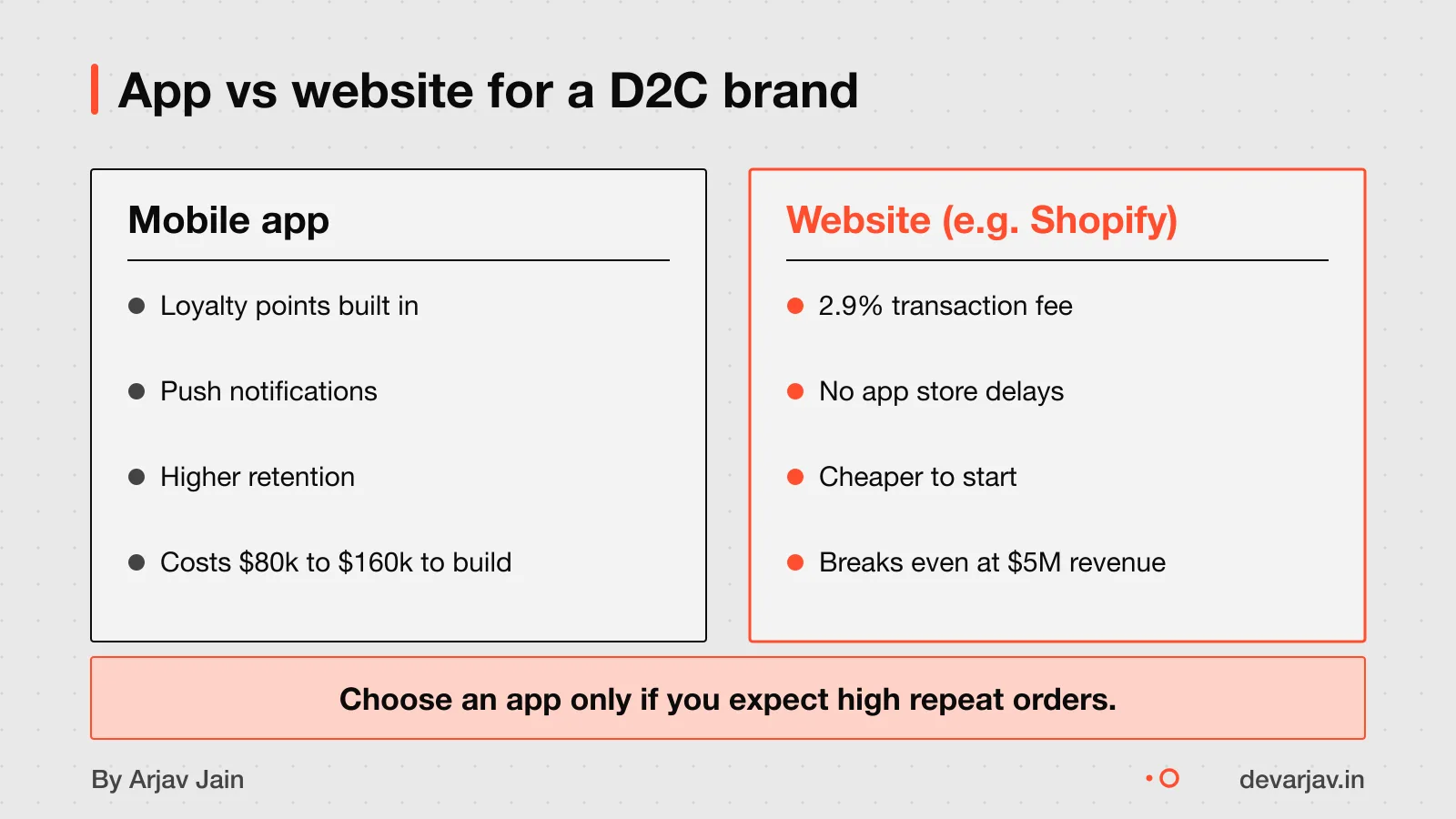
An app makes financial sense for your D2C brand only when your annual revenue exceeds $5 million. You are paying over $130,000 a year in platform fees. For example, if you use Shopify and pay 2.9% per transaction, those fees add up fast at scale. At $5 million in sales, you would pay about ₹1.06 crore in fees each year. That money could instead fund a custom app that you fully control.
Websites are cheaper to build and maintain, and for most small D2C brands, they are enough. You can sell online, collect customer data, and run ads without an app. But apps offer better retention. They let you send push notifications, save user preferences, and provide a faster, smoother experience. Over time, this can increase repeat purchases.
However, apps come with higher upkeep. Mobile operating systems change often, and apps need regular updates to stay secure and functional. If your sales are below the $5 million mark, focus on growing your website and social presence first. A custom app is not a growth hack, it is a cost-saving and retention tool for brands already scaling.
Consider no-code tools if you want app-like features without hiring a developer. Some platforms give you a mobile-optimised storefront, offline access, and even push notifications, all without writing code. See when a no-code tool beats a custom app to check if that fits your needs.
Total cost of owning a D2C app
The full cost of a D2C app includes both build and ongoing maintenance. This covers design, development, testing and launch. It does not include marketing or hardware. For smaller apps, costs may start lower, but core features like user accounts, payments and inventory sync drive most of the spend.
Annual maintenance costs 15% to 25% of the build cost every year the app runs. For a $30,000 app, that is $4,500 to $7,500 per year. These costs cover updates, bug fixes, server bills and compatibility with new phone versions. Even if no new features are added, the app needs regular care to stay secure and stable.
Monthly upkeep for small apps ranges from $500 to $5,000. This includes hosting, monitoring, minor fixes and developer time. The exact amount depends on user load, third-party services and how often updates are needed. Some months cost less; others cost more if a major patch is required.
Over time, maintenance can cost 2 to 4 times the original build cost. For example, an app built for $150,000 could see $300,000 to $600,000 in maintenance over eight years. This means you pay more after launch than before. Budgeting only for development leaves you at risk of sudden costs later.
To compare, how app costs compare across business types shows how D2C brands stack up against food delivery, clinics and local shops.
Want a number for your idea? Send one line on WhatsApp. I reply with what drives the cost and what to cut.
Message me on WhatsApp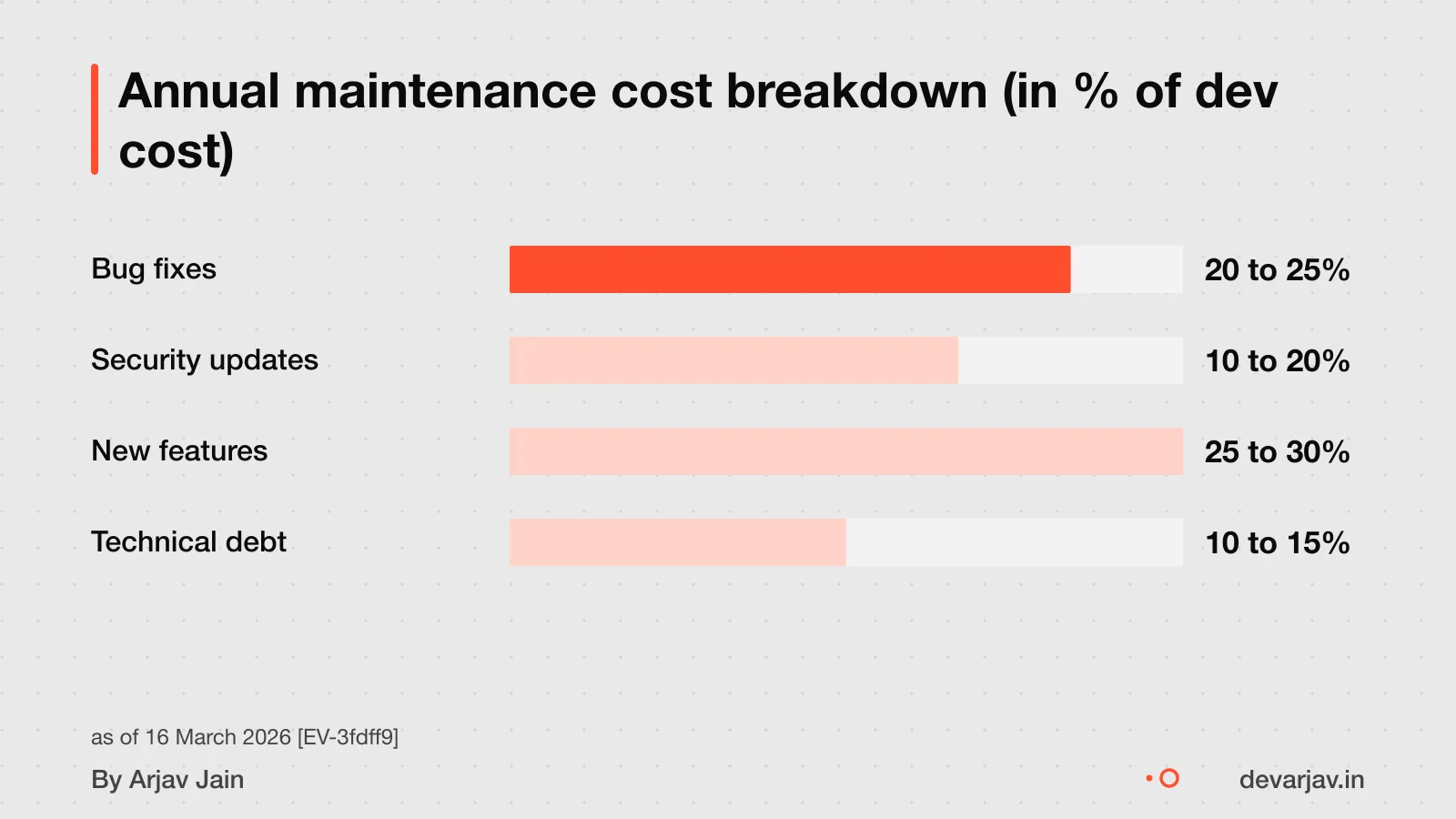
What can go wrong during development?
Poor planning leads to cost overruns because unclear goals mean more rework and delays. Developers may build features you do not need or miss key ones, pushing the budget up. A clear plan cuts waste.
Bug fixes and security updates take up 30% to 55% of maintenance time. Corrective maintenance, fixing bugs and crashes, takes 20 to 25% of costs. Emergency fixes for security issues or outages add another 10 to 20%. That is at least ₹30,000 to ₹55,000 in every ₹1 lakh spent on upkeep.
If you do not control technical debt, the app slows down over time. Old code that is not cleaned up makes new updates harder and costlier. Preventive maintenance like refactoring and documentation takes 10 to 15% of costs to reduce this debt. Without it, small changes take longer and break more often.
What to check before hiring a developer
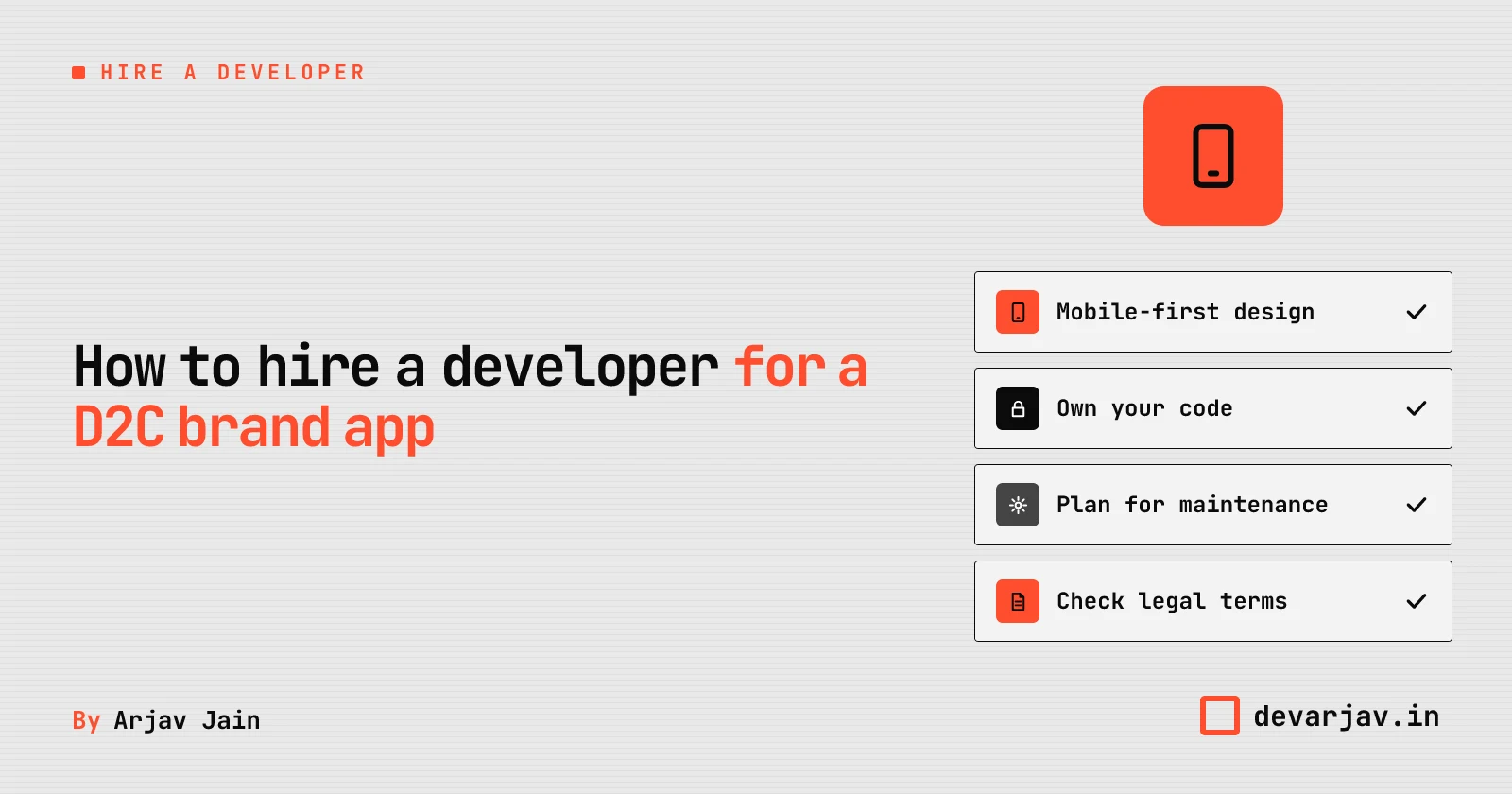
Before engaging developers, verify IP ownership and conduct thorough due diligence.
Comprehensive documentation matters because it cuts future costs. Well-documented code and design files help new developers understand your app quickly. As a result, fixing bugs or adding features later takes less time. For a 10-person team, good documentation can lead to a 20% reduction in investigation time per change.
Do due diligence to reduce risk. Ask if they own the code they will write for you. Verify they will transfer full intellectual property (IP) rights to your brand after payment. Confirm this in writing before work starts. Also, check if they have handled apps through app store approvals and updates.
For a local example, see how to check a developer's work in Raipur to spot red flags early.
What legal agreements do you need?
You must sign a written contract that uses "hereby assign" to own your D2C app’s code. Without it, the developer may retain legal rights even after payment. This is true whether you hire a freelancer or a studio.
"Agree to assign" only promises future transfer, it does not hand over ownership now. Courts have rejected such vague terms when disputes arise. For example, one company lost control of its software. Because the contract said "will assign" instead of "hereby assigns", a small phrase with a big cost.
Your contract must clearly state that all code and designs belong to you from day one. The Copyright Act requires assignments of IP to be in writing and signed. A verbal agreement or email promise is not enough.
Ownership of software depends on clear contractual assignment, as demonstrated in the Pine Labs case. To avoid this, your agreement should not rely on promises, it must act. Use "hereby assign" so ownership transfers the moment the contract is signed.
Generic templates from the internet often use weak language. A local lawyer can draft or review your contract to make sure it holds up in India. Do not skip this step, it protects your brand and future sales.
For peace of mind, get legal help to draft or check your developer agreement. This is not a DIY task. A single page of strong terms is better than ten pages of vague promises.
Who owns the app code and accounts?
By default, the developer owns the app code under Indian law unless your contract says otherwise. This means even if you pay for the app, you may not have the right to change, update or reuse the code without their permission. To get full ownership, your contract must include a clear clause that transfers all intellectual property rights to you. Use the phrase “hereby assign” instead of “agree to assign”, the first gives immediate ownership, while the second only promises it later. Courts have ruled that vague language is not enough. Always get this in writing before work begins.
Not sure if your contract gives you full ownership? Send the clause and I will mark what is missing.
Message me on WhatsAppWhen this advice does not apply
- If your annual revenue is under $5 million and you pay less than ₹1.1 crore a year in platform fees. An app may cost more than it saves. Stick to Shopify, Instagram or a website until you grow.
- If you can scale using low-fee channels like Instagram Shopping or Meesho, with fewer tech risks, delay the app. These platforms handle payments, hosting and updates for you.
- If you only need a simple product catalogue or order form, a mobile-friendly website or WhatsApp catalog works faster and cheaper than an app.
Next step: message me on WhatsApp with what you want to build. No forms, no sales team.
Message me on WhatsAppAssumptions behind the numbers
- Estimate assumes a full-featured D2C app with standard modules like catalogue, checkout and notifications.
- Revenue threshold of $5M is an estimate based on transaction fee savings and development cost recovery.
- Platform choice affects cost and timeline; building for one first is assumed unless user specifies otherwise.
- Budget range is often unknown; tool clarifies scope rather than locks in price.
The chapters
A step-by-step guide to writing a clear project brief for your D2C app. Takes 5 minutes and sets the right expectations with your developer.
5 min read, in 6 chapters.
01 · Purpose
Define what your app must do
Every good brief starts with one clear sentence: who uses it and what they do with it. For example: 'Farmers in Punjab use it to track crop prices daily.' This focus prevents scope creep later.
List the one problem it solves. Not three features or five ideas — just the core job. Everything else is optional until this works.
Do this One user. One job. One sentence.
02 · Features
Pick three must-have features
A D2C app usually needs catalogue, checkout and notifications. Add one more only if it's central to your brand — like subscriptions or loyalty.
Avoid listing 10 features. Developers can't price a moving target. A tight scope leads to a real first version, not a demo.
Do this Three core features. No more.
03 · Platforms
Choose iOS, Android or both
Building for both platforms doubles effort. Start with the one your users prefer. In India, Android leads but high-value customers often use iOS.
If budget is under $100,000, build for one platform first. You can always expand later when you have real usage data.
Do this One platform first. Expand later.
04 · Timeline
Set a realistic delivery date
A basic D2C app takes 16 to 24 weeks to build properly. Rushing leads to bugs, poor UX and higher maintenance costs later.
Add four weeks after launch for bug fixes. Real users find issues no tester caught, especially with real data.
Do this 16–24 weeks to build. 4 weeks to stabilise.
05 · Budget
Match budget to scope
A full D2C app costs $82,000 to $161,000. If your budget is lower, cut features — not quality. A half-built feature helps no one.
Never pay the full amount upfront. Tie payments to working milestones you can test on a real phone.
Do this Pay per milestone. Test before each one.
06 · Ownership
Insist on full code ownership
Under Indian law, the developer owns the code unless the contract says otherwise. Use 'hereby assign' language to make ownership clear from day one.
Also insist on store accounts (Google Play, App Store) in your name. Without them, you can't update or even cancel the app later.
Do this Contract says 'hereby assign'. Accounts in your name.
Quick answers
Can I build a cheaper version first?
Yes. Start with a landing page and email capture. Add features only after validating demand. A full app too early risks high cost with low learning.
Should I hire a freelancer or an agency?
Freelancers are faster for small scopes. Agencies bring process and polish, at a higher price. Either way, check shipped apps on real phones.
What if I don’t know my budget?
Use this tool to clarify scope, not to lock in price. A clear brief helps you compare quotes fairly — even if budgets vary.
How do I verify a developer’s past work?
Ask for a shipped app you can open on your phone. Then call one past client. Screenshots prove nothing — a live app and a reference do.
What if I want changes during the build?
Small tweaks are fine, but major changes reset the timeline and cost. That’s why a tight scope matters — it leaves less room for drift.
Who owns the app after it’s built?
You do — but only if the contract assigns full ownership. Without that, the developer can block updates or even sell your app to someone else.
What about ongoing costs?
Expect 15% to 25% of the build cost every year for maintenance. That covers bug fixes, platform updates and small improvements.
Questions people ask
What should I check before hiring a developer for a D2C brand app?
Check that the developer shows apps they have built and provides full documentation. For your case, verify their past work matches your app’s needs.
How do I pay a developer safely?
Pay in milestones tied to clear deliverables, not hourly or all upfront. This protects you if the work slows or stops. For example, release funds only after you test each feature.
Who owns the app if the developer disappears?
You own the app only if your contract says so in writing. Without it, Indian law gives ownership to the developer by default. Vague promises are not enough, use clear language like 'hereby assign'.
Can I build the app myself with no-code tools?
You can build a simple app with no-code tools, but not one with checkout, subscriptions or complex logic. For those, you need a developer. See when a no-code tool beats a custom app.
How long does app development take?
The time to build a D2C app is not known from the evidence. Ask your developer for a timeline based on your features and team size. Complex apps with checkout and subscriptions take longer.
What if the app has bugs after launch?
Bugs are fixed under corrective maintenance, which makes up 20 to 25% of annual upkeep. Perfective updates like new features add another 25 to 30%. Budget for this yearly cost.
Do I need a contract for a small app?
Yes, even for small apps. Under Indian law, you must have a written contract to own the code. Without it, the developer keeps ownership, even if you paid.
Can I hire a freelancer from a platform like Upwork?
Yes, but it is harder to verify their work and legal standing. Always check the contract assigns IP to you. Confirm ownership is 'hereby assigned' in writing, not just promised.