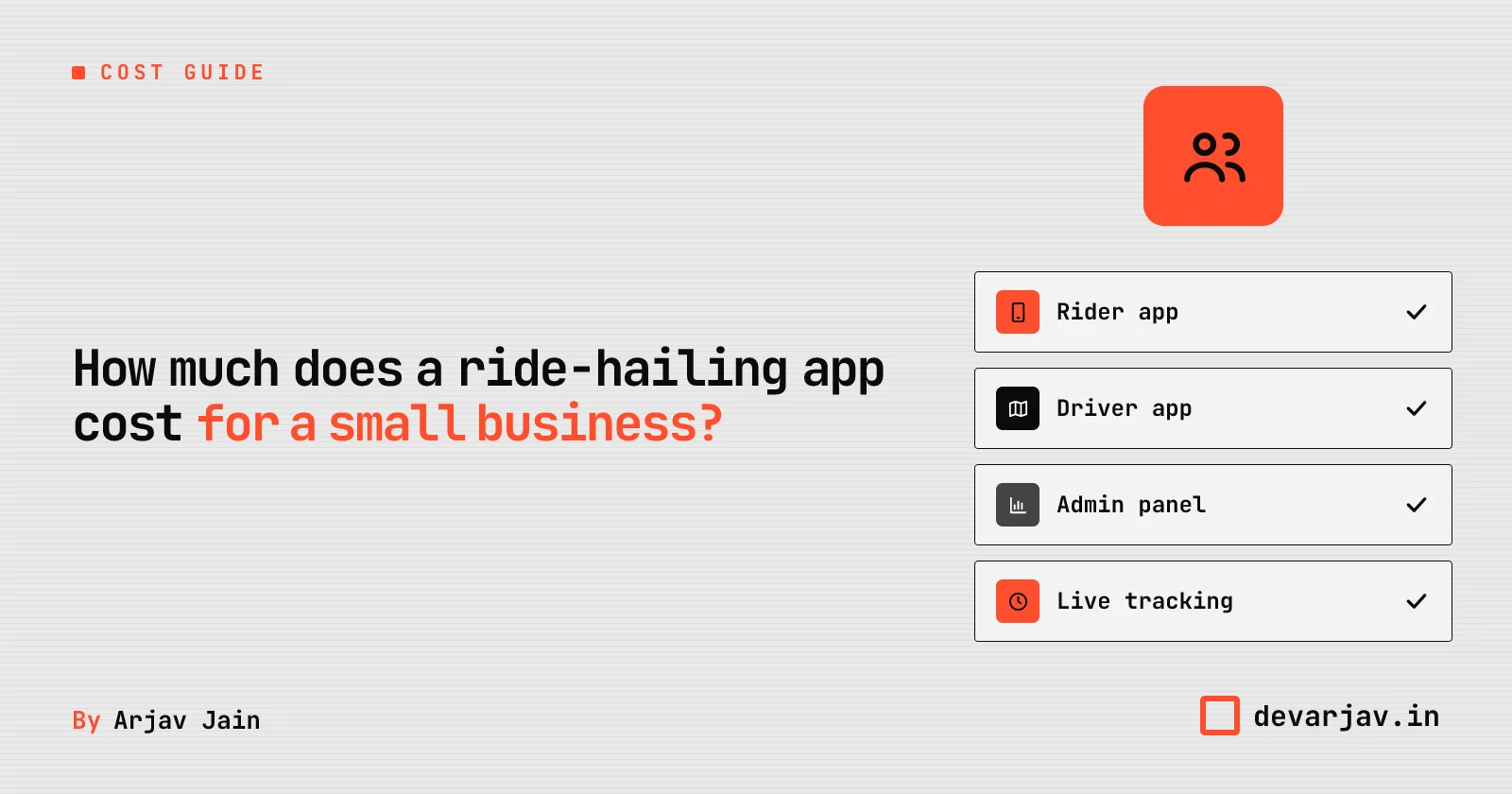
What is a ride-hailing app and what does it include?
A ride-hailing app lets you book a ride right away using your phone, with live tracking and digital payment. It is different from a taxi booking app, which is for planning rides ahead of time. This system matches nearby drivers to riders in seconds, not hours.
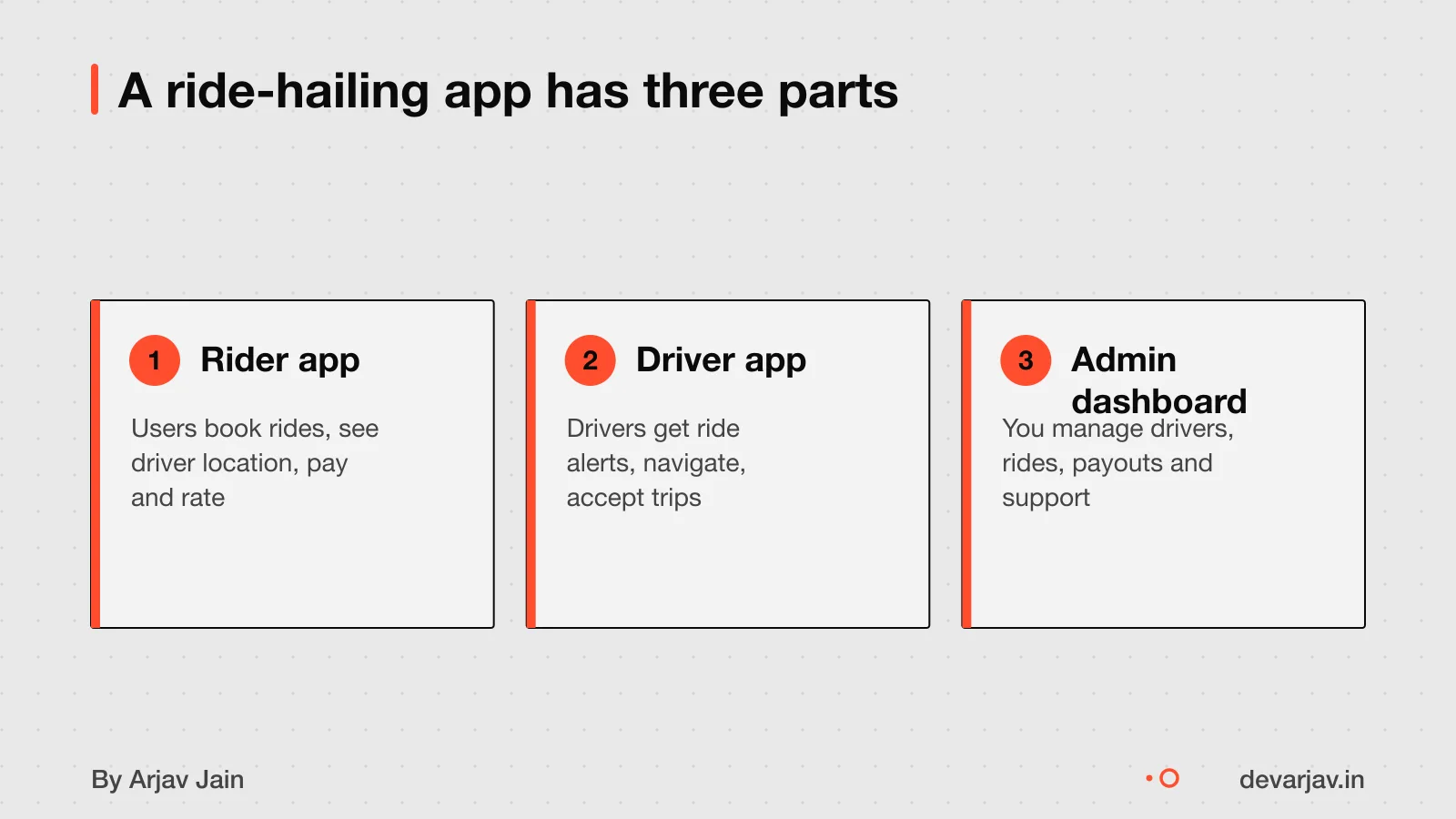
The app has three main parts. First, the rider app, where customers sign up, see nearby cabs, book rides, view fare estimates, track the driver live, and pay digitally. Second, the driver app, where drivers log in, accept or reject rides, navigate to the pickup, and mark trips as complete. Third, the admin dashboard, where you manage drivers, riders, trips, support tickets, and earnings. The backend system runs the matching, live location updates, payments, and trip records.
For example, when a rider in Indore books a ride, the app checks nearby drivers. Picks the closest one, shares live locations, calculates the fare, and records the trip. You can learn more about building such an app, feature by feature. In our full guide on how to build a ride-hailing app: features and timeline.
Build custom or use a white-label solution?
A white-label ride-hailing app is a pre-built platform you rebrand and launch faster. It costs less and takes less time than custom development. But you do not own the core code or the data fully. Custom building means full ownership of the product, data, and roadmap. You can change any feature and scale as needed. But it costs more and takes longer.
White-label solutions work well if you want to test demand quickly. They act like discovery tools, connecting drivers and riders without setting fares or handling payments. This suits small businesses with tight budgets. Custom apps make sense when you need unique features, full control, or plan to scale across regions. You also avoid monthly fees from white-label providers.
For most small businesses in tier-2 or tier-3 cities, starting with a white-label app helps validate the idea without heavy risk. If demand grows, you can later invest in a custom version. Ownership of code and data matters most when you plan to raise funds or expand into allied services.
Build or buy a ride-hailing app: custom, white-label or platform? compares all three paths in detail.
Still unsure between custom and white-label? Tell me your budget and timeline and I will say which fits.
Message me on WhatsAppWhat features make a ride-hailing app expensive?
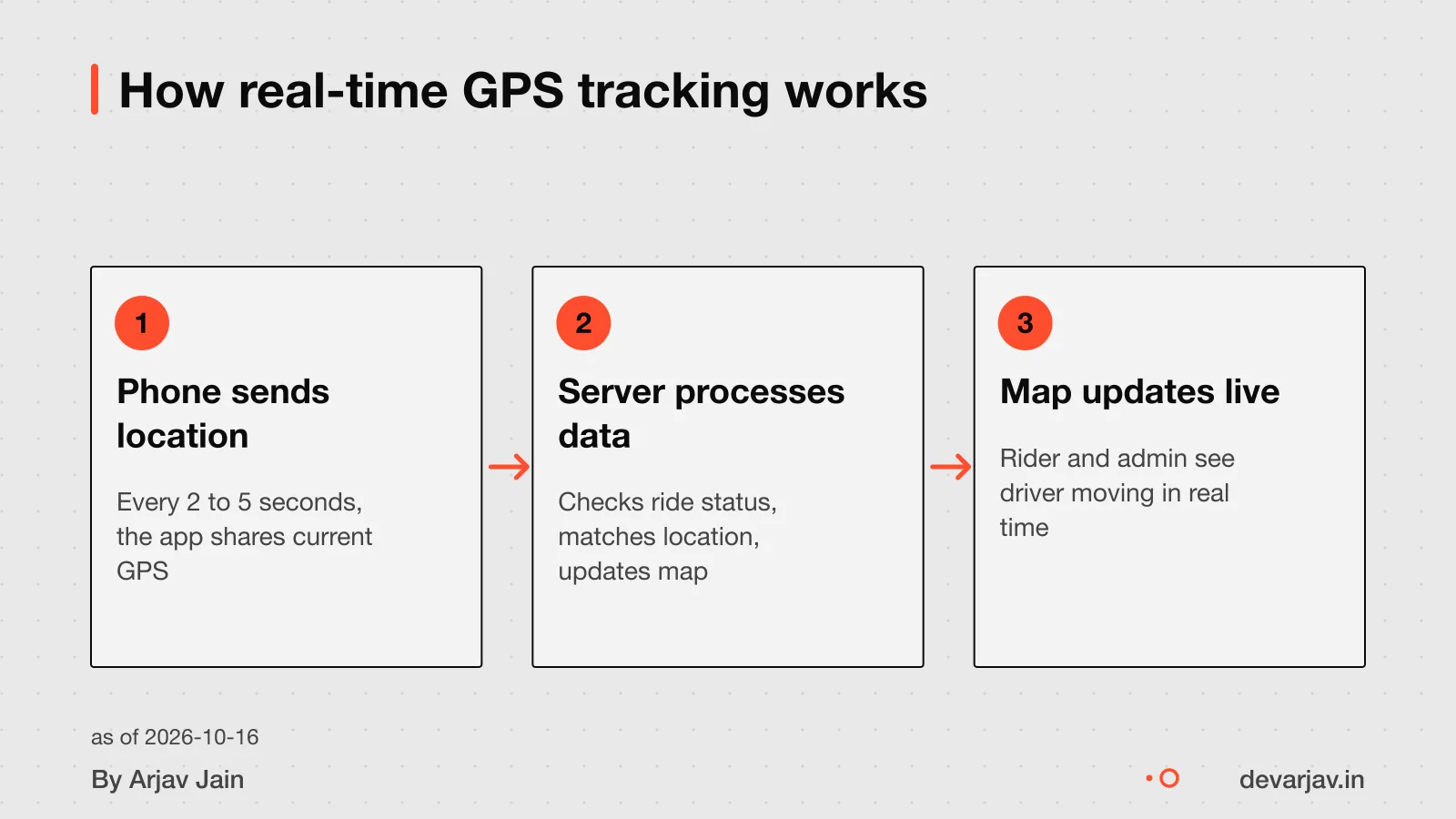
Real-time GPS tracking and secure payment integration are the top cost drivers in a ride-hailing app. These features need constant data flow, strong servers and tight security, which raises the build and server costs. For example, real-time tracking alone can increase server costs by 25 to 50%. Because the app must update locations every few seconds for all active rides. This means more powerful hosting and complex code to avoid lag or crashes.
Core features like booking, driver matching, ride tracking, payments and ratings are all essential and add to the cost. You cannot skip real-time tracking if you want live ride updates, and you cannot avoid secure payments since riders use UPI, cards and wallets. Each payment method must be tested and linked to a gateway like Razorpay or Paytm, which takes time and code. Smooth app performance under high load also adds to the effort, as delays during peak times hurt trust.
Want to know which features you can delay? What features does a ride-hailing app need?
How long does it take to build a ride-hailing app?
A full custom ride-hailing app can take longer than an enterprise app, which takes 4 to 6 months in India. A minimum viable product (MVP) for a ride-hailing app must include core features like booking, tracking and payments to work in real use.
The timeline is long because the app must handle live ride matching, driver-rider coordination, GPS tracking and trip logging. You also need time to test the system under real loads and fix bugs before launch. Unlike a simple booking app, delays in response can break the user experience or cause safety issues.
As an estimate, assuming a small team and no major rework, building a working MVP takes at least 3 months. Then, adding advanced features, security, and compliance pushes the full build to 8 to 14 months. A staged approach helps: start with a lean MVP in one city, prove demand, then scale.
What are the ongoing costs after launch?
Yearly maintenance costs 15 to 20 percent of the original build cost. This covers bug fixes, security updates, and small feature tweaks as phone systems change. For a ₹90 lakh app, yearly maintenance costs ₹13.5 to ₹18 lakh per year.
App store fees are $25 one-time for Google Play and $99 per year for Apple. These are fixed and must be paid to keep your apps live.
In the first year, add 25 to 30 percent on top of the build cost to cover app store fees, maintenance, and basic marketing. For a ₹90 lakh app, first-year extra costs are ₹22.5 to ₹27 lakh. These costs help you stay live, secure, and visible.
What legal rules apply to ride-hailing apps in India?
You need to follow state transport laws, IT rules and tax norms. There is no single national licence for ride-hailing apps, but you may need approvals from state transport authorities. For example, Maharashtra requires Urban Local Body (ULB) approval under its ride-hailing policy.
As for tax rules, the GST Council has not yet clarified the status of discovery-only platforms. However, rulings from the Karnataka and West Bengal Authority for Advance Rulings (AAR) suggest that platforms which only connect riders. Drivers without handling payments may not be liable to pay GST on ride fares. This means if your app only shows available rides and does not collect money, you might not have to pay GST on each fare.
The Information Technology (Intermediary Guidelines and Digital Media Ethics Code) Rules, 2021 were amended in 2026. These rules apply to all digital intermediaries, including ride-hailing apps. The exact date of enforcement for the 2026 amendments is not yet announced.
Since rules vary by state and are still evolving, talk to a local transport lawyer before launching. They can help you check if your city requires a licence, what tax duties apply, and whether your app model fits the latest IT rules.
What safety features are required by law?
Some safety features are required by law for ride-hailing apps in India. The app includes a one-tap SOS button linked to local police control rooms. This is often called a panic button and must be easy to find in the app. The app includes live ride tracking that can be shared with family and friends. Bharat Taxi, for example, includes a loud in-app siren and emergency contact alerts.
Who owns the app code after development?
You do not automatically own the app code, even if you paid for it. The developer who writes the code is the first legal owner under Indian copyright law. This is true even if you hired them as a freelancer or agency.
To get full ownership, you must have a written agreement that assigns the intellectual property (IP) to you. This should be part of your contract. Most developers will only sign over the code after you have made full payment. This protects them from giving away work they have not been paid for.
For example, if a developer builds your ride-hailing app and you stop payment halfway, they can legally keep the code until you clear the dues. Without a signed IP assignment, you cannot update, fix or reuse the app later.
Always include an IP assignment clause in your contract. It should state that ownership passes to you only after full payment. This keeps both sides safe.
Can I get the source code of my app?
Can I switch to another developer later?
Yes, you can switch developers after starting your ride-hailing app. The app’s name, URL, reviews, ratings and download history stay the same during an official transfer. You do not need to relaunch or lose user trust.
The app remains online throughout the move. Google Play and Apple App Store allow official transfers so your service does not go down. This means riders can still book rides while the handover happens.
You keep full access until the new team confirms they can build and deploy updates. Do not cancel the old developer’s access too soon. Wait until the new team has built a test version and pushed a small update successfully.
This keeps your app safe and running without gaps.
Have a quote in hand? Send it to me and I will mark what is missing.
Message me on WhatsAppWorked example: cost breakdown for a ride-hailing app
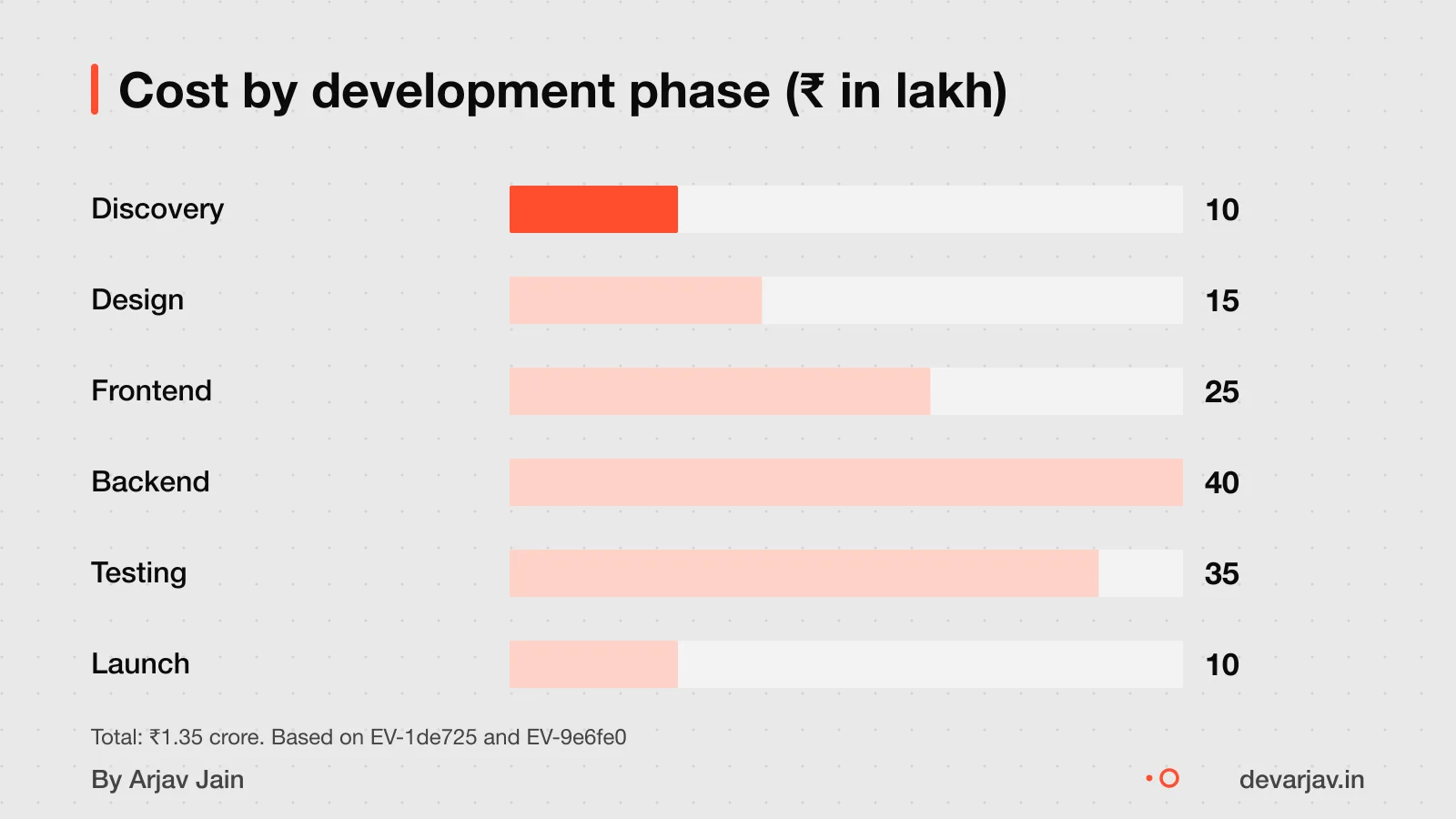
As an estimate, a custom ride-hailing app costs ₹45 lakh to ₹1.8 crore. This range comes from converting the US dollar estimate of $150,000 to $400,000 using an exchange rate of ₹80 per dollar. The final cost depends on team size, hourly rate, and how much real-time functionality you include.
Discovery and planning take 10 to 15% of the total. This includes market research, user interviews, and mapping your city's routes. Design (UI/UX) adds another 15 to 20%. This covers app screens, driver dashboard, and branding.
Frontend development (iOS and Android apps) takes 25 to 30% of cost. Backend (servers, APIs, databases) takes 30 to 35%. Testing and quality assurance add 10%.
The base cost does not include first-year extras. This brings the total to approximately ₹1.8 crore at the higher end, based on an estimate.
Assumptions: - Exchange rate: ₹80 = $1 - Team size: 6 to 8 people (product, design, mobile, backend, QA) - Hourly rate: $10 to $40 for Indian developers - App includes surge pricing, multiple payment methods, and live tracking
When this advice is wrong
When this advice is wrong
- If your city has fewer than 5,000 daily ride requests, a custom app is not worth the ₹45 lakh minimum cost. Use a white-label solution or partner with an existing platform instead.
- If your budget is under ₹30 lakh, custom development will leave you short. White-label apps start at ₹8 lakh and launch in 8 weeks, but you trade control for speed and cost.
- If you do not have a local team to manage driver onboarding, support and safety checks, even a working app will fail. The software is only one part of the operation.
- White-label fails if you need deep local customisation. Such as integrating with city-specific transport APIs or offering non-standard vehicle types like auto-rickshaws with fixed zones.
- Custom makes sense only if you plan to scale across multiple cities, want full control over pricing. Promotions, and can invest in a team to run both tech and operations.
Next step: message me on WhatsApp with what you want to build. No forms, no sales team.
Message me on WhatsAppAssumptions behind the numbers
- Exchange rate: ₹80–90 per dollar
- Team size: 3–5 people
- Hourly rate: $10–40
- Timeline: 8–14 months
Work out your own number
I won't hand you a number that pretends to be the market. Instead, here is the working: set the weeks, the people and the rate, and see where the money goes.
Your working total
₹9,60,00024 weeks × 2 people × 5 days × ₹4,000- Discovery and planning8%
- UI/UX Design13%
- Frontend development33%
- Backend and database25%
- Testing and QA13%
- Deployment and launch8%
The weeks shown are an example of a small app, there to be changed. Fees you pay others (store accounts, cloud, SMS) are not in this total.
What moves the price
- Real-time features
Live tracking and chat need more design and more testing.
- Multiple user roles
Each extra user type (customer, admin, rider) is close to another app.
- Many integrations
Every payment, SMS, maps or ERP link is its own piece of work.
- Android-only launch
Starting with one platform cuts nearly half the work.
- Clear scope upfront
Changes mid-build are the most expensive weeks.
- Using managed services
A managed backend for login and data removes weeks.
Fees that go to someone else
Google Play developer account
A one-time registration fee, paid to Google. Check the current amount.
Apple Developer Program
A yearly fee paid to Apple. Check the current amount.
Cloud, SMS, maps, payments
Usage-based, billed by the provider to you.
Ask for these before you sign
- How many weeks per phase, and with how many people?
- What is not included?
- Which fees do I pay to others directly?
- What happens to the price when I change my mind?
- What does the first month after launch cost?
Questions people ask
What is the total cost to build a ride-hailing app in India?
A full custom ride-hailing app costs roughly $150,000 to $400,000-plus. For a simple version in India, expect ₹3 to 5 lakh if you limit features and use one platform. This is only for custom builds, not white-label apps.
Why is a ride-hailing app so expensive?
Real-time tracking, fare estimates, secure payments, and smooth app performance are essential for a custom ride-hailing app. These features add 25 to 50 percent to server costs. Third-party tools for maps and payments also add to the price.
How long does it take to build a ride-hailing app from scratch?
A medium complexity app takes 2 to 3 months. A full ride-hailing app with real-time systems can take 4 to 6 months. This depends on the number of features and team size.
What are the monthly costs after the app is launched?
Yearly maintenance costs 15 to 20 percent of the build cost. Add 25 to 30 percent more for the first year to cover app store fees, updates and basic marketing. Cloud, SMS and payment gateway fees rise with usage.
Do I need a licence to run a ride-hailing app in my city?
Maharashtra requires a ULIN for ride-hailing operators. The 2026 IT Rules may apply but their exact date of coming into force is not yet specified. Check with your state transport authority for local rules.
Can I start with just an Android app to save money?
Yes, building only for Android cuts frontend cost and time. Using Flutter for both platforms costs about 30 percent more than one platform. Start with Android if your users are mostly on it.
What should I ask a developer before hiring them?
Ask for the full scope, delivery timeline, team size and payment terms. Confirm who owns the code and what third-party tools they will use. Get this in writing.
How do I know if a developer’s quote is fair?
Compare the hourly rate, team size and milestones offered. A fair quote ties payments to progress, not time. Check what is included and if scope changes are allowed.
What happens if my app crashes during peak hours?
An app crash during peak hours can lose rides and trust. Use load testing and backup servers to reduce risk. As no evidence covers this, run stress tests and monitor performance daily.
How do I handle disputes between riders and drivers?
There is no standard way to handle disputes. Offer 24/7 support and a clear refund or penalty policy. Since no evidence covers this, set clear rules and train your team to act fast.