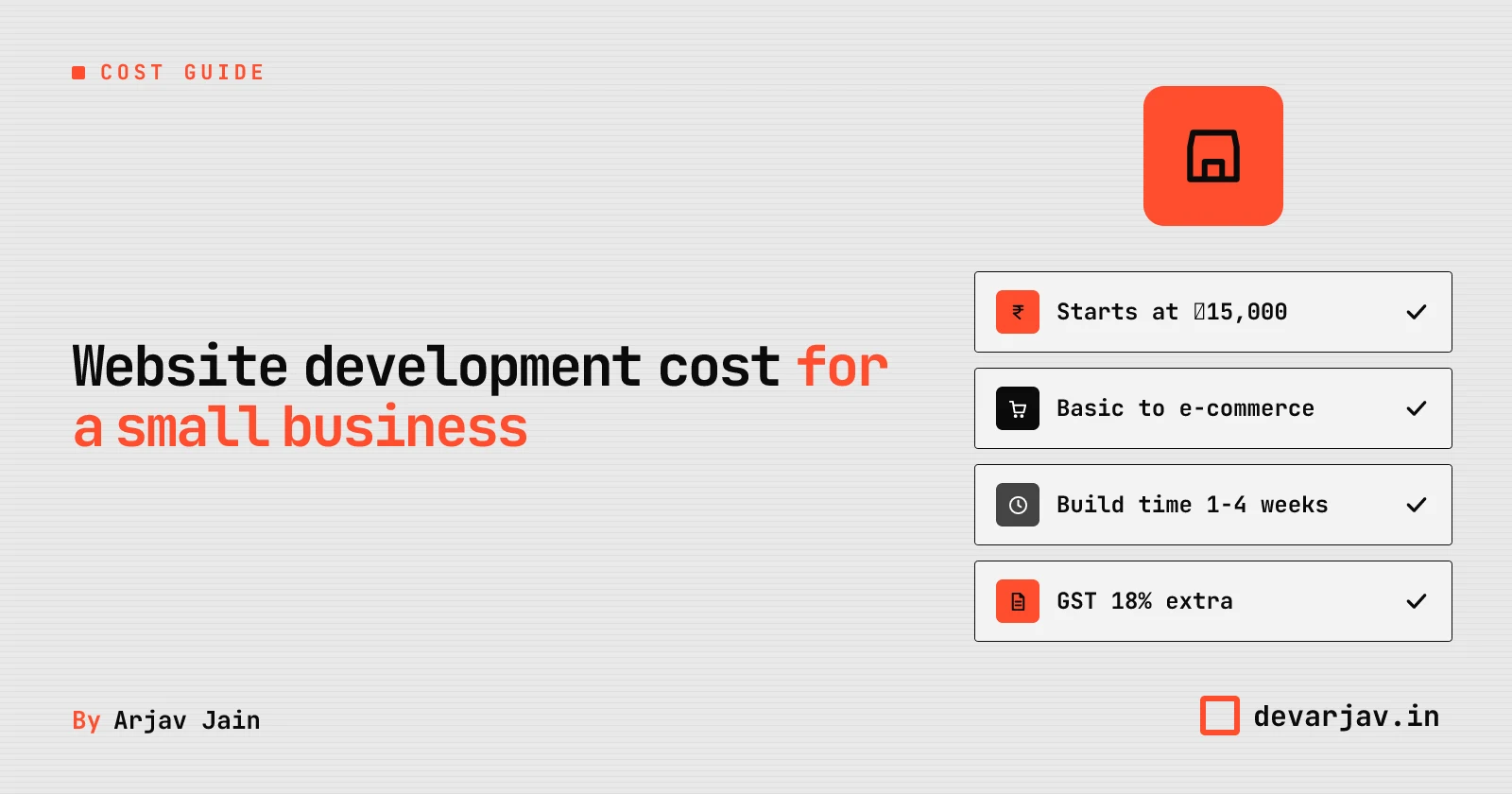
What is a small business website?
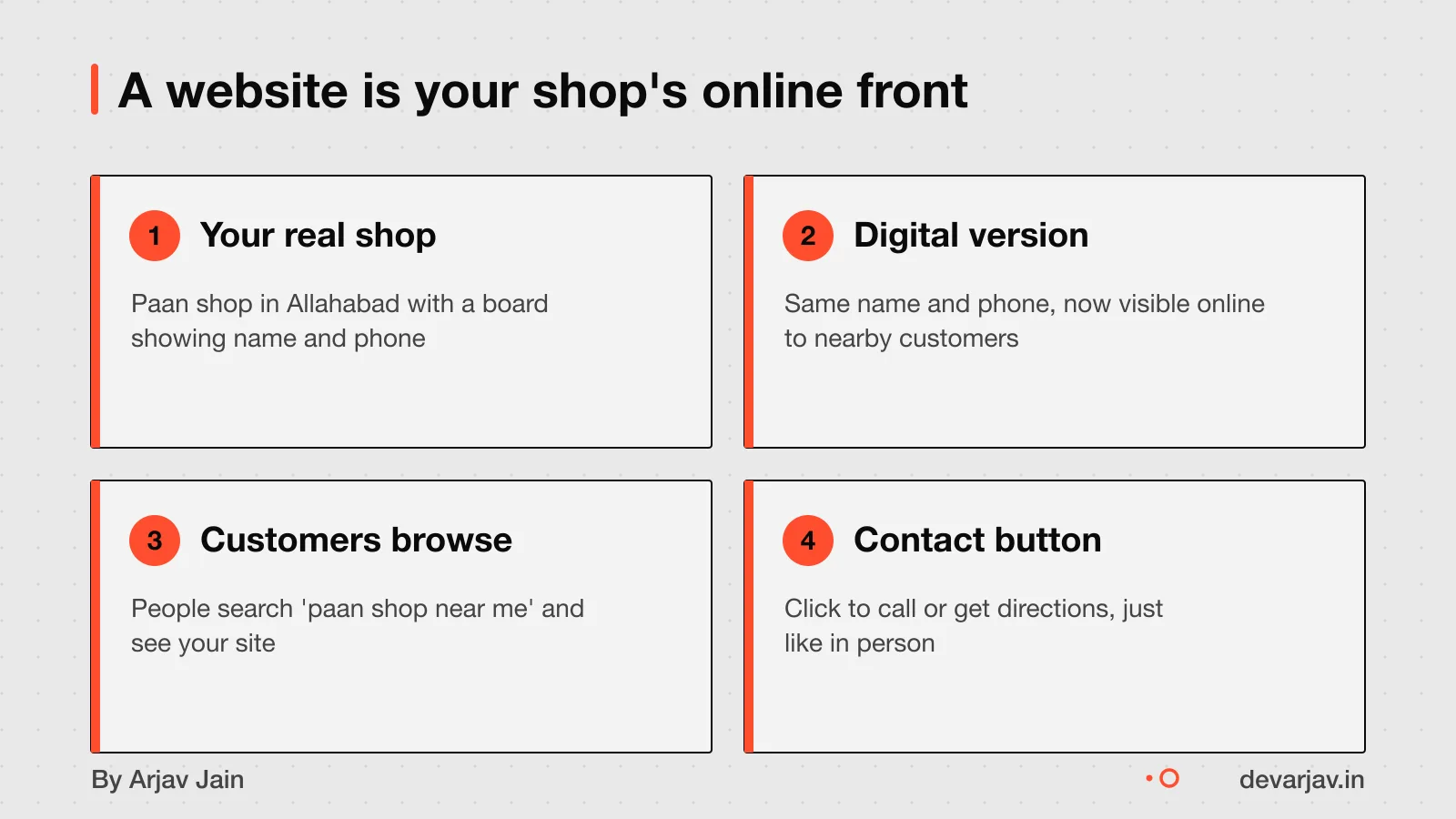
A small business website is an online page where customers find what you sell, how to reach you and why they should trust you. It works like a shop signboard, menu and salesperson all in one. For example, a paan shop in Allahabad can list its special flavours, show opening hours, share a map and let customers order online.
It is different from a social media page because it belongs to you, not the platform. You control what it says, how it looks and what it can do. A website can include a homepage, list of services, about section and contact form.
While Facebook or Instagram pages are free and quick to set up, they change often and may hide your posts. A website stays the same unless you change it. It acts as your 24/7 sales representative, main marketing tool and the central place for your brand’s identity.
If you sell only by word of mouth today, a website helps you reach more people beyond your street or colony. It is not the same as a mobile app, a website works in any phone’s browser, no download needed. See the difference between a website vs app for small businesses.
Do you really need a website?
Yes, you do need a website, even if you already use WhatsApp. Most customers look for your business online before they decide to buy. A website gives you full control over your brand, what you show and how you sell. It works 24 hours a day, even when your shop is closed, to bring in new customers.
As of February 2025, 55% of small businesses in India have launched a website. This means more people trust a business that has an online presence. If you run a shop, clinic or service, having a website builds that trust fast.
For example, a local electrician in Indore added a simple website with his services, photos and contact form. Within two months, he started getting one to two new calls every day from people who found him online.
But a website may not be worth it if you only sell to people you already know. Like family or regulars who visit your shop daily. If your business runs on word-of-mouth and you have no plans to grow, a WhatsApp number might still be enough. Still, if you want to attract new customers beyond your street or colony, a website helps more than any other tool.
What parts of a website add the most to the cost?
Custom design raises the cost because every unique page needs separate work. A 15-page website with all custom designs costs more than a 50-page site using just three templates. You pay for the time, not the pages.
Content migration adds cost because moving text, images and files from an old site is manual work. If you have a blog with 100 posts or a product list with 50 items, each one must be checked and placed.
Payment gateways and security features also raise the price. Adding payment links or forms needs secure coding and third-party setups. This is more complex than a simple contact form. A site that takes money must protect it.
A template-based design keeps costs low. You choose a layout once and reuse it. Custom design is like ordering a tailor-made shirt for each day, instead of buying a readymade pack.
You save when you reuse. Ask your developer: "Can we use one design for all service pages?" That cuts cost more than any discount.
How long does it take to build a website?
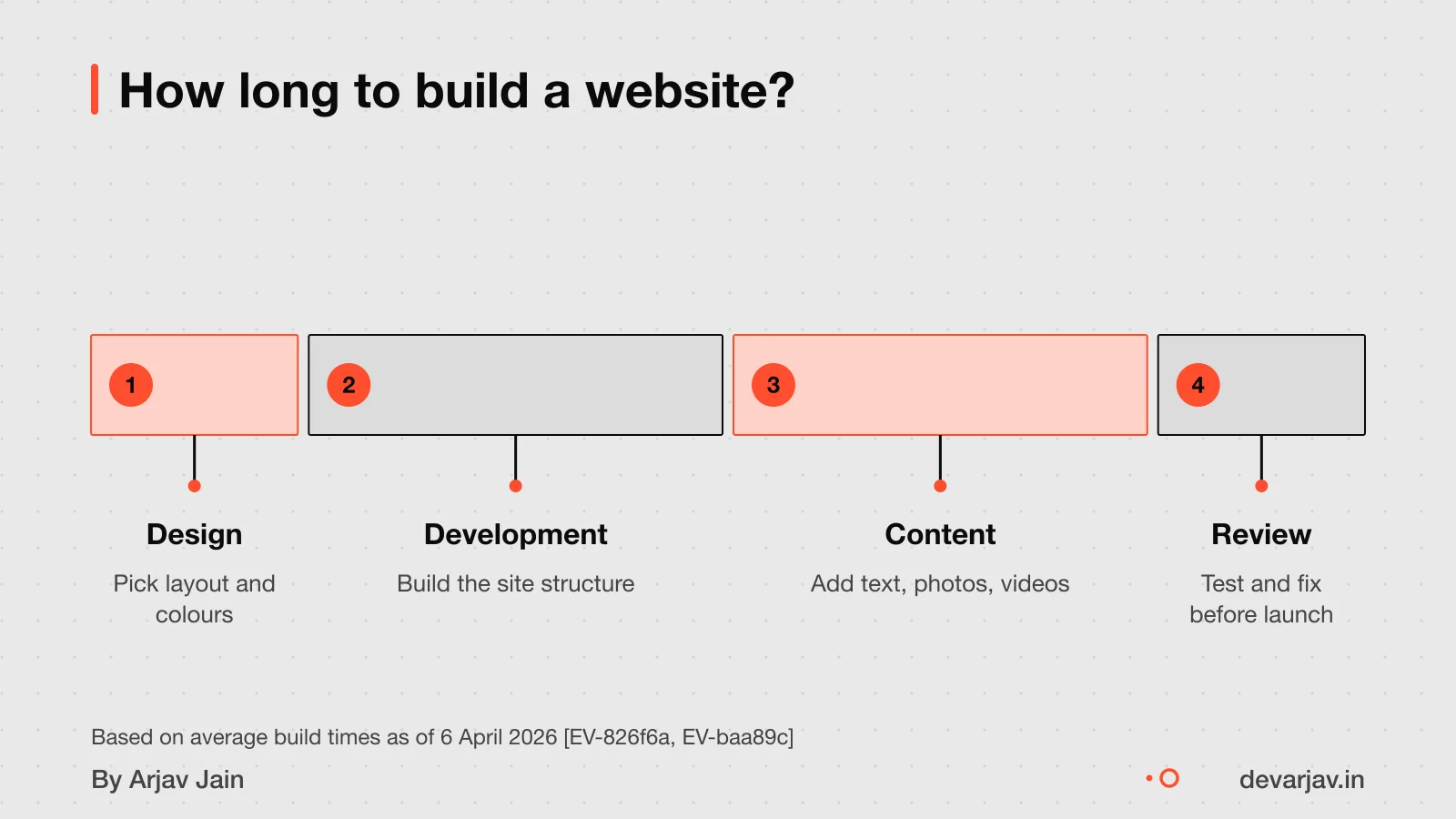
A basic one-page website takes 1 to 2 weeks to build. This includes a home page with your business name, address, phone number, and a short description of what you offer. Most small shops, clinics, or local service providers can go live in this time if they provide content on time.
A standard business website with multiple pages, like Home, About, Services, and Contact, takes 2 to 4 weeks. This allows for design, content integration, mobile testing, and feedback rounds. Delays often come from slow replies, unclear content, or last-minute changes.
Using a website builder like Wix or Squarespace can cut this time by half. These tools let you pick templates and edit text without coding. But they may not support custom features like local language forms or offline access. For most small businesses in tier-2 or tier-3 towns, 2 to 4 weeks is a realistic timeline when working with a developer.
How much extra do online booking or payments add?
This covers the payment gateway integration, which is the system that securely sends payment details between your site and the bank. A payment gateway is different from a payment aggregator: the gateway handles data, while the aggregator manages money settlement and your merchant account.
You also pay a merchant discount rate (MDR) on each transaction. As of April 2026, UPI transactions cost 0% to 0.9% per transaction. Some providers even offer zero fees for new businesses. Debit card payments cost 0.9% to 1.5%. Credit card payments are higher, at 1.5% to 2.5%, because of bank interchange fees.
Security and compliance add to the cost. If you accept card payments, you must follow PCI DSS rules to protect customer data. This may require extra checks or tools. For small businesses, using a trusted payment provider like Razorpay or Paytm helps meet these rules without heavy technical work. See PCI DSS basics to understand what applies to you.
For example, if your shop makes ₹50,000 in sales online in a month using credit cards, the MDR at 2% would be ₹1,000. Over a year, that adds up. So while the website cost is one-time, transaction fees are ongoing.
Does the cost include GST?
Yes, most developers charge 18% GST on top of their base price for website development. This is the standard rate for IT services in India. However, if a developer’s annual income from services is ₹20 lakh or less, they do not charge GST. Also, if the website work is for a client outside India, GST may not apply.
You should always ask for a GST invoice. It is a legal record and lets you claim input tax credit if you are a registered business. Without it, you cannot claim credit for the tax you paid. Even if the developer is exempt, they must state this clearly on the bill. A proper invoice builds trust and protects both sides. If a developer refuses to give one, it is a red flag.
Worked example: ₹18,000 vs ₹1.2 lakh website
Worked example: ₹18,000 vs ₹1.2 lakh website
A basic website can be created for less than ₹1,500 per month, covering domain registration and hosting costs. It uses a ready-made template and is built quickly. This suits a small shop that wants customers to find it online. As an estimate, this cost covers domain registration and hosting costs. For example, a local grocer in Bilaspur might use this to list opening hours and location.
A professional brochure site for a small business costs between $2,500 and $7,500. It may support online payments and is built to reflect your brand with unique colours and layout. For example, a multi-location salon in Raipur might use this to let customers book appointments and view services.
Want a number for your idea? Send one line on WhatsApp. I reply with what drives the cost and what to cut.
Message me on WhatsApp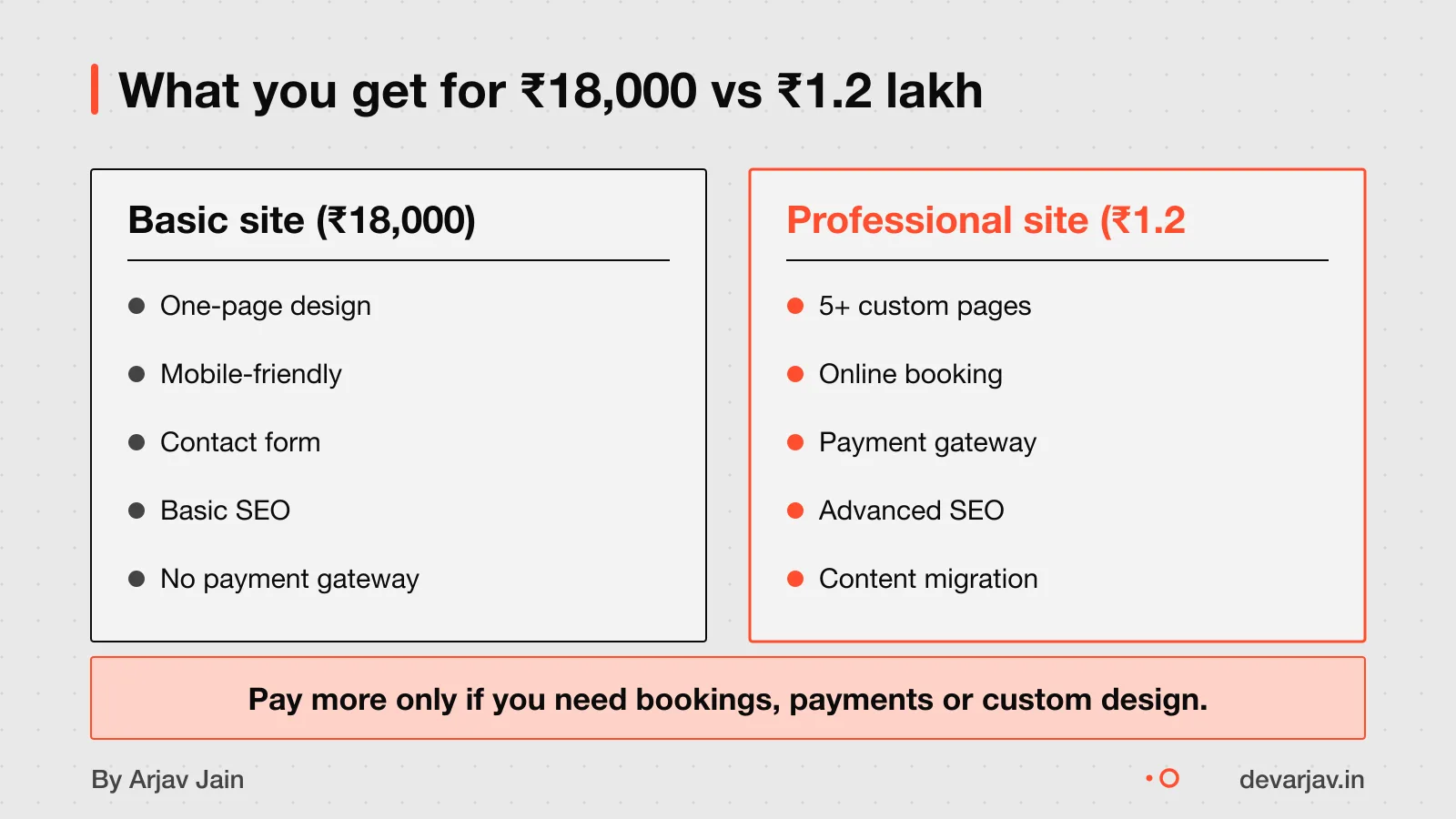
When this advice is wrong
When this advice is wrong This guidance is not for you if your business can get found through a Google Business page alone. Many small shops, repair services and local clinics only need a verified Google listing with address, phone and working hours.
It is also not for you if your customers do not use the internet to find services. If your shop relies on foot traffic or word-of-mouth in a low-connectivity area, a website may not bring new sales.
Lastly, if you only need a simple online presence, a free or low-cost Google Business profile or WhatsApp link may be enough. You can share it on posters, receipts or word-of-mouth without paying for a full website.
Related reading: clinic booking app, how to hire a developer.
Next step: message me on WhatsApp with what you want to build. No forms, no sales team.
Message me on WhatsAppAssumptions behind the numbers
- Assumes 1 designer and 1 developer for 4 weeks at ₹1,000/day
- Assumes basic brochure-style site with 5–10 pages
- Assumes content and images are provided by the owner
Work out your own number
I won't hand you a number that pretends to be the market. Instead, here is the working: set the weeks, the people and the rate, and see where the money goes.
Your working total
₹2,40,0006 weeks × 2 people × 5 days × ₹4,000- Design and planning17%
- Content entry and images17%
- Development50%
- Payment setup17%
The weeks shown are an example of a small app, there to be changed. Fees you pay others (store accounts, cloud, SMS) are not in this total.
What moves the price
- Custom design per page
Unique layouts for each page take more time than templates.
- Online booking or forms
Each form or calendar integration adds logic and testing.
- Multi-language support
Each added language doubles the content and QA work.
- Using a website builder
Tools like Wix or WordPress speed up the process.
- Ready content and photos
If you provide all text and images, that saves weeks.
- Fewer pages or sections
A tight scope with 3–5 pages cuts both time and cost.
Fees that go to someone else
Domain name
Yearly renewal, paid to a domain registrar like GoDaddy.
Hosting
Monthly fee paid to a hosting provider. Shared plans start low.
Payment gateway charges
MDR per transaction, paid to the gateway provider like Razorpay.
Ask for these before you sign
- How many pages will your site have?
- Will you use stock images or hire a photographer?
- Do you need multi-language support?
- Are you adding online payments?
- Who will manage updates after launch?
Questions people ask
What is the cheapest way to build a small business website?
The cheapest way is to use a website builder with a basic plan. As an estimate, this costs from ₹249 per month, covering domain and hosting. This suits small shops needing only a contact page and business details.
How much should I pay upfront for a website?
You should not pay more than 30 to 50% upfront. Use milestone payments to protect yourself. Freelancer platforms support this method to reduce risk.
Can I build a website myself without a developer?
Yes, you can build a website using tools like Wix or Squarespace. It may take a few hours to many weeks, depending on your skill and content readiness.
What maintenance does a website need after launch?
Your website needs monthly updates, backups, and security checks. WordPress and PHP sites must be patched regularly to avoid compromise. Ongoing cost is 15 to 20% of build price yearly.
How often should I update my website?
Update your website at least once a month. Add new content like blog posts or service changes to keep customer trust and SEO strength. Sites not updated in 12+ months typically lose 20 to 40% of their organic traffic over the same period..
What legal rules apply to website development costs?
IT services in India attract 18% GST (9% CGST + 9% SGST). You can claim input tax credit if you are GST-registered. Small service providers with annual turnover up to ₹20 lakhs are exempt from GST.. Check this for your case with a chartered accountant.
Who owns the website after it is built?
You should own the domain and hosting. Register the domain in your legal name, not the developer's, to avoid transfer issues later. Changing hosting does not affect domain ownership.
How do I know if my developer is overcharging?
Ask for a cost breakdown by feature, build method, and security needs. Prices vary by complexity. Compare with standard rates and check what each part includes.
What should I give the developer to start the work?
Provide your logo, brand colours, contact details, and business description. Clear content helps avoid delays. Agree on code ownership and integration roles early.