
What is the real difference between a website and an app?
A website works when you have internet, but most cannot do anything offline. An app can work even without a network, like taking orders during a power cut. But an app built for Android won’t run on iPhone, and vice versa.
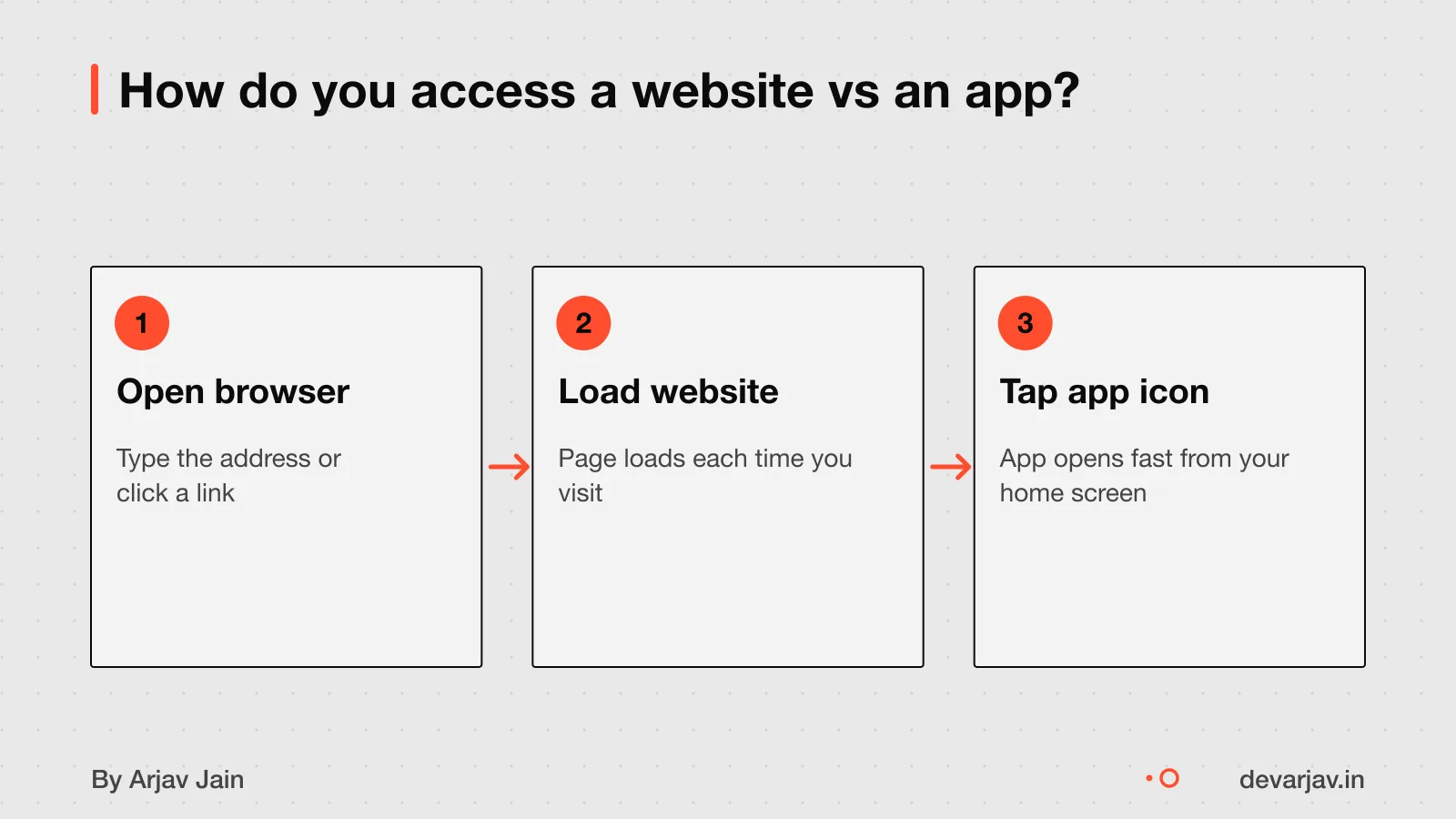
You find a website by typing its name in a browser. You find an app through the Play Store or App Store after downloading it.
For example, a paan shop with a website can share the link with customers on WhatsApp. They click and see the menu. But if the phone has no signal, the page won’t load. The same shop with an app could let regulars place orders offline. The app saves them and sends when the network returns.
An app gives a smoother experience and can use phone features like camera or GPS. A website reaches more people faster, on any phone or computer, with just one version.
Next.js or WordPress for a business site
Is a PWA the same as a mobile app?
No, a PWA is not the same as a mobile app. You can install a PWA on your phone, and it will look like a regular app on your home screen. It can also work offline, thanks to modern web tools. But on iPhones and iPads, Apple’s support for PWA features has been limited since 2018. While basic functions like installation and offline use are possible, many advanced features work better on Android. So, a PWA gives you some app-like benefits without building a full app, but it does not fully replace one on iOS. If your customers use iPhones daily, test the PWA on Safari first.
When should you choose a website?
Start with a website if you want to attract new customers, update fast, and work across all devices. A website reaches more people at lower cost than an app. You can add new offers, photos, or contact details in minutes. It shows up in Google searches when nearby customers look for what you sell. A website works on any phone, tablet, or computer, no matter the brand or operating system. Even Apple promotes Safari as a strong web browser alongside its App Store. This means your shop, clinic, or coaching centre can go digital today without waiting or spending extra.
If you run a local business like a bakery, tuition class, or repair service, a website helps you get found and stay flexible.
Do I need both a website and an app?
When should you choose an app?
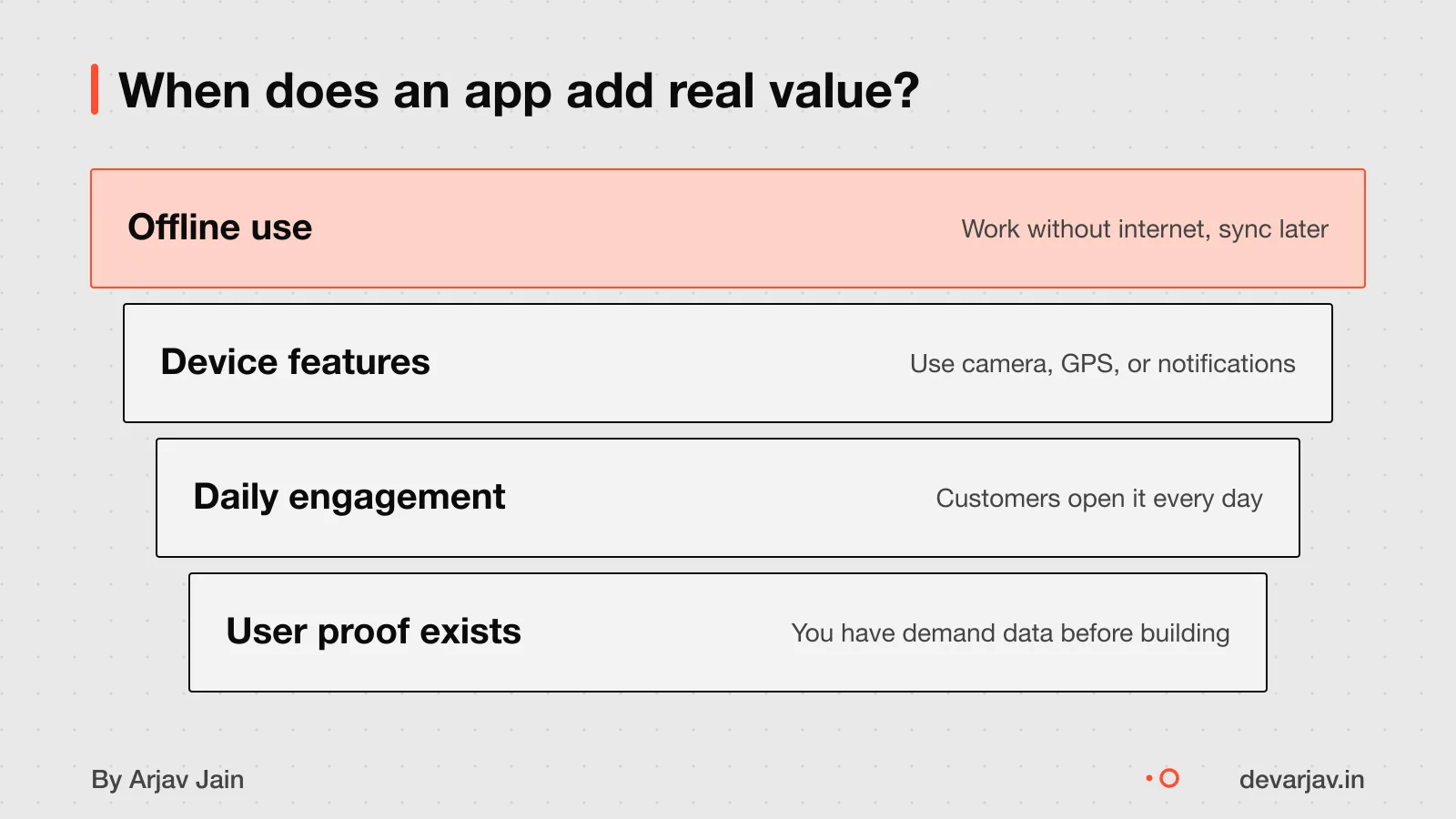
Choose an app only if your customers need daily offline access or must use device features like camera, GPS or microphone. A website works online only, but an app can store data on the phone and run without internet. For example, a coaching centre that shares daily study sheets must let students download them at night for use in low-signal areas. That needs an app.
Some device tools work only in apps. If your service uses the camera to scan documents, tracks field staff with GPS, or records voice notes, a website cannot help. A clinic using patient photo records or a delivery business tracking live locations must use an app. These features are locked behind app permissions.
Daily use strengthens the case. If customers open your service every day, like a habit tracker or staff attendance tool, an app’s home screen presence helps. But even then, build the website first. Prove demand. Then build the app when users ask for offline access. As an estimate, an offline-first app costs more than a website. See how much more it costs to build an offline-first app.
How much does each cost to build?
A basic website can start from ₹2,400 under a government-supported pod scheme as of 2026-08-01. This is a real, documented price for a simple online presence. However, the cost of most custom websites for small businesses is not confirmed in the evidence.
A basic mobile app, on the other hand, is more expensive. As an estimate, an in-house developed app costs $5,000 to $30,000 (₹3.75 lakh to ₹22.5 lakh at ₹75 per dollar). While an outsourced app ranges from $30,000 to $75,000 (₹22.5 lakh to ₹56.25 lakh). These figures are based on global averages and may vary by region and complexity.
Apps cost more because they need separate versions for Android and iOS, stricter design rules. Deeper integration with phone features like the camera or GPS. Development time and cost rise with feature complexity. Also, teams in higher-cost regions like the US or Europe charge more than those in India.
For example, a clinic app that stores patient records offline and syncs later needs secure local storage. Encryption, and background sync, all of which increase cost and time.
What does it cost to build an app in India?
Want a number for your idea? Send one line on WhatsApp. I reply with what drives the cost and what to cut.
Message me on WhatsAppHow long will it take to build?
Ask your developer for their timeline. The time to build a website or app is not published in the evidence, so you must check with your developer. Delays happen most often due to late content, unclear changes, or slow feedback from your side. For example, if you take five days to reply to a message about a design change, the launch slips by five days. Even a simple website can stall if text, photos or logos arrive late. A basic app may take longer than a website because it must be tested on different phones and screen sizes. To stay on track, set deadlines for your own tasks and stick to them. Share final content early, and agree on how many rounds of changes are included.
How much does each cost to run for three years?
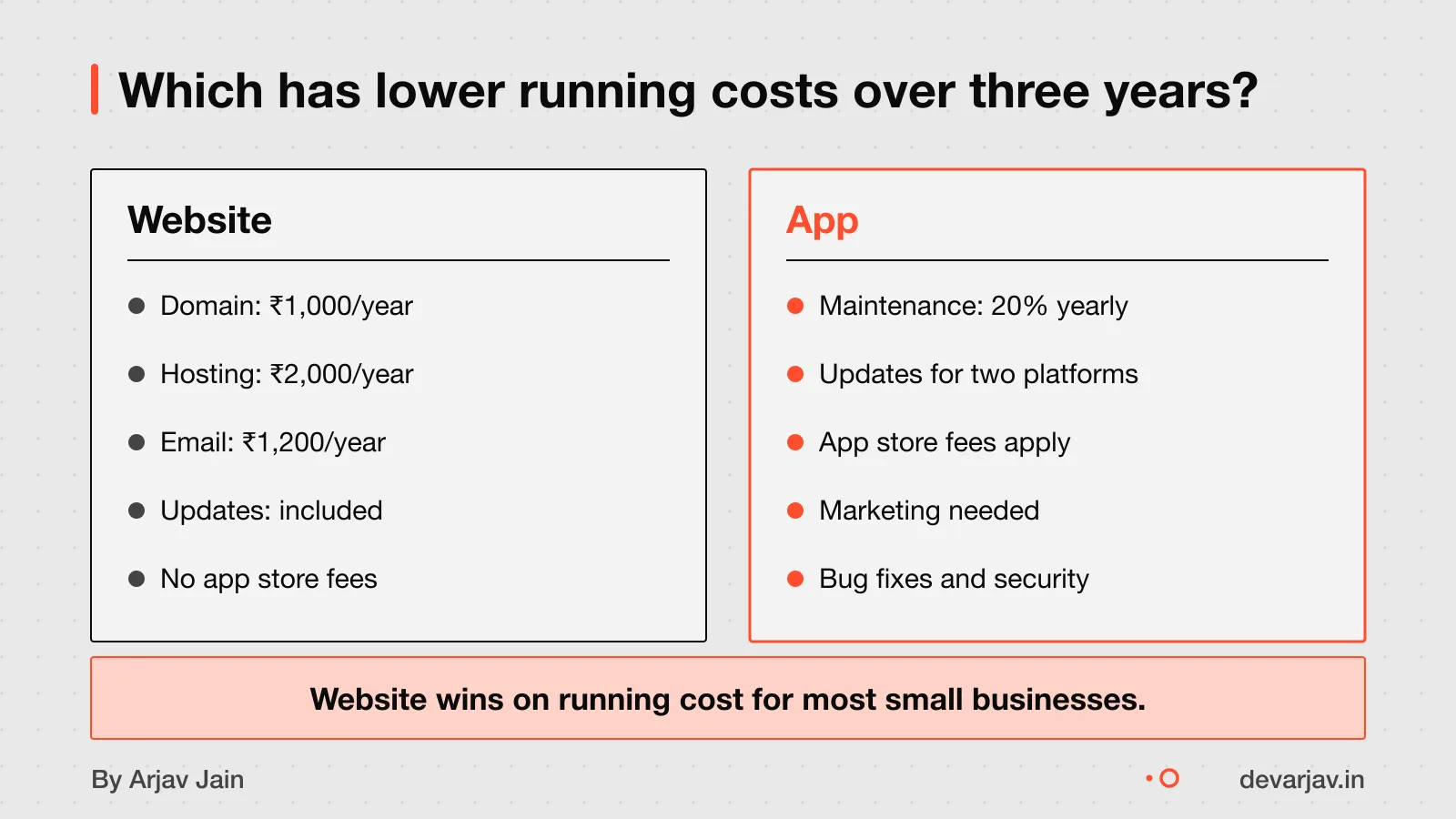
As an estimate, assuming a ₹5 lakh app build cost and 20% annual maintenance, the three-year maintenance cost is ₹3 lakh. Marketing costs are not in evidence. Other costs are not in evidence. App maintenance includes bug fixes, OS updates, and backend hosting. App marketing costs can range from $35,000 to $65,000 annually. These are not official figures and can vary by business size and sector.
Assumptions: - App development cost: ₹5 lakh (based on common small-business projects). - Website development cost: ₹1 lakh (basic responsive site). - Maintenance: 20% of build cost per year. - App marketing: ₹50,000 per year (localised estimate, not direct conversion). - No major redesigns or feature additions in three years.
What legal and tax rules apply in India?
For personal data, the DPDP Act requires you to get clear consent before collecting phone numbers, addresses or IDs. As of now, the DPDPA includes provisions for processing personal data outside India. It also lists exemptions for certain data processing activities.
Apple may reject your app if it is just a website wrapped in an app shell. Their App Store guidelines state that apps should offer real functionality beyond what a website already provides.
For GSTIN and DPDP Act compliance, talk to a chartered accountant or lawyer. Rules depend on your business type, location and data use. This is not legal advice.
DPDP Act consent flows for apps Primary source: DPDP Act, Section 16 is referenced in the evidence.
Not sure if your business needs GSTIN or DPDP consent? Tell me your service and I will say what applies.
Message me on WhatsAppCan you switch from website to app later?
Yes, you can switch from a website to an app later without losing your brand or user data, if you plan ahead. Your website content and customer data can be reused in the app, keeping your identity intact. For example, a clinic’s patient booking system on a website can feed into a future app using the same database.
You must design your website with a shared backend from the start so the app can access the same data. Without this, data will not carry over. Use a neutral domain name and consistent branding so your SEO and reputation stay strong when you launch the app.
Moving your brand to an app does not reset your search rankings. Your website keeps its SEO value, and the app becomes a new touchpoint. You can even link from the website to the app once it is live.
To preserve data and branding, start with a technology setup that supports both website and app from day one. This avoids rework and cost later.
Rescue a failed or abandoned app if you inherit a broken project.
When this advice is wrong
For example, a fitness coach whose clients log workouts daily during commutes. A website may not be sufficient when your service must use device features like the camera, GPS or microphone without internet. Platform-specific apps can store data locally and work during network outages, which websites cannot do reliably.
Next step: message me on WhatsApp with what you want to build. No forms, no sales team.
Message me on WhatsAppAssumptions behind the numbers
- A basic app starts at $30,000 when outsourced (converted to INR at market rate)
- Websites under ₹1 lakh cover basic brochure or service sites
- Users prefer apps for daily tasks due to convenience
- Search engine traffic is key for early-stage discovery
Pick your situation
I build both apps and websites. I benefit if you choose either, but I advise starting with a website to reduce risk.
Pick your situation
Mobile App wins. An app feels native and fast. Users are more likely to return if the experience is smooth and quick.
The whole comparison
| Website | Mobile App | |
|---|---|---|
| Starting cost | ₹2,400 (government pod) | $30,000+ if outsourced |
| Works offline | No, needs internet | Yes, stores data locally |
| Device features | Limited access (camera, GPS) | Full access to all sensors |
| Launch speed | Days to weeks | Months, if complex |
| User reach | Anyone with a browser | Only those who install it |
| Updates | Instant for all users | Needs app store approval |
Whichever you choose, ask these
- Can I switch from a website to an app later?
- Will my website work on phones too?
- Do I own the code if I hire someone?
- What happens if I stop paying for hosting?
Questions people ask
Which one is cheaper to start with?
A basic website under a government scheme can cost ₹2,400. A basic mobile app costs between $5,000 and $30,000 if developed in-house and $30,000 to $75,000 if outsourced.
Can I convert my website to an app later?
Yes, you can convert your website to an app later. If your website is built with data and branding in mind, you can reuse content and user accounts. You must be the account holder to transfer an app on Apple, and the app must meet platform rules.
Will my users lose data if I switch platforms?
No, users will not lose data if you switch platforms. The app remains live, keeps its URL, ratings, and reviews, and users will not experience any downtime.
What features only work in apps, not websites?
Apps can work offline and launch in a standalone experience. Platform-specific apps are known for being rich and reliable.
Do Indian users prefer websites or apps?
Indian users reach more easily through websites at first. Once trust is built, apps keep users longer. Most small businesses start with a website to attract new customers before adding an app for repeat users.
How do I know when to build an app after starting with a website?
Build an app when users ask for offline access or repeat visits increase. If customers want to use your service during power cuts or poor internet, an app is the next step. Track usage patterns to decide.
What if my customers have poor internet?
An app or PWA with offline caching works better than a standard website. They work regardless of network connection.
Can a small shop in a tier-2 town manage a website without tech help?
Yes, a small shop can manage a simple website using WhatsApp for orders and updates. Use a developer to set it up and stay on call for fixes. See the guide to hiring a developer for a small business website [link].
What are the risks of building an app first?
Building an app first risks high cost, low downloads, and poor user retention. Apps are not found on search engines, so you must spend on marketing. Slow performance increases abandonment after 3 seconds.