What are the types of app development teams in India?
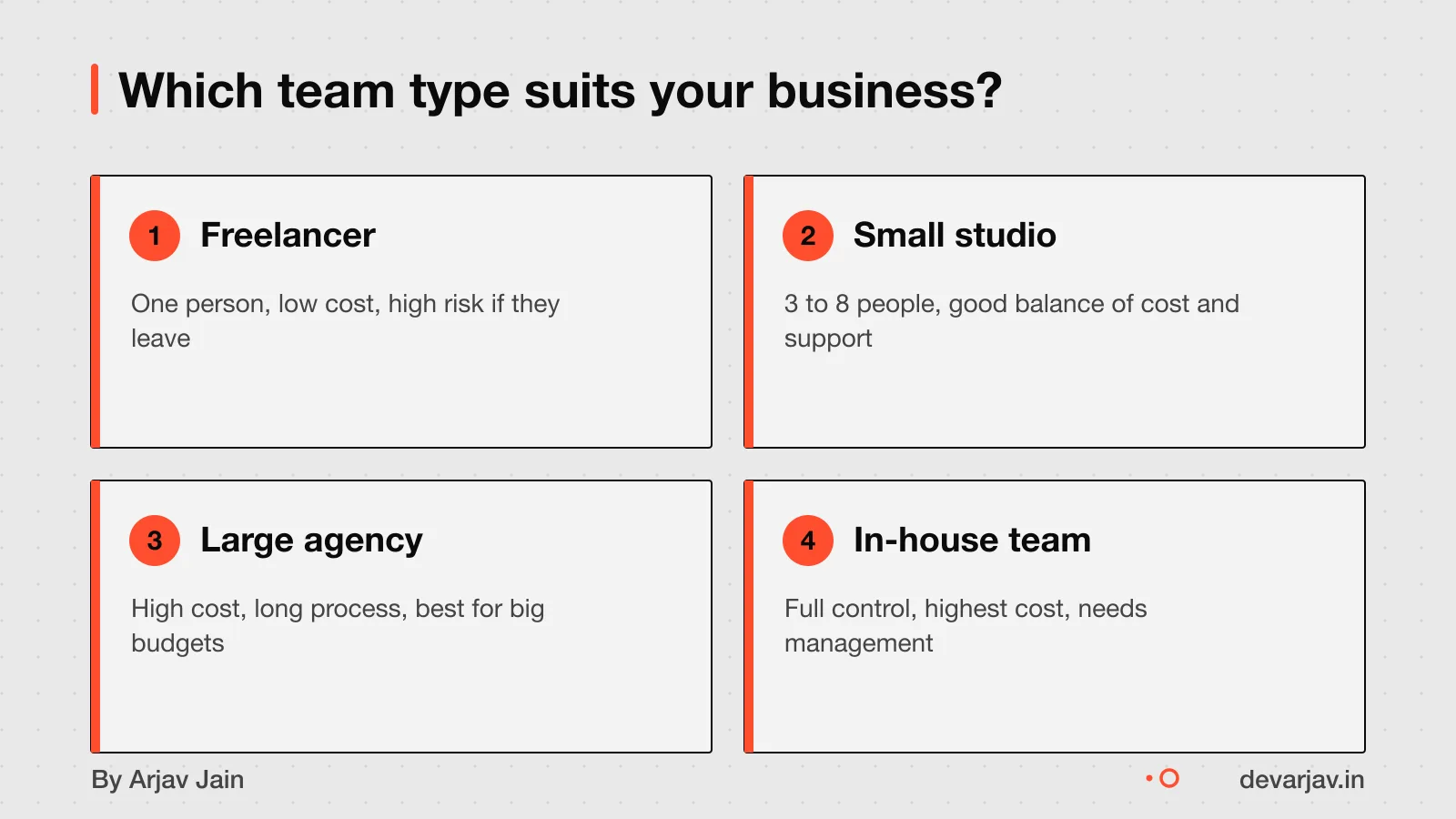
A freelancer is a single self-employed developer who works on your app as a one-off job. They are often cheaper but you must manage them closely. For example, a clinic owner might hire one to build a simple appointment app.
A small studio has 2 to 10 people, including a designer, developer and tester. They handle small to medium apps like a shop inventory system. They cost more than freelancers but offer better quality and support.
A large agency has many teams, including project managers, designers and legal staff. They take on complex apps, such as a multi-brand delivery platform. But they are costly and may treat small projects as low priority.
An in-house team is hired full time by your business. This gives you full control but is the most expensive option. It suits only large businesses with ongoing tech needs.
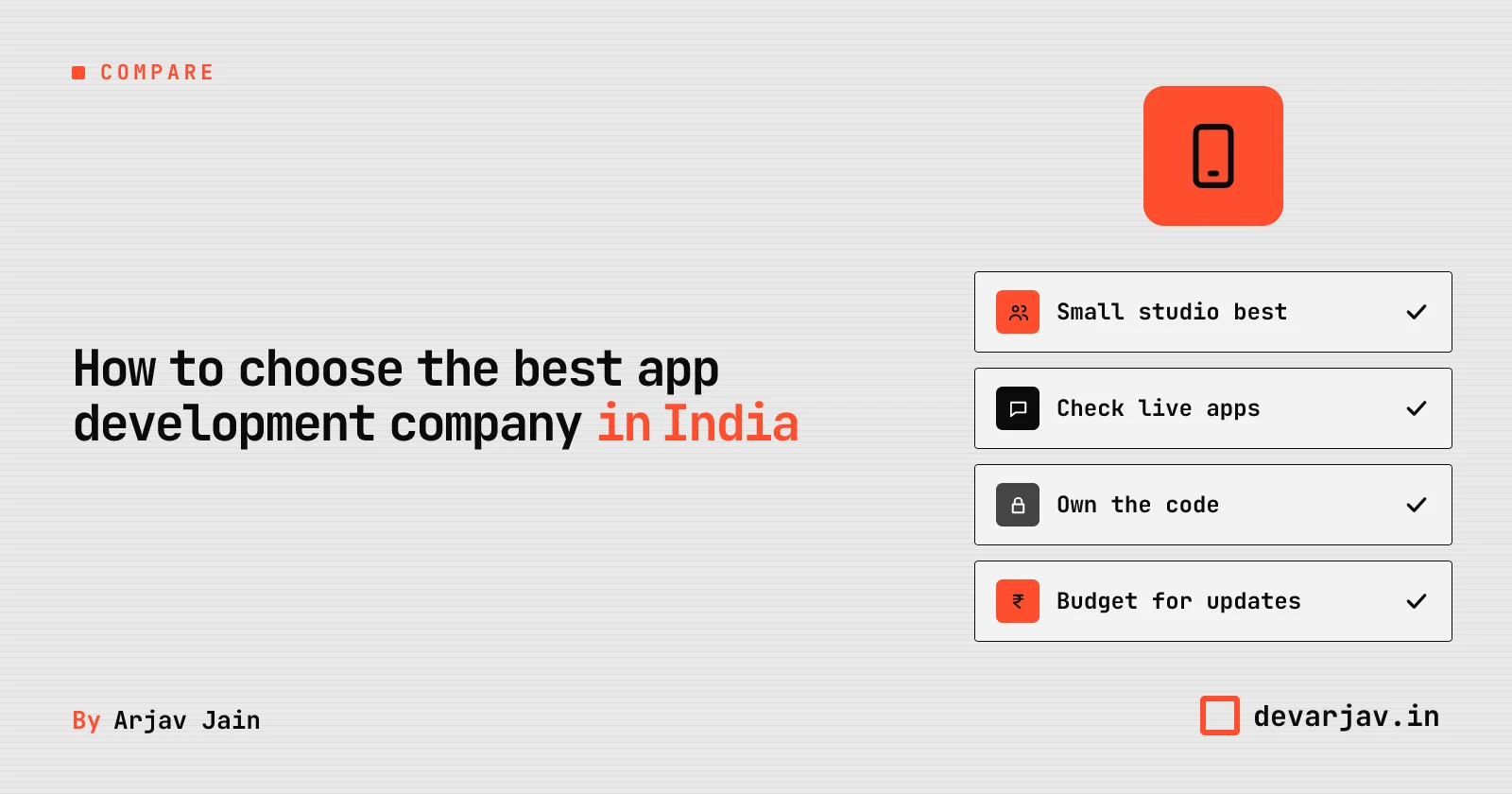
For most small businesses, a small studio is the best fit. They balance cost, speed and reliability. They work well for apps with up to 10 core features, like a local store’s order tracker.
Very simple apps, like a single-form submission tool, can use a freelancer. Complex, long-term apps with many parts need a large agency or in-house team. Your choice should match your app’s size and how much control you need.
How much does each team charge and what hidden costs to watch?
A basic app with login, profiles and static content costs ₹4,00,000 to ₹8,00,000. Freelancers may charge less but often skip backend work or testing. Small studios usually quote within this range if the scope is clear. Large agencies may start at ₹10,00,000 or more, especially if they include project management and legal checks. Hourly rates vary from $20 to $95 (₹1,650 to ₹7,850) per hour for agencies like InnovationM.
Hidden costs often come from unscoped work not written down in the original agreement. For example, a quote might assume the app only shows static content, but. If you later want users to save data, that needs a backend, user accounts and security, all extra. Third-party integrations like payment gateways or maps are often priced based on best-case API conditions, but real-world bugs add cost.
A quote far below ₹4,00,000 likely skips QA, backend systems, or source-code ownership, always ask what is excluded. You may also face extra charges for app-store publishing, ongoing hosting, or legal compliance.
Worked example: basic app cost
- Design and frontend: ₹2,50,000
- Backend and API: ₹1,00,000
- QA and testing: ₹1,00,000
- Project management and buffer: ₹1,50,000
This assumes no third-party integrations, no offline sync, and one platform (Android or iOS). Adding both platforms or features like payments can raise costs by ₹1,00,000 to ₹3,00,000.
You can save money by reusing templates, limiting features, or working directly with a solo developer like me. But if speed and support matter, a small studio with clear ownership terms may be safer.
Want a number for your idea? Send one line on WhatsApp. I reply with what drives the cost and what to cut.
Message me on WhatsAppWhat causes delays and how can you avoid them?
Scope creep causes 45% of delays in Indian app projects, when requirements grow during development. To avoid this, agree on a detailed product requirement document (PRD) before work starts. Include a change order process in the contract so any new feature is reviewed and priced separately.
Client review delays cause 25% of project delays, due to slow feedback on designs or builds. You can reduce this by setting a review SLA in the contract, ask for a 48 to 72 hour maximum response time for each milestone.
Third-party API issues cause 15% of delays, especially with payment gateways or government services like Aadhaar, GSTN or DigiLocker. These APIs can be slow or go down. Plan for this by adding a 1 to 2 week buffer for each critical API you depend on.
The rest of delays come from other causes not covered in this evidence. Timelines vary by team and project, and support after launch is not specified. How to compare two quotes or verify references is not known.
What are the steps to hire a development team?
Start with a clear brief, get a written quote, verify the developer’s identity and app ownership, then sign a contract. A good quote should list each feature, the tech stack, delivery timeline, payment schedule, and who owns the code after launch. It must also state if maintenance and updates are included or billed extra.
Before signing, check that the developer has delivered real apps. Ask for links to live apps on the Play Store or App Store. Confirm they built it by checking the developer name or asking for a short screen share of the code or admin panel. For companies, verify their business registration and GSTIN through the Ministry of Corporate Affairs portal.
To verify a developer’s identity, ask for a government ID and a business address. If they are a company, request their incorporation certificate. For app ownership, they must prove control of the app’s package name. On Android, this means providing a signed APK linked to their developer account. For iOS, they should show access to the Apple Developer account.
Use an app brief template to make sure your project scope is clear and priced fairly. A complete brief helps avoid changes later that can raise costs.
Have a quote in hand? Send it to me and I will mark what is missing.
Message me on WhatsAppHow to check if a developer really built the apps they show
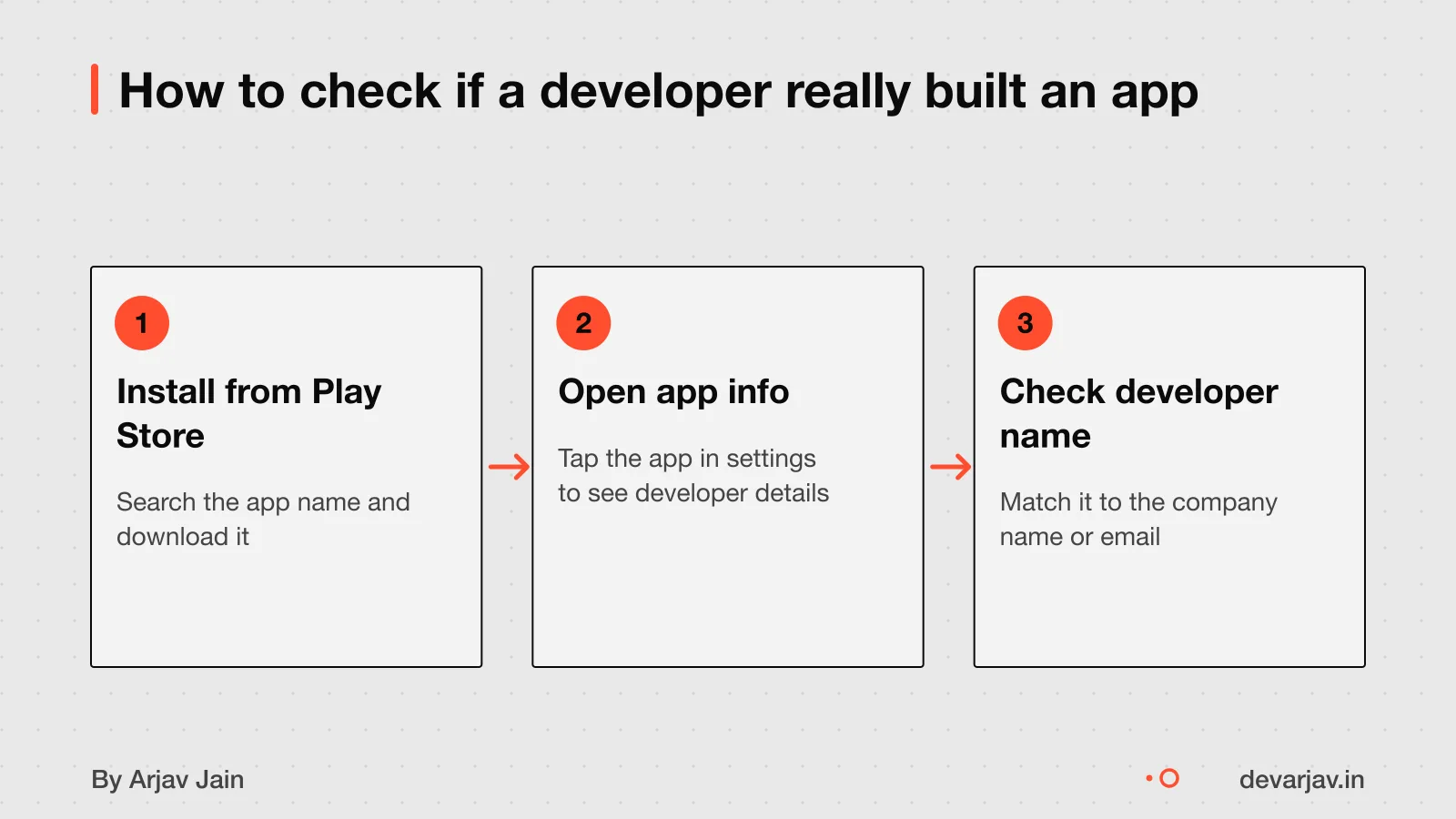
Install the apps they claim to have built. Open the app on your phone and go to the app store listing. Check the developer name and email shown there. Match it with the person or company you are hiring. If the name matches, it is strong proof they built it. If not, they may have only helped or copied the idea.
To verify a developer’s identity, look at the Google Play or Apple App Store profile. On Google Play, tap the developer name to see their email and other apps. On Apple, check the "Developer" section for contact details. As of 30 September 2026, Google is rolling out new developer verification for users in Brazil, Indonesia, Singapore and Thailand. This will expand globally for all apps on certified Android devices in 2027.
If a developer account is terminated, all apps are removed from Google Play and the developer cannot publish new apps. This means if you see their apps still live, the account is active. But if an account was closed due to inactivity, the developer can create a new one later. So check if the account is current and has multiple live apps.
A live app with your features, published under their name, is better proof than any portfolio claim. For iOS apps, ask for a direct download link or TestFlight invite, as Apple’s store is harder to verify. Always test the app yourself before paying.
Who owns the code and what legal rights do you have?
You own the code only if your contract says so. Without a written agreement, the developer may keep ownership even if you paid for the work. To be safe, your contract must include a clause that assigns all intellectual property rights to you once the project is complete and paid for. This is called a "work for hire" or IP assignment clause. It makes you the legal owner of the source code, design files and app accounts.
You can move your app to another developer later, but only if you own the accounts and have access. For iOS apps, you must be the Account Holder (Team Agent) of the Apple Developer account to transfer the app. The app must also meet Apple’s rules for transfer, such as having no unresolved issues or violations. Without this, you cannot switch developers even if you own the code.
For example, one clinic owner paid a freelancer to build a patient booking app but did not get the Apple account access. When the freelancer stopped responding, the clinic could not update the app or fix bugs. They had to build a new app from scratch.
If your app collects user data, you must also follow India’s DPDP Act rules on consent and data handling. DPDP Act consent flows an Indian app needs
How much does maintenance cost and what if the company shuts down?
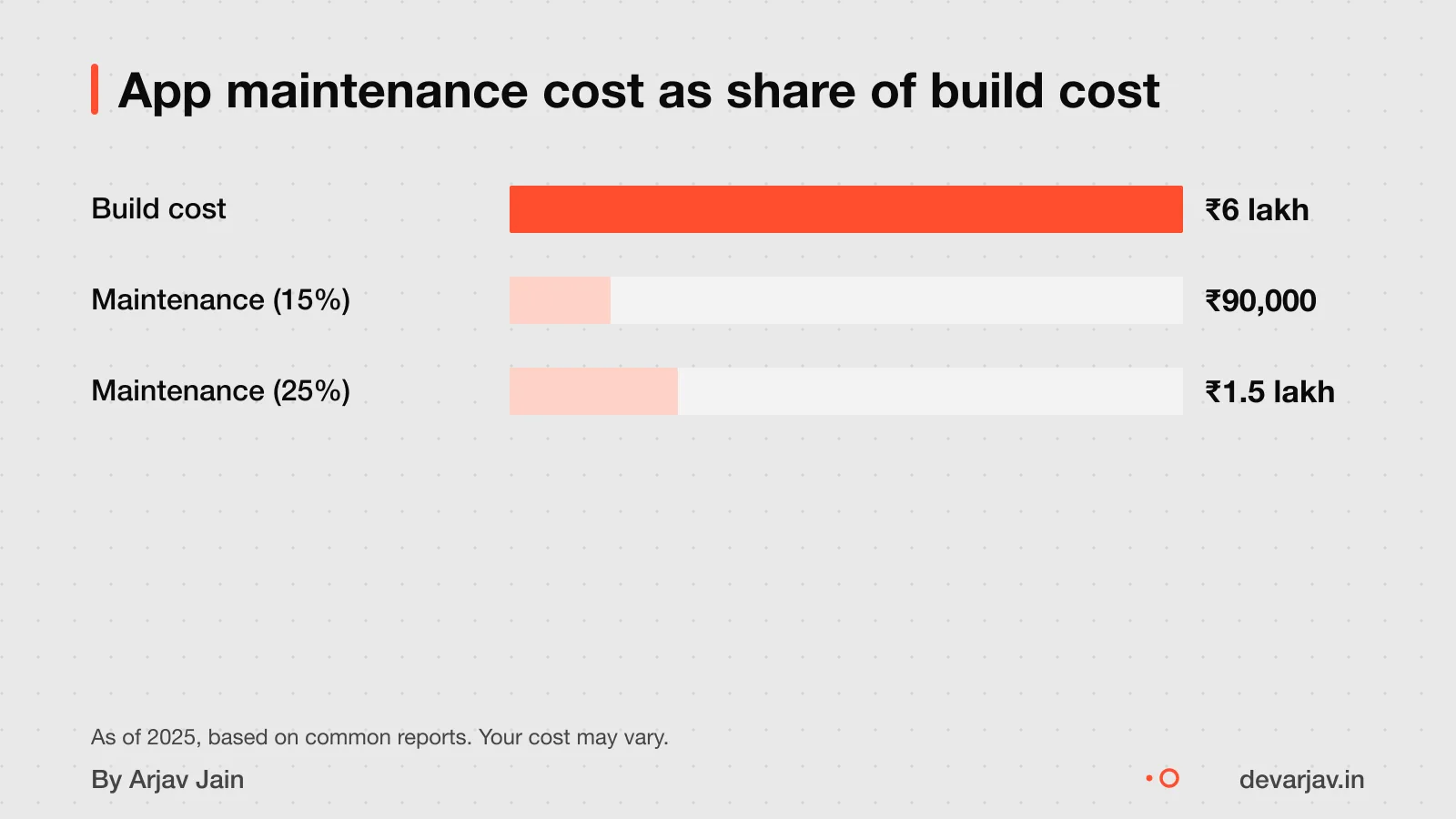
Budget 15 to 20% of the build cost each year for maintenance. This covers OS updates, bug fixes, and small feature tweaks. For example, if your app cost ₹5 lakh to build, set aside ₹75,000 to ₹1 lakh per year for upkeep.
Over its lifetime, maintenance may cost 2 to 4 times the original build cost. This includes security patches, performance fixes, and adapting to new devices or Android/iOS versions.
If the company shuts down, your app stays live only if you own the developer accounts. Even if you open a new account, Google may close it without a refund if linked to a terminated one.
To protect yourself, ensure you own the Play Console and Apple Developer accounts. Get login access or nominate a trusted person to manage them. Ask for a list of what maintenance includes before signing any quote. If a quote does not mention maintenance, treat it as incomplete.
What are the risks and red flags to watch for?
Hiring a freelance developer is riskier than working with a studio because one person may not have time for testing, design and support. If they fall sick or quit, your project can stall. Studios have teams that share the work, so progress continues even if one person is away.
A vague contract often means you do not own the source code or have rights to use the app fully. Always check that it says you own the final product and get full access to the code after payment. A quote far below market rate usually leaves out key work like quality testing, backend servers or legal ownership. Ask what is excluded before signing.
Walk away if a vendor refuses to show live apps they built or will not share client references. Also avoid anyone who does not provide a clear contract with milestones, payment terms and ownership clauses. If they pressure you to pay the full amount upfront, it is a red flag.
Not sure if your project has this risk? Tell me the plan in two lines and I will say yes or no.
Message me on WhatsAppDoes location matter and do you need a project manager?
Yes, you can hire a team from another city. Most small businesses in India work with remote developers without issues. For example, I built the website for Ralas AutoCorp, an Ather dealership in Raipur, while based in Delhi. Communication happens over WhatsApp, email and video calls, which works well if both sides are clear and regular with updates.
A project manager may help but is not always worth the cost. They can coordinate tasks and keep things on track, and their experience matters more than certifications. But hiring one adds expense. The average salary is around $66,000 per year, which may be too high for small projects.
For most small-business apps, direct contact with the developer or a small studio is simpler and cheaper. You save money and get faster replies. If your project is large or complex, then a project manager might be useful. But for a basic app, you can manage it yourself by checking progress every week.
If you are in Chhattisgarh, you may want to know about the best app developer in Raipur.
When this advice does not apply to you
- You should start simpler if your goal is to test an idea fast. Build a no-code prototype using tools like Glide or Adalo. These let you turn a spreadsheet into a working app in hours. Once you have real users and feedback, then hire a developer to build the full version.
- You should consider hiring in-house if you are launching a product that will be core to your business and need daily updates. For example, a fintech startup building a payments app would need its own team to fix bugs, add features and stay compliant. Most small businesses do not need this. They use apps to support their work, not sell software.
- This advice is for owners who want a custom app built by an outside team. It does not apply if you already have developers on staff or. If you are using a template-based builder like Wix or Shopify for a simple site.
- If your project is highly regulated, like a health data app or one that handles payments. You may need a specialist firm with legal and security experience. General studios may not know the rules.
Related reading: best kind of app developer for a startup, what it costs to build an app in India, app brief template developers can actually price.
Next step: message me on WhatsApp with what you want to build. No forms, no sales team.
Message me on WhatsAppAssumptions behind the numbers
- Score weights are subjective and reflect typical small business priorities.
- Support after launch is scored lower for solo developers due to limited availability.
- Large agencies score high on proof and ownership but low on price due to overheads.
Weigh what matters to you
I won't name a number one, because the best depends on what you weigh. Set what matters and see which kind of team fits.
- 1Large agency4.0
- 2Small studio3.8
- 3Solo developer3.5
- 4Hire in-house3.3
Scores are general tendencies for each kind of team, set out as a starting point. They are not ratings of any named company.
Whoever you pick: checks, in the order they save you
- Open two of their shipped apps on your own phone.
- Ask who will write the code, by name.
- Get the scope, and the not-included list, in writing.
- Ask for milestones you can test.
- Confirm the repository and store accounts are in your name.
- Speak to a past client.
- Ask what happens if you stop midway.
- Ask how changes are priced.
- Ask what the first month after launch costs.
- Compare the assumptions in quotes, not the totals.
Questions people ask
Which option is cheaper: freelancer or agency?
A freelancer is usually cheaper than an agency for a basic app. A simple app with login, profiles, and static content costs ₹4,00,000 to ₹8,00,000. But lower cost comes with higher risk, as freelancers may skip testing or backend work.
When is a freelancer better than a studio?
A freelancer works well for simple apps when you can manage the project closely. Since they are self-employed, you get direct control over the process. This suits small updates or apps with fixed features, but not complex systems needing a team.
Can I switch to another developer later?
Yes, you can switch developers, but only if you own the app store accounts. You must be the Account Holder (Team Agent) on Apple’s Developer account to transfer an app. Also, the app must meet the store’s rules before it can be moved.
What should a contract include for an Indian app?
Your contract must say you own the app code after payment. It should cover data handling, how disputes are resolved, and that both parties agree freely. Any clause with an unlawful purpose is void under Indian law.
How do Indian data laws affect my app?
The DPDPA, 2023 applies if your app collects digital personal data in India. You must get user consent before processing data. Check this for your case with a chartered accountant or lawyer.
What if my needs change during development?
Changes during development, such as undefined requirements that expand, cause 45% of delays in Indian app projects To avoid this. Agree on a detailed product requirement document (PRD) and a change process before work starts. Each new request should go through a formal review.
How do I compare two different quotes?
Do not just compare the total price. Check what each quote leaves out, like third-party integrations or backend work. Hidden costs often come from unscoped items, so ask for a line-by-line breakdown.
Do I need to be technical to hire a developer?
No, you do not need to be technical. But ask three things: what stack they use, how they test apps, and how they handle updates. These show if they have practical knowledge.
What happens if the developer goes out of business?
If a developer’s Google Play account is terminated, all their apps are removed and they cannot publish new ones. Even a new account you try to open will be blocked. This is why you must own your app’s account.