Do you even need an app?
An app is a program you install on your phone or tablet to do a specific job. Like booking clinic visits or tracking shop inventory. Unlike a website, which you open in a browser, an app lives on the device and can work without internet. For many small businesses, a website works better and costs less. You can set one up for free using tools like Wix, with steps like picking a template and adding your details.
Apps have downsides. They need frequent updates because phone systems change often, so upkeep costs more over time. If your need is simple, like showing your shop’s address or services, a website is faster to build and easier to manage. An app makes sense only if you need features like offline access or phone alerts.
What you actually get: one person or a team?
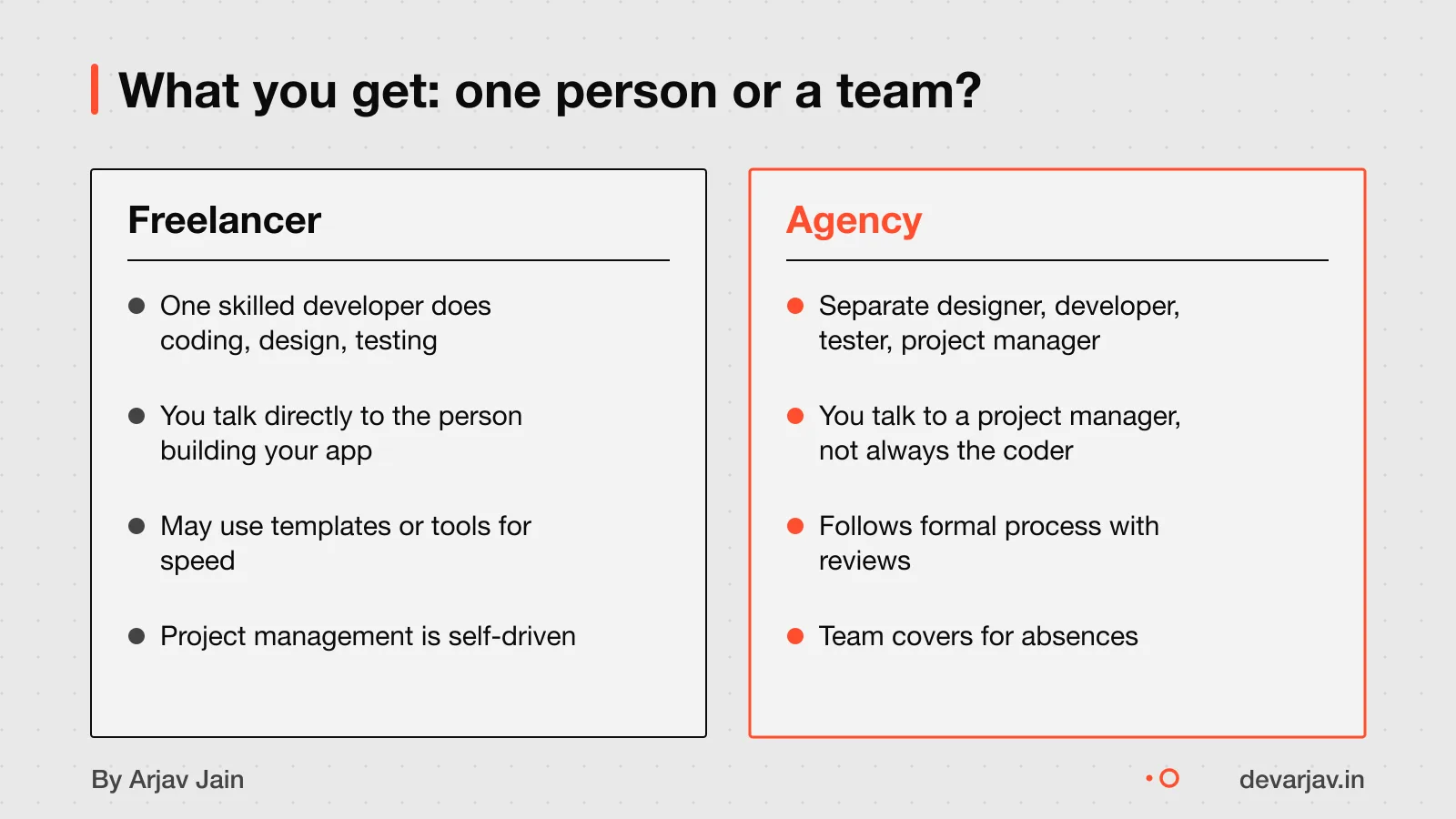
With a freelancer, you get one skilled developer who writes all the code, handles design, testing and project management themselves. You talk directly to the person doing the work. With an agency, you get a team: one developer may write code, while others handle design, testing and project management separately.
A freelancer’s price usually covers only the core work they do themselves. An agency’s higher cost often includes extras like project planning, documentation, security checks, performance tuning and post-launch support.
For example, if you want a simple shop app to track orders, a freelancer can build and test it alone. An agency would assign roles: one for design, one for code, one for testing, and a manager to coordinate.
| Role | Freelancer | Agency |
|---|---|---|
| Code | One person | Dedicated developer |
| Design | Same person | Separate designer |
| Testing | Same person | QA specialist |
| Project management | Same person | Project manager |
| Direct access | Yes, always | Through a manager |
Cost: what you pay and what hides behind the number
Hiring two freelancers costs ₹60,000 to ₹1.2 lakh per month. An agency costs ₹2 lakh to ₹5 lakh per month for the same work. Freelancers charge less because you pay only for coding time. Agencies include project managers, designers, and testers in their fee.
Hidden costs can add 25% to 35% to your total spend. These include app store fees (Apple and Google take 15 to 30%). Payment gateway charges (1.5 to 3% per transaction), GST compliance tools, and basic marketing. For example, if your app costs ₹5 lakh to build, add ₹1.25 lakh to ₹1.75 lakh for these extras.
Yearly maintenance adds 20% to 30% of the build cost. This covers bug fixes, server bills, and updates for new phone or OS versions. As an estimate, assuming a ₹6 lakh build, add ₹1.2 lakh per year for upkeep. Over five years, maintenance may total two to four times the original development cost.
This assumes no major new features.
You save money with a freelancer if your scope is clear and small. Agencies cost more but include oversight and broader skills.
Freelancer vs agency: what you actually pay for
Want a number for your idea? Send one line on WhatsApp. I reply with what drives the cost and what to cut.
Message me on WhatsApp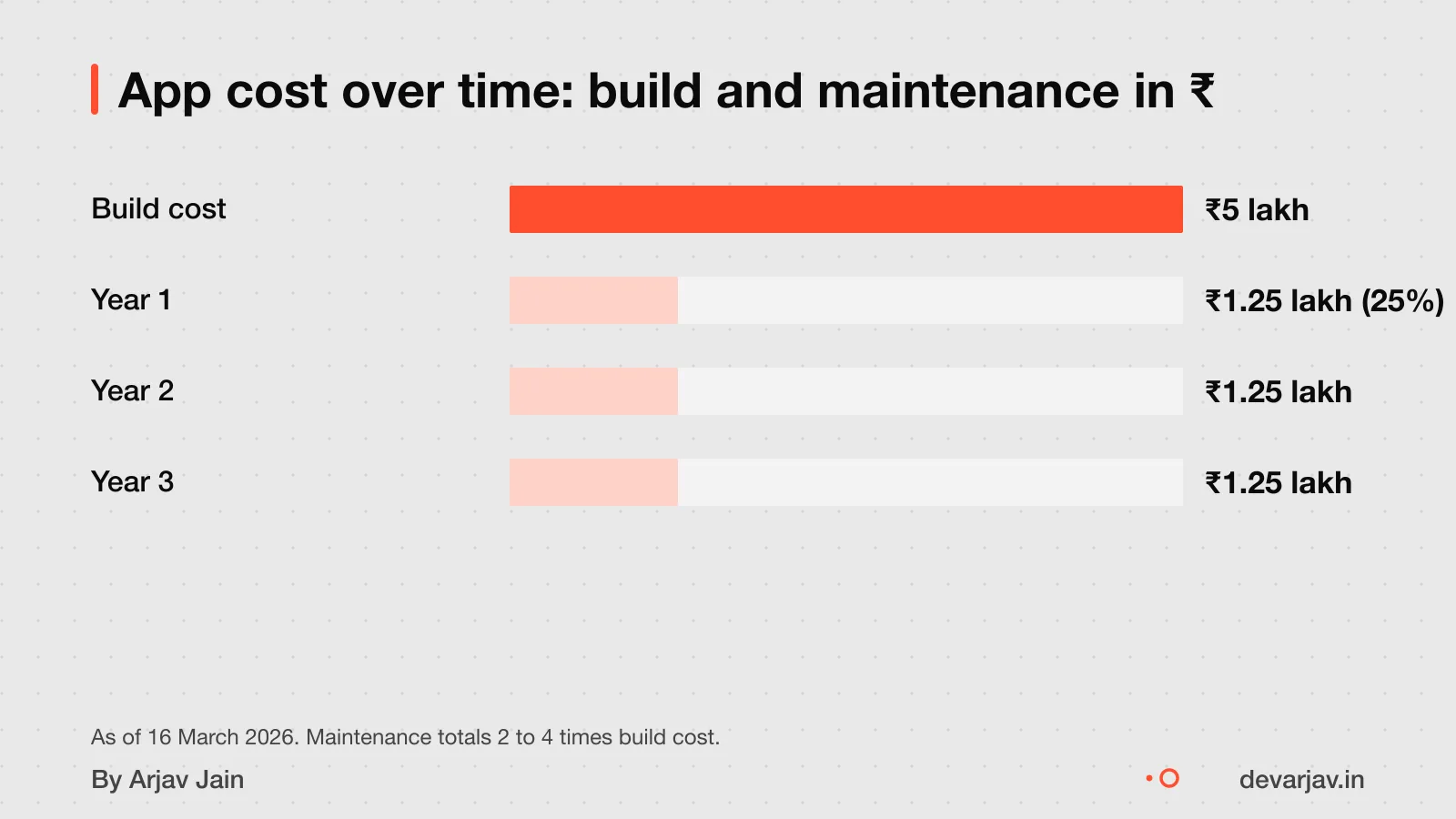
Time: when will it start and when will it finish?
A freelancer can start within 1 to 3 days of agreeing to your project. This means you can go from idea to code quickly, with no delays for onboarding. In contrast, an agency may take 1 to 2 weeks to assign a team and begin.
A simple app (MVP) takes 6 to 12 weeks to build. This timeline covers design, core features, testing, and launch. Freelancers often deliver faster because there is less handover and fewer meetings. Agencies may take longer due to process, even for the same scope.
For example, if you want an app to manage daily deliveries for your bakery. A freelancer could begin coding within days and have a working version in under 10 weeks. An agency might take the same time but with more formal check-ins and documentation. The start delay and process depth are the main differences.
When a freelancer is the better choice
A freelancer is best when your app has a clear, narrow purpose and you want to move fast at a lower cost. They suit MVPs or simple apps. Freelancers can help you move quickly and keep costs down.
This works well if your scope is small and you are not technical. You do not need to be an engineer to start. AI tools can help turn your idea into a working model without code. For example, you describe a daily menu app for your restaurant, and an AI builder drafts the screens.
A single skilled developer handles design, coding, testing and updates. You avoid delays from meetings or handovers. This direct contact means changes are faster and cheaper.
If you want a simple app with one core job, a freelancer gives better value. For more complex needs, an agency may be better.
Hire a Flutter developer for your first app to get started with someone who builds and ships apps for small businesses.
When an agency is the better choice
An agency may be better if your app needs complex features, multiple platforms, or long-term support. These apps often require more than one skill, like design, backend coding, security and testing, which agencies provide as a team. Agencies are best for building mid-level, advanced, and enterprise-grade applications with complex features.
Agencies also offer formal contracts, which matter if you need legal protection or your business must follow strict rules. Since an agency is a registered business, you have a clear point of accountability if something goes wrong. Their contracts often include planning, documentation and post-launch help, so you are not left alone after release. For example, a clinic chain adding online bookings, payments and doctor schedules across cities may need an agency to handle the workload and ensure uptime.
If your app must be secure, reliable and ready for growth, an agency’s higher cost may save money over time. You pay for structure, not just code.
Risks: what could go wrong with each option
Freelancer risks The main risk with a freelancer is that they may disappear mid-project, causing delays and missed deadlines. If there is no contract, there is no guarantee they will finish your work. You may then need to find a new developer, which adds cost and time. Poor documentation can also double future maintenance effort. To reduce this risk, always sign a contract that states code ownership, includes milestones, and asks for regular updates.
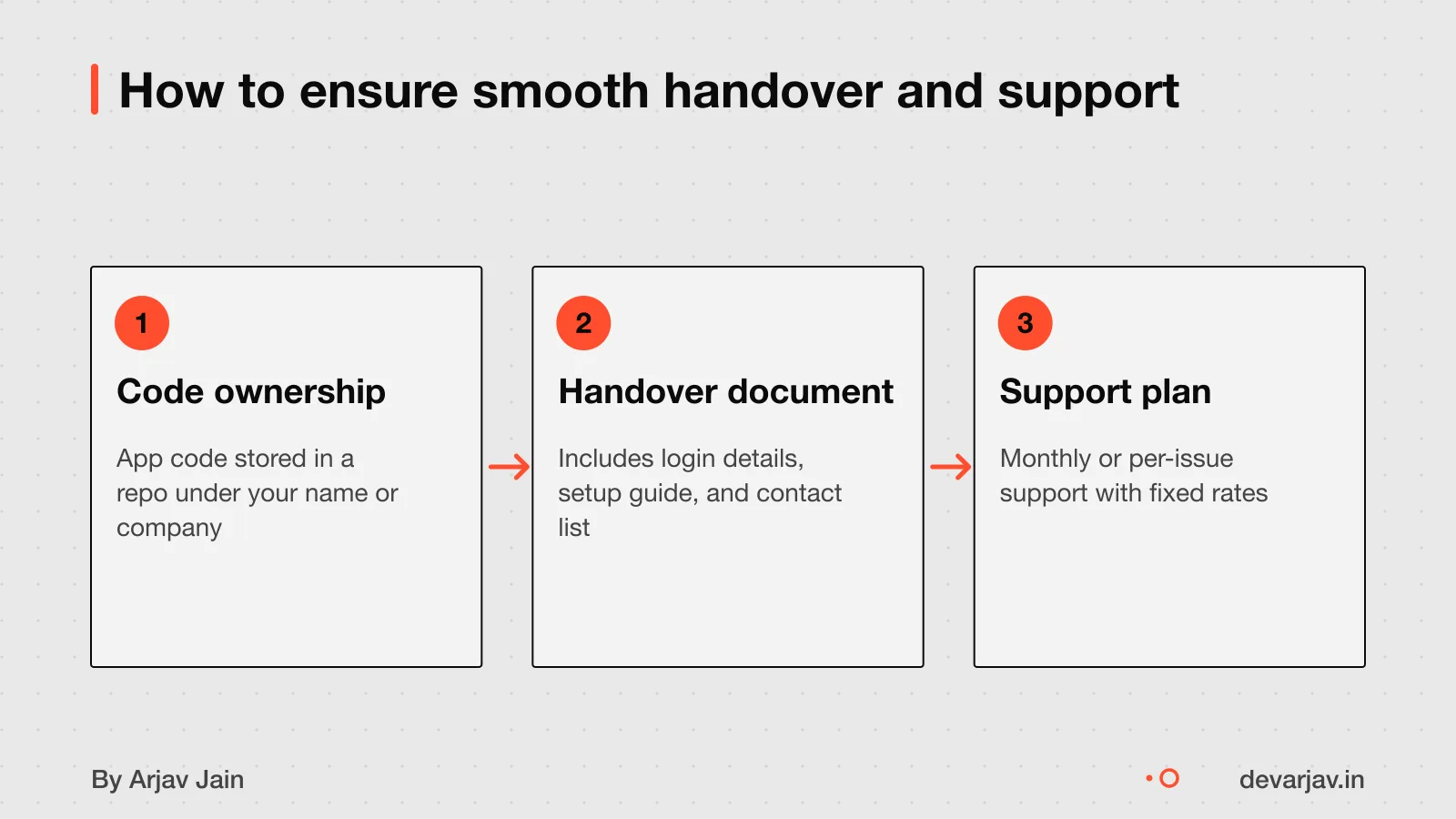
Ask the freelancer for full access to the source code and documentation as it is built. This lets you take over or hand it to another developer if needed. Use a contract that clearly says you own the final product. For added safety, ask to see the developer’s past work or client references.
Agency risks Choosing the wrong type of developer, like a freelancer instead of a WordPress agency, can lead to delays, technical debt, or recurring rebuild costs. Some use subcontractors without telling you, so the person you meet may not write the code. This can hurt quality and accountability. Agencies often charge more upfront, but this usually includes planning, testing, and support. Still, not all deliver what they promise.
To protect yourself, ask for the names and roles of every team member working on your app. Check if they are full-time staff or outsourced. Ask for documentation samples and a clear maintenance plan. A detailed contract should cover delivery dates, code ownership, and what happens if the project stalls.
66% of software projects fail due to poor planning and execution. The key is not who you hire, but how clear and protected your agreement is. Whether freelancer or agency, always get proof of progress, own the code, and plan for what happens if things go wrong.
Rescue a failed or abandoned app if you inherit messy code or an incomplete project. This service helps you regain control and move forward.
Ownership: who owns the code, accounts and domain?
You own the app only if the contract says so, whether you hire a freelancer or an agency. Without a clear agreement, ownership is not automatic. The contract must include a clause that assigns all intellectual property (IP) rights to you. This covers the code, design, and any data the app creates.
Agencies often have standard contracts that state IP ownership clearly. Freelancers may not mention it unless you ask. Some freelancers work under terms where they retain partial rights or reuse code across projects, making ownership "often unclear". To protect yourself, insist on a written agreement that includes IP assignment and a non-disclosure agreement (NDA).
For example, if you hire someone to build a shop inventory app, you must own the code to update it later or hire someone else. If the developer refuses to hand it over, you could lose control of your own business tool.
Since tax and legal rules apply, consult a local lawyer before signing. This is especially important if the app handles customer data or payments. The current GST rate for freelancers in India is not specified, so ask your developer for their GST details to verify their status [unknown].
Support after launch: updates, bugs and new features
Annual maintenance costs 20% to 30% of the original build cost each year. This covers updates, bug fixes and server costs. Over the full life of the app, these costs add up to 2 to 4 times the initial development cost. Mobile apps often need more frequent updates due to changes in Android and iOS, so their maintenance share is higher than other software.
The same developer who built your app should handle updates and security patches. Freelancers and agencies both offer this, but you must agree on it in writing. If you hire a freelancer, you rely on one person. With an agency, a team may support you, but you might not speak to the same person each time.
Switching developers later is possible, but only if you own the source code and have full documentation. Without these, moving to someone else is hard and may cost extra. Always confirm code ownership and ask for a handover plan before starting.
How much more does an offline-first app cost?
How to check if they are trustworthy
Ask for proof of past work and client reviews. A trustworthy developer will share links to apps they have built and let you contact past clients. On platforms like Freelancer.com, you can check ratings: clients rate mobile app developers 4.9 out of 5 from 374,156 reviews. This does not guarantee quality, but it shows a track record.
In the first call, ask how they plan to understand your business. A good developer will ask about your shop, your customers, and what problem the app should solve.
To verify past work, test the apps they mention. Open them on your phone, see how fast they load, and check if features work smoothly. For clinic or shop apps, try booking a slot or adding an item to cart. If they cannot show live apps, ask why.
Start by writing a clear one-page scope: what the app should do, who will use it, and what success looks like. Post this on a platform like Freelancer.com, where you can receive the first bid in about 40 seconds. Review each bid, check their profile, past projects, and client feedback. Avoid those with no reviews or vague portfolios.
When you have a quote, check if it includes design, testing, launch, and first-round fixes. Many leave out hidden costs like app store fees or backend hosting. A clear quote lists each part of the work and what you get.
Hire a developer for a clinic booking app if your app serves a specific local need. Tailored advice helps you avoid common hiring mistakes.
Have a quote in hand? Send it to me and I will mark what is missing.
Message me on WhatsAppWhen this advice does not apply to you
Do not hire a freelancer if your idea is still unclear or keeps changing. A single developer works best when the scope is fixed and small. If you need help shaping the idea first, work with a coach or consultant instead.
Do not hire an agency if your app is simple and well-defined, like a basic shop inventory or appointment booker. Agencies add overhead and cost more for straightforward work. You pay for multiple roles, even if you do not need them all.
If your scope is not clear, do not hire either yet. Take time to map your core problem and list the must-have features. Use tools like pen-and-paper mockups or no-code prototypes to test ideas first. Jumping into hiring too early can waste money and delay results.
Next step: message me on WhatsApp with what you want to build. No forms, no sales team.
Message me on WhatsAppPick your situation
I am a solo developer, so I benefit from the first answer. That is why the table below also tells you when an agency is the better pick.
Pick your situation
Freelancer wins. Nothing is lost between a salesperson and the person writing code. A clear scope is the case where one skilled person is fastest.
The whole comparison
| Freelancer | Agency | |
|---|---|---|
| Who writes the code | The person you speak to | Often someone you never meet |
| Cost shape | Day rate or fixed price, little overhead | Higher rates carry the team and process |
| Time to start | Quick, if they have capacity | Slower to staff, steady once started |
| Main risk | One point of failure | Hand-offs and who is really on it |
| Breadth | Deep in a few things | Many specialisms available |
| Accountability | One name | A company and a contract |
Whichever you choose, ask these
- Who exactly will write my code?
- What happens to my code if we stop midway?
- What is not included?
- What does support cost after launch?
Questions people ask
Which one is cheaper: freelancer or agency?
Freelancers are usually cheaper upfront, costing ₹60,000 to ₹1.2 lakh per month for two developers. Agencies charge ₹2 lakh to ₹5 lakh per month for a full team. Freelancers have lower rates and no agency overhead. But hidden costs like poor documentation or delays can add 25% to 35% to either option.
Can I switch from a freelancer to an agency later?
You can switch only if the code is in your name and all accounts are under your control. If the freelancer owns the code or accounts, switching means a full rebuild.
Do freelancers charge GST? What about agencies?
Freelancers must pay income tax according to the GST rate for freelancers set by the government if they are registered. Agencies always charge GST as registered businesses. Check the GSTIN on their invoice and consult a chartered accountant to confirm compliance for your case.
What legal agreement do I need when hiring a freelancer or agency?
You must have a signed contract that assigns full IP ownership to you. It should cover milestones, payment terms, and project scope. Have a lawyer or chartered accountant review it before signing.
How do I verify a freelancer's work without technical skills?
Check if their apps are live and working on the App Store or Google Play. Read client reviews and ask for references. Use tools like FairQuote to compare quotes and check for missing items.
What happens to my app if the freelancer stops working?
Your app may face delays if the freelancer disappears mid-project. If not, work stops and you may need to rebuild. A clear contract helps avoid this risk.
How much does post-launch support cost per year?
Post-launch support costs 15% to 25% of the build cost each year. Over time, maintenance can total 2 to 4 times the build cost.
Is it safe for a non-technical owner to hire a freelancer?
Yes, it is safe if you use AI tools to clarify your idea. Get a clear contract, and insist on code ownership and full documentation. This protects you even if you do not understand the code.
What questions should I ask a freelancer or agency in the first call?
Ask: Who will actually write the code? What is not included in the quote? How will you protect my business data? Can I see live apps you have built? How do you handle delays? These reveal their process and honesty.
How do I know if a quote is fair?
Use FairQuote to compare the quote against market rates. Check if items like design, testing, or GST are missing from the quote. A fair quote lists all costs and explains what you get at each stage.