
What is a native app vs a cross-platform app?
A native app is built for just one operating system, like iOS or Android, using its own tools and languages. For iOS, developers use Swift or Objective-C with Apple’s Xcode and SwiftUI. For Android, they use Kotlin or Java. This means the app runs fast and can use all device features.
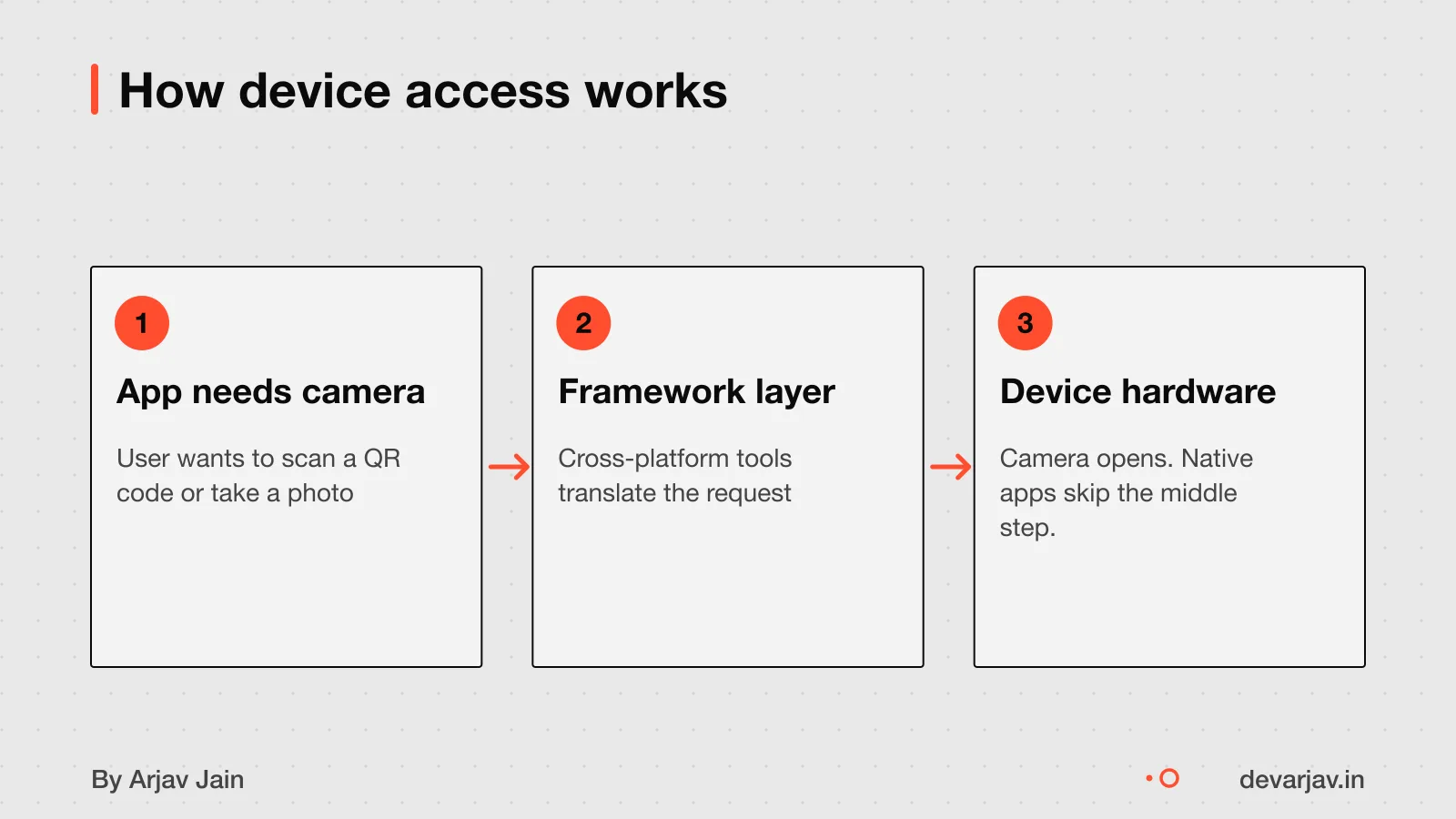
A cross-platform app uses one codebase to work on both iOS and Android. Tools like Flutter and React Native let developers write once and deploy on both platforms. The code talks to each platform’s native parts so the app feels like it belongs.
The key difference is code and tools. Native apps need two separate codebases and teams. Cross-platform apps use one codebase, cutting effort and cost. You can learn more about how this works in our guide on What is a cross-platform app?.

Is cross-platform the same as hybrid apps?
No, cross-platform is not the same as hybrid apps. Hybrid apps run inside a web view, like a website in a box. Use web technologies like HTML, CSS and JavaScript to display content. Cross-platform apps, like those built with Flutter or React Native, compile to native code and run directly on the device. They do not rely on a web view for the user interface. Flutter draws its own UI components using the Skia graphics engine, not a browser. This means Flutter apps feel more like native apps in performance and look. So while both aim to build for multiple platforms, cross-platform is not just a modern version of hybrid. It is a different method altogether.
When is native better than cross-platform?
Choose native if your app needs maximum performance, deep hardware access, or you expect very high user numbers. Native apps use Swift for iOS and Kotlin for Android, giving full control over device features. If you need Bluetooth, NFC, or advanced AR/VR, native is likely necessary. These features often do not work reliably in cross-platform apps. For example, a delivery app that scans QR codes using the camera and connects to a Bluetooth printer at a kirana store needs native tools. Also, if your revenue model depends on in-app purchases, native may offer better store approval and performance. High-growth apps aiming for over 10 million users often switch to native later to improve speed and stability. For most small businesses, these cases are rare. If your app is a service, listing, or content platform, cross-platform is enough. The Best tech stack for a quick commerce app covers hardware needs for delivery and retail apps.
When is cross-platform better than native?
Cross-platform is better when your app has standard features like forms, lists, maps or chat. By simplify app development across platforms, this approach can deliver significant cost and time savings and better ROI. This works well for most small businesses and startups in India who need a working app fast and on a tight budget.
Startups should pick cross-platform when testing an idea, as it cuts initial spend and speeds up launch. Apps like store locators, service booking, internal tools or content feeds run well this way. You also avoid hiring two separate teams.
As frameworks improve, cross-platform apps now look and feel close to native in many cases. But if your app grows complex, native may become better later. For now, if you do not need advanced camera use, real-time gaming or heavy offline tasks, cross-platform is the smarter start.
App or website first?, you may not need an app at all.
How much does each option cost in India?
A simple native app for one platform costs ₹3 to 5 lakh. This is for an app with 3 to 5 core features, no complex backend, and built only for Android or iOS. Flutter cross-platform gives you both for ~30% extra. So if a native Android app costs ₹4 lakh, the same app on both platforms using Flutter would cost around ₹5.2 lakh.
Third-party features add cost based on complexity. For example, adding a payment gateway, live chat, or cloud sync raises the price. A mid-complexity app with more screens and integrations costs ₹33 to 75 lakh. A complex enterprise app with admin panels, user roles, and real-time data can cost ₹83 lakh to ₹2.5 crore or more.
As an estimate, assuming a simple cross-platform app with basic user login, five screens, and one API integration, the cost is ₹5 to 6 lakh. This assumes no custom animations, offline sync, or advanced security.
Adding real-time sync, background tasks, or biometric login may add ₹1 to 2 lakh. The final cost depends on your app’s exact needs.
Cost to build an e-learning app if your app includes video, quizzes or user progress tracking.
Want a number for your idea? Send one line on WhatsApp. I reply with what drives the cost and what to cut.
Message me on WhatsApp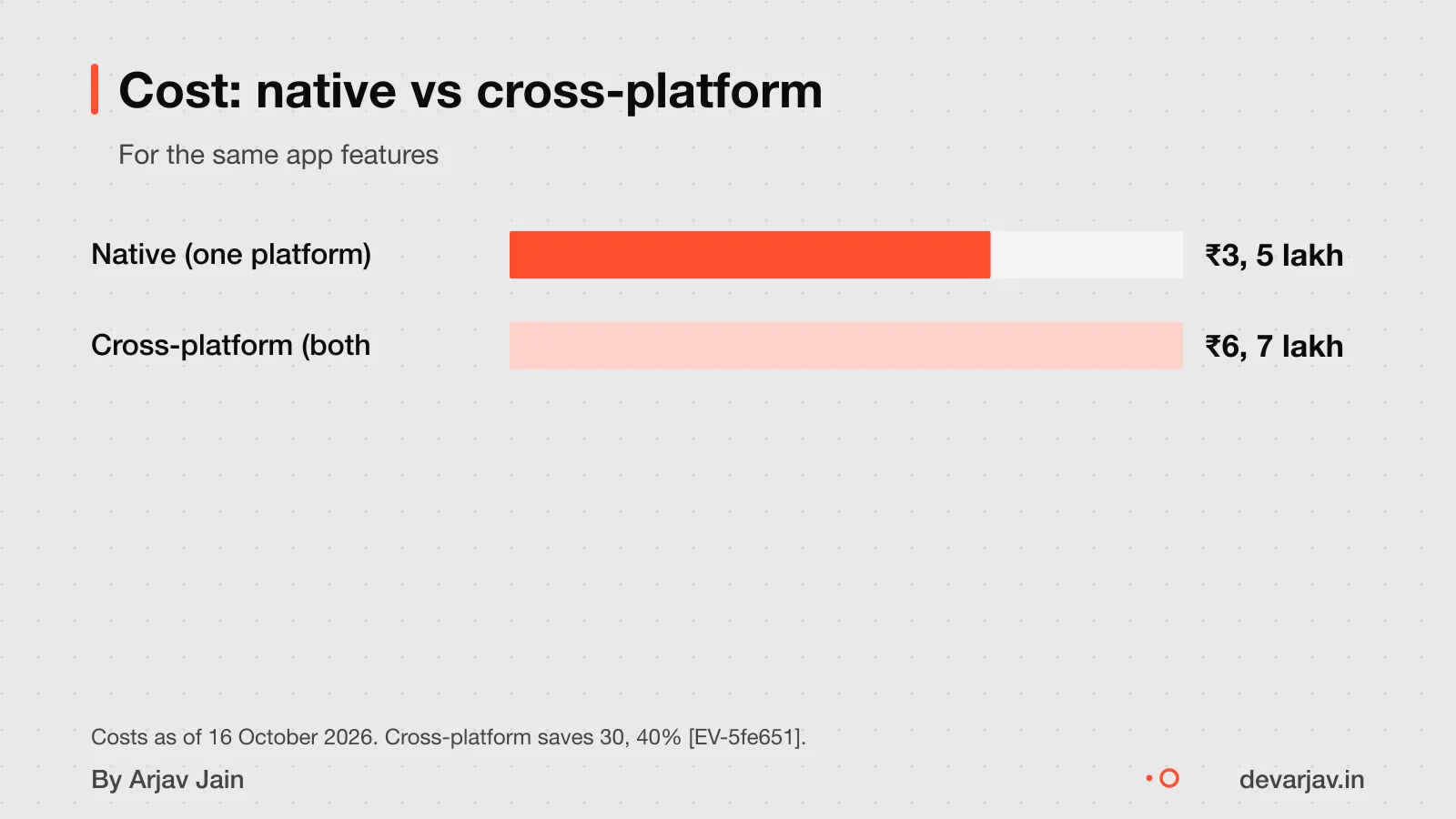
How long does each take to build?
A simple app takes 4 to 6 weeks to build. For a cross-platform app, this timeline applies because you write one code for both Android and iOS. Cross-platform development can be quicker than native development.
We know that simple apps take 4 to 6 weeks and mid-complexity apps take 3 to 5 months. Cross-platform frameworks like React Native and Flutter can cut development time by 30-40%. But we do not know what specific steps slow down native or cross-platform development. Or how long it takes if you build for iOS and Android separately. To plan your timeline, ask your developer for a week-by-week breakdown based on your app’s features.
Do you need separate developers for each?
Yes, native apps usually need separate developers for iOS and Android because each uses a different codebase and set of tools. You cannot share code between them, so two teams must build, test and update each version at the same time. This doubles the manpower and raises costs. In contrast, cross-platform apps use one shared codebase, so a single team, or even one developer, can handle both platforms. That cuts hiring needs and speeds up work. For small businesses in India, this means lower monthly payroll and faster launch times. A smaller team also simplifies communication and reduces management overhead.
What are the risks of each option?
A native app may cost more and take longer because you build it twice, once for each platform. This means double the development time and higher maintenance. If your team only knows one platform, you may face delays or quality drops on the other.
A cross-platform app may run slightly slower than a native one because it has an extra layer between the code and the device. It may also miss out on new device features until the framework updates, which can delay your app’s access.
To avoid performance issues, test early on low-end devices common in India, like ₹10,000 smartphones. Use native modules only when needed, and monitor frame rates and load times. For most business apps, like forms, lists or bookings, these risks are small and manageable.
Cross-platform apps built with Flutter or React Native work well for standard needs, but you must check. If your app uses features like AR, real-time gaming or deep sensor access. If yes, test a prototype first.
How to check if you own your app to avoid losing control later.
Not sure if your project has this risk? Tell me the plan in two lines and I will say yes or no.
Message me on WhatsAppHow to check if your app really supports your needs
Test device access by asking the developer for a working demo that uses the exact feature you need. If they cannot show it, the app likely does not support it. For performance, run the app on a low-end phone common in India. Like a ₹15,000 Android device, and check for lag or crashes during real use. Ask for a side-by-side video of the app running on both iOS and Android if cross-platform is claimed.
Benchmark speed by timing how fast the app loads data, switches screens and saves offline entries. Compare it to a known app with similar features. A long delay in saving a form may indicate poor performance. Measure and compare it to similar apps. In demos, insist on real functionality, not just animations. Ask to see error handling, offline mode and background sync. Avoid polished videos that skip real user steps.
Can I get the source code of my app? This helps you verify claims and switch developers later. Always test on your own phone before approving. If the developer resists, it may mean the code is incomplete or copied.
Who owns the code in each case?
You do not automatically own the code just because you paid for it. In India, the developer who writes the code is the first owner of the copyright by default, even if you funded the project. This applies whether you hire an individual or an agency under a service contract.
To gain ownership, you must get it in writing. The only way to transfer code ownership is through a signed written assignment. Without this, the developer retains legal rights, and you may not be able to update, fix or hand over the app later.
Full ownership means you control the source code, can modify it, choose new developers, and reuse parts in future projects [assumption: full ownership rights]. Always confirm this transfer before paying the final amount.
If you're unsure whether you own your app’s code. Read Can I get the source code of my app? to learn how to check and what to ask for.
When this advice is wrong
- You need maximum performance or deep device access, such as using Swift for iOS or Kotlin for Android. In such cases, native development with Swift or Kotlin is the clear choice.
- Your app is complex, and native development is recommended for such cases. Native code handles complexity better and reduces long-term bugs.
- Cross-platform tools do not yet support a feature you must have, like a new Android sensor or iOS privacy control. If your app depends on it, native development is less risky.
Next step: message me on WhatsApp with what you want to build. No forms, no sales team.
Message me on WhatsAppAssumptions behind the numbers
- App does not rely on rare hardware features
- User does not need early access to platform updates
- Performance needs are not extreme
Pick your situation
I build apps in Flutter, so I benefit from the cross-platform recommendation. That is why the table also shows when native is the better pick.
Pick your situation
Cross-Platform wins. One codebase means less work. Launch faster and spend less.
The whole comparison
| Cross-Platform | Native | |
|---|---|---|
| Codebase | Single shared codebase | Two separate codebases |
| Cost | 30–40% lower | Higher due to two teams |
| Time to build | Up to 50% faster | Takes longer, two versions |
| Device access | Limited by framework | Full and instant |
| Performance | Near-native (95%+) | Maximum |
| Risk | Framework may lag | Higher cost and time |
Whichever you choose, ask these
- Which features need full device access?
- Do I expect over 10 lakh users?
- Can I launch with fewer features?
- Who will maintain it after launch?
Questions people ask
Which one is cheaper: native or cross-platform?
Cross-platform is cheaper to build, and can cut development costs by 30 to 40 percent. This saving comes from using one codebase for both Android and iOS. However, long-term maintenance costs may vary based on updates and feature needs.
Can I switch from cross-platform to native later?
Yes, you can switch from cross-platform to native later, but it means rebuilding the app from scratch. No code can be reused directly. This adds time and cost, so plan your tech choice early.
Does cross-platform affect app performance?
Yes, cross-platform apps are slightly slower than native apps due to an extra layer of computation. For most business apps, this difference may not be noticeable. But for high-speed or real-time tasks, native may perform better.
Is Flutter a cross-platform or hybrid tool?
Flutter is a cross-platform tool that handles translation between your code and each platform's native components. It uses Dart. This may make it faster and more stable than hybrid frameworks.
Do I need two developers for a cross-platform app?
No, you do not need two developers for a cross-platform app. One team can build for both Android and iOS using a shared codebase. This reduces coordination time and speeds up delivery, especially for small to mid-sized apps.
How do I know if my app needs native development?
Your app likely needs native development if it uses Bluetooth, NFC, AR/VR, or real-time processing. Also, if your app's revenue model depends on in-app purchases, native is better. For standard features like forms or maps, cross-platform works well.
Are there legal risks in choosing cross-platform?
There are no extra legal risks just for using cross-platform apps. But if your app collects personal data, you must follow the Digital Personal Data Protection Act, 2023. Check this for your case with a data protection lawyer.
What happens to my app if the framework stops updating?
If the cross-platform framework stops updating, your app may fall behind in OS updates and security patches. You might need to migrate to a new framework, which can be costly. Choose stable frameworks to reduce this risk.
Does GST apply to app development in India?
Yes, GST applies to app development services in India. But the rate depends on whether it is a product or service and how it is delivered. Check this for your case with a GST practitioner.