What is Flutter and how is it different?
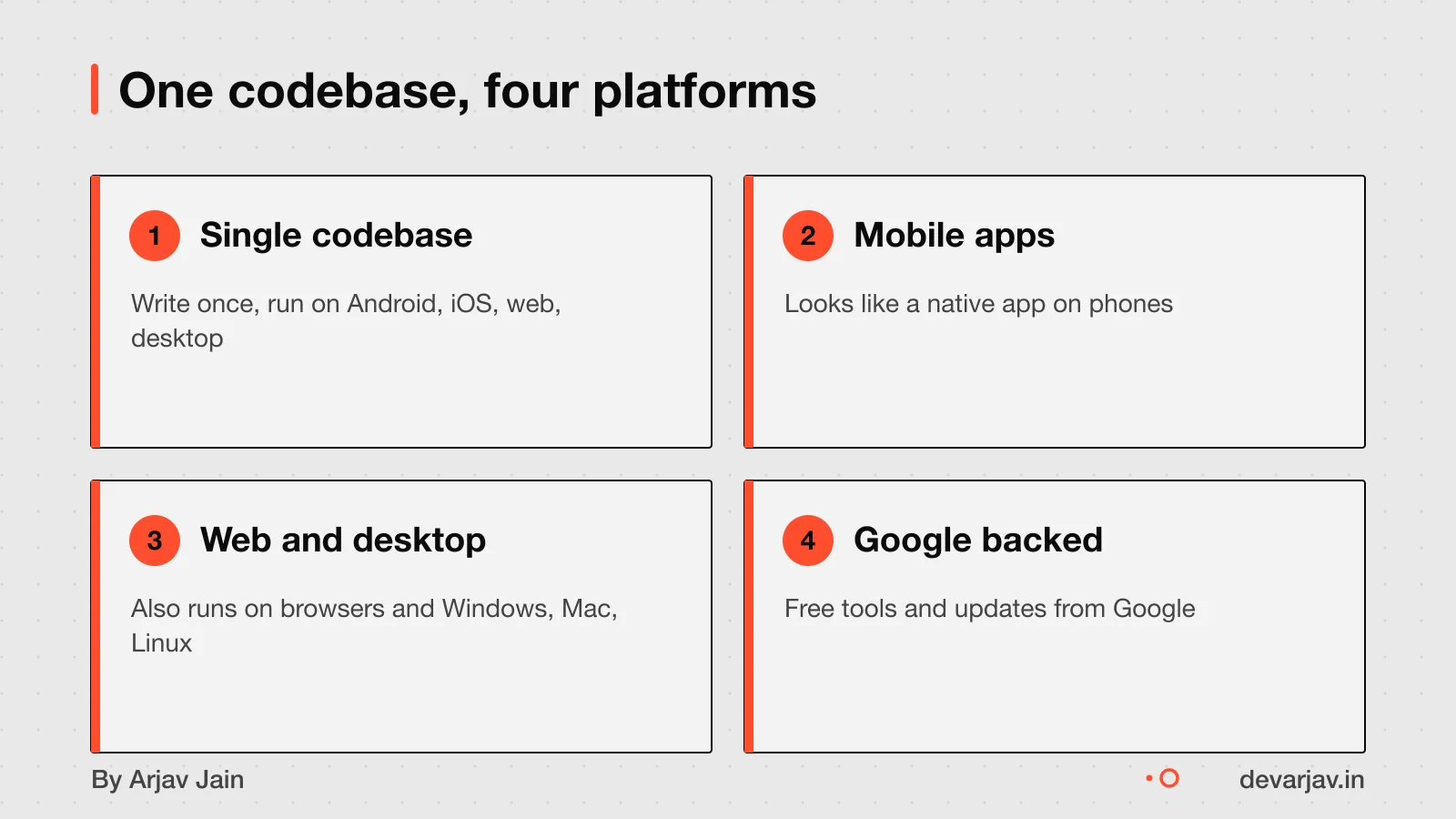
Flutter is a free tool made by Google that builds apps for phones, tablets, computers and the web using one codebase. This means your developer writes the app once, and it works on both Android and iPhone, saving time and cutting cost. It uses a language called Dart, and the app runs fast because the code turns into machine code for each device.
It is different from older methods where you had to build two separate apps for Android and iOS. With Flutter, updates and fixes go live faster. For example, if you run a small shop and want an app to show your products. A Flutter developer can make one app that works for all your customers, no matter their phone.
A feature called Hot Reload lets developers change the app and see results in seconds, without restarting. Flutter now powers 46% of all cross-platform mobile apps in India. So most developers know it, making it easier to find help.
Native or cross-platform: which one for your app?
How much does it cost and what hidden costs to expect?
A Flutter app for a first-time buyer in India costs ₹4 to 12 lakh for an MVP. ₹20 to 65 lakh for a standard app, and up to ₹1.25 crore for a complex one. These costs are for one app that works on both Android and iOS, which saves 30 to 40% compared to building two separate apps. Freelancers charge ₹400 to ₹1,200 per hour, while small agencies charge ₹800 to ₹2,000 per hour.
Extra costs often come later. A standard payment gateway like Razorpay or Paytm adds ₹1.6 to 4 lakh. Deep links to your CRM or ERP system can add ₹8 to 20 lakh. Design work takes 10 to 20% of your total budget. If you hire an agency, add 18% GST to their quoted price. After launch, plan to spend 15 to 20% of the build cost each year on updates, bug fixes and server bills.
For example, a salon booking app with 20 screens, payments and a staff dashboard might cost ₹50 lakh to build. Design takes ₹7.5 lakh (15%). Payments add ₹2.5 lakh. Yearly maintenance will be around ₹7.5 to ₹10 lakh. You can use the full cost breakdown to compare quotes and spot missing items.
Want a number for your idea? Send one line on WhatsApp. I reply with what drives the cost and what to cut.
Message me on WhatsAppHow long does it take to build a first Flutter app?
A first Flutter app takes 4 to 8 weeks for a basic version with 3 to 10 screens. Or 8 to 16 weeks for a full business app with 15 to 30 screens. Flutter speeds up development by 25 to 35 percent compared to native Android and iOS apps because of instant preview tools. This time saving applies only if the scope is clear and you make decisions quickly. Delays happen when features are not defined, feedback takes days, or you change the plan mid-way. For example, a shop owner adding a new order screen after coding starts can add two weeks. The timeline assumes one platform (Android or iOS) at first. Adding the second later takes extra time.
Freelancer, agency or direct hire: which is better?
A freelancer is 30 to 50% cheaper than a small agency for the same app. But a freelancer is a single point of failure. If they vanish, your project stops. An agency has a team, so someone else can take over if needed.
Agencies charge 18% GST, which you can claim back if you are GST-registered. Freelancers often do not charge GST if their turnover is below ₹20 lakh. But a freelancer who gives you a written scope, shares working demos, ties payments to milestones. Puts code in your name is safer than an agency that does none of these.
For a first-time buyer, a freelancer may be cheaper but riskier. An agency offers more cover. Direct hire, like working with me, cuts out the middleman and keeps control with you.
Freelancer or agency for a first app? to see a full breakdown of trade-offs.
What proof should I ask for to verify a developer?
Ask to see a live app they built and shipped on the App Store or Google Play. You can check its status history in App Store Connect to confirm when it was submitted, reviewed, and approved. This proves the app is real and not just a demo. For Android, ask for the Google Play Console link or a signed APK they uploaded.
Request references from past clients to check reliability. A developer who has worked with others should be able to share contactable clients. Call or message one to ask: Did the app launch? Was it on time? Would you hire them again?
Review their past projects. I have shipped Flutter apps like Loopin, a habit tracker with Google Drive sync, Legease. An AI legal-document app, Aashwasan for gig workers, and Wally, a wallpaper app with offline caching. These are real apps, not just code samples. You should ask for something similar, a working app you can test.
Check their GitHub or pub.dev profile. Since Flutter is open source, active developers often contribute to packages or share tools. Look for public repos with clean code, recent updates, and real user downloads. Avoid developers who only show design mockups or videos.
Have a quote in hand? Send it to me and I will mark what is missing.
Message me on WhatsAppWho owns the code and what if the developer leaves?
You must own the code and accounts from day one. If the developer leaves or stops responding, you can still keep your app running and hire someone else. The safest way is to set up a GitHub account in your name and let the developer work under it. Your account owns the code, known as repositories. This means you never lose access. Use a personal account if the app is just for your business. If more people will work on it, create an organisation account, which lets many people collaborate under one roof.
Avoid letting the developer use their own personal GitHub account. If they vanish, you cannot reach the code. Also, do not let them register app store accounts (like Google Play or Apple App Store) under their name. You must own those. Store logins in a secure place you control.
If the developer vanishes, check your GitHub account first. If you have access, hire a new developer to continue. If not, you may need legal help to claim ownership. A written contract that states you own the code helps in such cases. A freelancer who agrees to hand over source code and use your accounts is safer than one who does not.
For full control, especially if your app works offline or stores user data, consider hiring a developer who follows strict ownership rules from the start.
Hire a developer for an offline-first app if you need full ownership and control.
Not sure if your project has this risk? Tell me the plan in two lines and I will say yes or no.
Message me on WhatsApp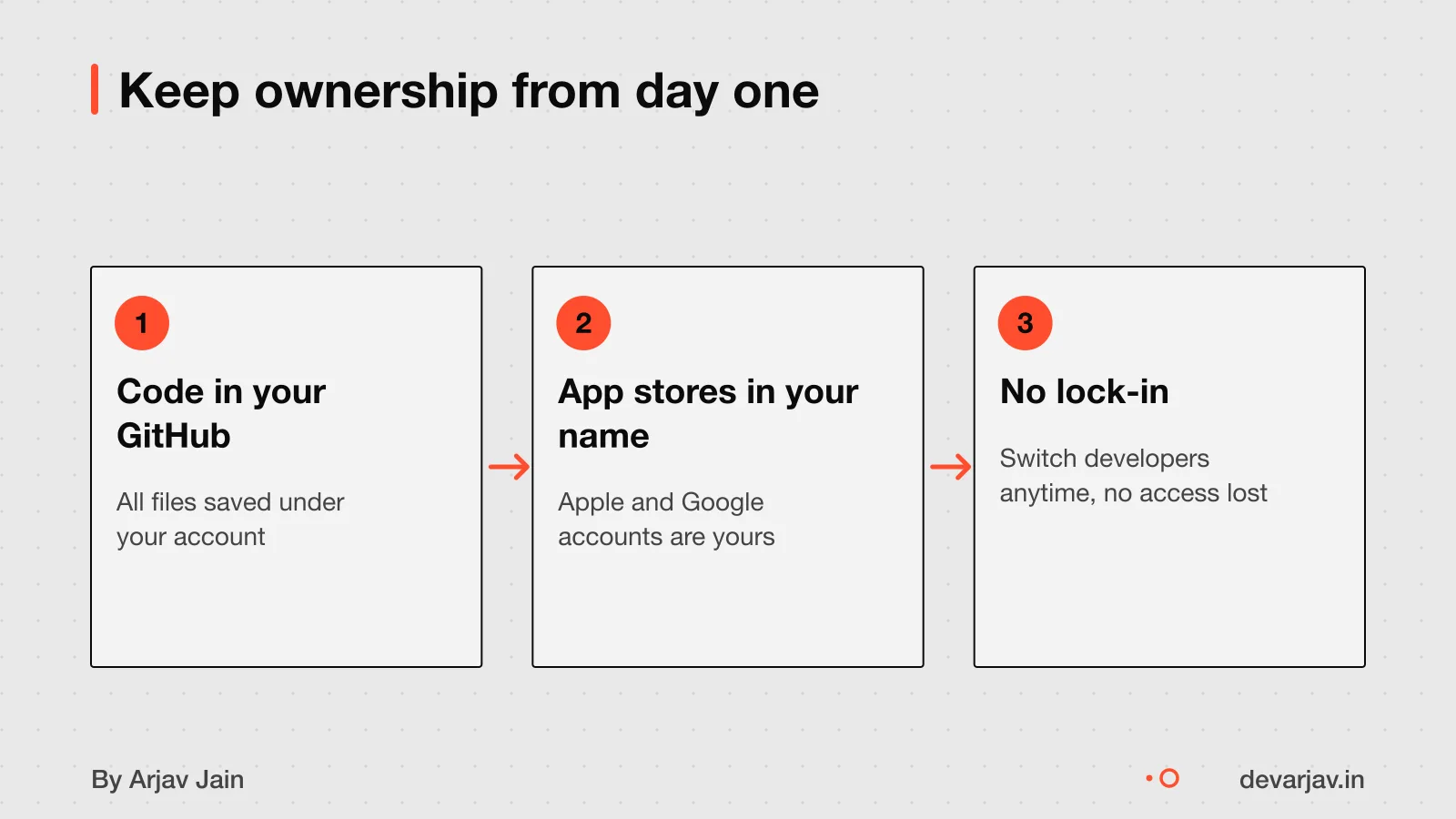
What process should you follow and how to pay?
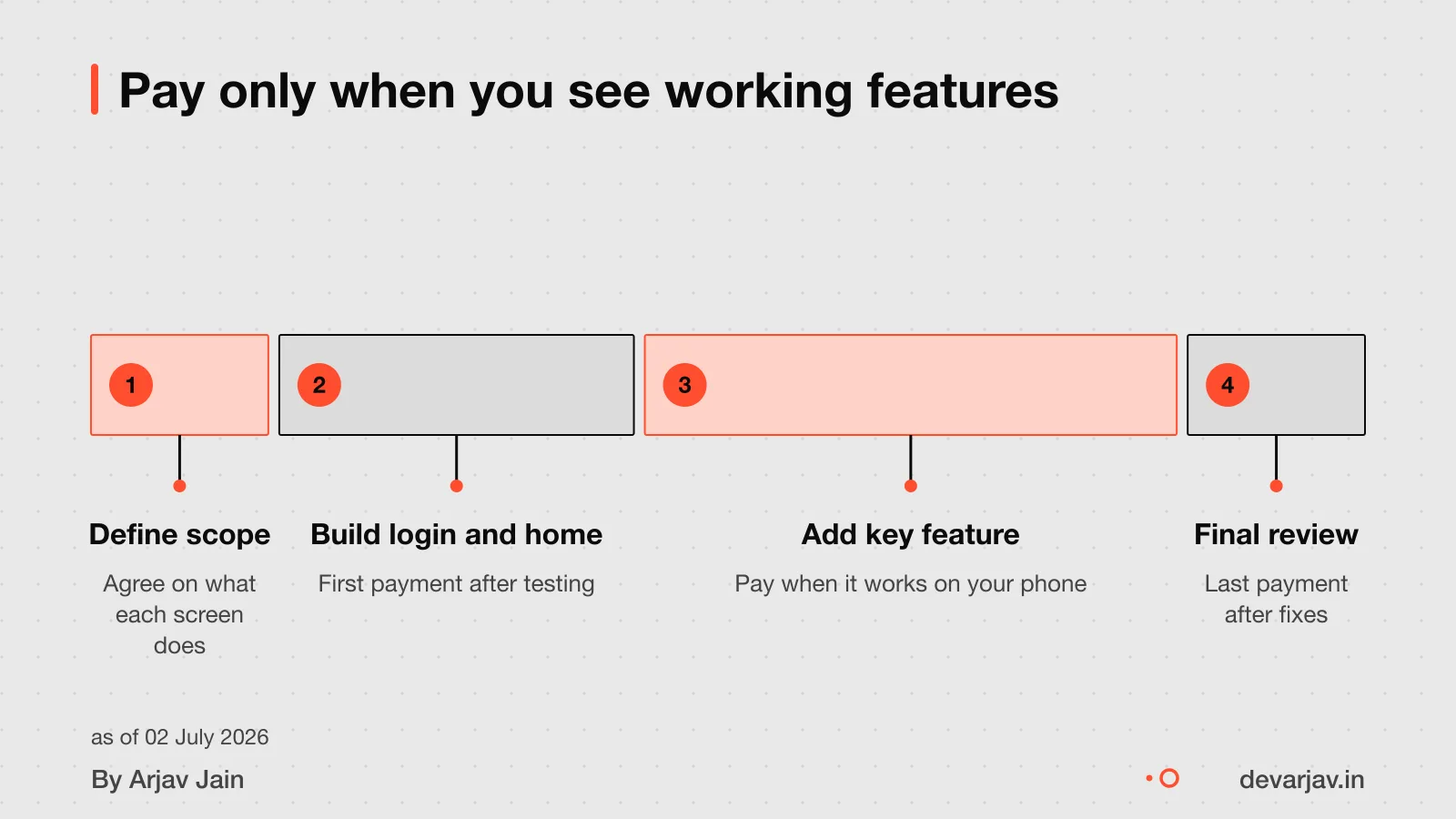
Use milestone-based payments with testable outcomes. This gives you budget control and proof of progress at each step. A fixed price offers budget certainty, which helps when your app’s goals are clear and the scope is limited. Hourly billing pays only for time worked, offering flexibility, but it can lead to cost overruns if the project drags.
Milestones are safest for first-time buyers. Each payment should tie to a working feature you can test. For example, a milestone could be: “User can book a slot and get an SMS confirmation.” You check it works before paying.
A written scope with inclusions and exclusions, fixed price, and milestones is a sign of a professional setup. Avoid deals based only on chat messages. Insist on a clear contract that defines each milestone and what “done” means.
When this advice is wrong
- If you are building a government or regulated app, such as for health or finance, you may need a developer with specific compliance experience. Flutter itself does not block this, but your project will need extra checks, audits and documentation that a generalist may not provide.
- If you already have a tech team, you do not need to hire externally. Your team can evaluate Flutter on its own. This advice is meant for those without in-house skills who must rely on freelancers or agencies.
Next step: message me on WhatsApp with what you want to build. No forms, no sales team.
Message me on WhatsAppYour checklist
Before the first call, here is what to check, in the order it hurts to skip. Tick what you have verified; the page tells you where you stand.
Proof
Process
Ownership
Money
Walk away if
- Quotes only a total with no scope
- Won't say who writes the code
- Asks for the whole payment up front
- Keeps the store accounts or repository
- Promises a fixed date without seeing a scope
Questions people ask
What should I check before paying a Flutter developer?
Check that the developer agrees to a written scope, source-code ownership, working demos, and payment in milestones. This protects you if the project stalls or fails. A freelancer who agrees to these is safer than an agency that does not.
Can one developer build my whole app?
Yes, one Flutter developer can build a small app with basic features and no complex backend. A single developer may lack the skills or time for complex parts.
How do I know if a Flutter developer is good?
Ask to see apps they have shipped and check if those apps are live on the App Store or Google Play. Review their past projects and ask for references from past clients. This shows real experience and reliability.
What questions should I ask before hiring a Flutter developer?
Ask if they have built and shipped apps like yours, for a written scope, for milestone-based payments, and who will own the source code. Also ask about support after launch. For help comparing options, see Native or cross-platform: which one for your app?.
Is Flutter better than native for my first app?
Flutter costs 30 to 40% less and is 25 to 35% faster to build than native apps for Android and iOS. This makes it better for saving time and money. Performance differences are not proven for most small apps.
What if the developer asks for full payment upfront?
This is a red flag. Insist on paying in milestones tied to clear deliverables. Fixed rates with milestones make progress easier to track. A written contract with deliverables is safer than a chat thread.
How do I transfer an app to a new developer?
Hand over the source code, access to app store accounts, and all project documents. The app should be in a shared GitHub organisation account. Make sure the new developer can access and build the app.
Do I need to pay GST when hiring a developer?
Yes, if you hire an agency, they charge 18% GST, which you can reclaim if you are GST-registered. Freelancers below ₹20 lakh turnover do not charge GST. Check this for your case with a chartered accountant.