What is a bike taxi app and how is it different?
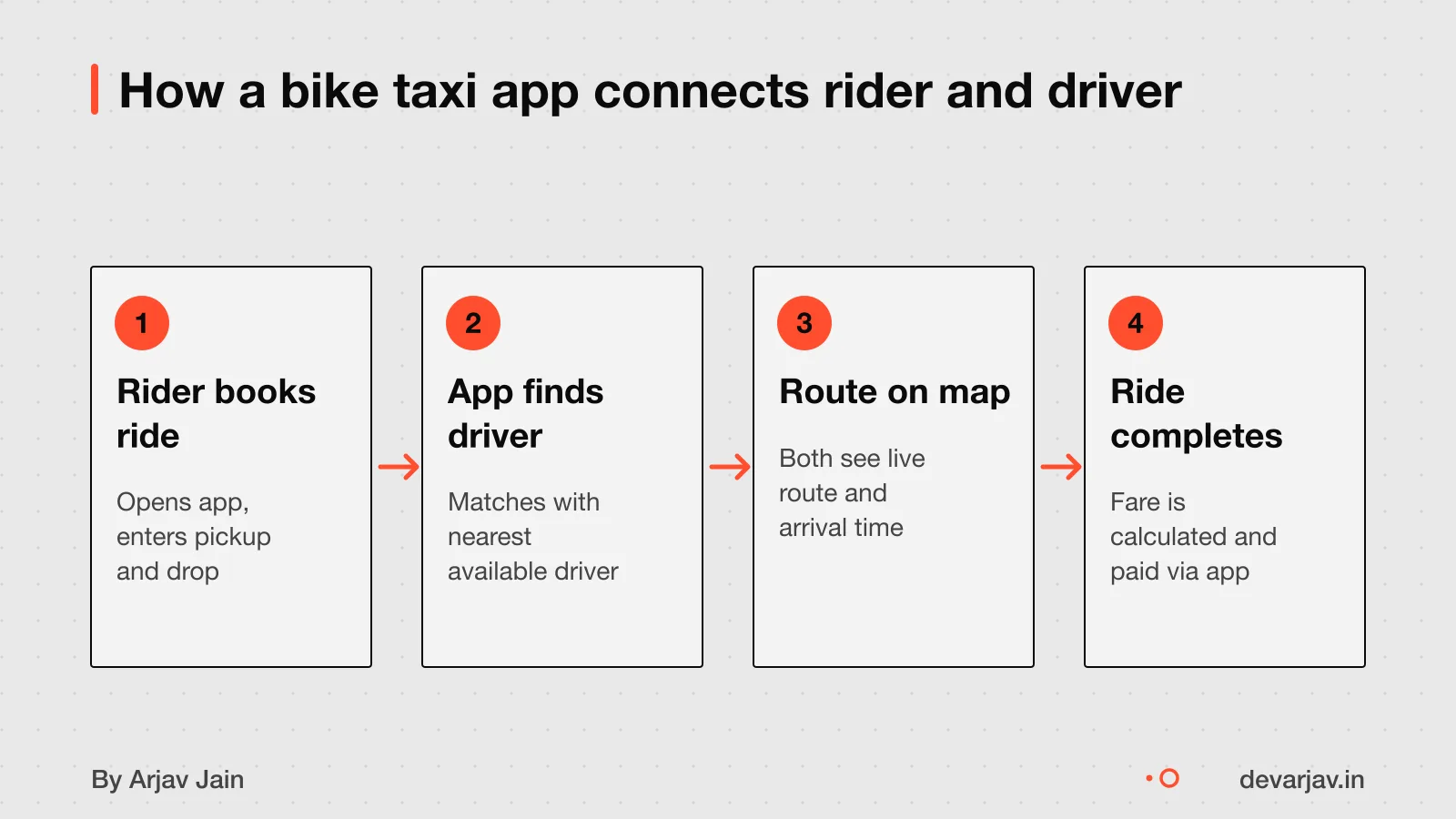
A bike taxi app lets riders book a ride on a motorbike through their phone, just like a cab app but with two-wheelers. It uses private bikes, not commercial ones, so drivers can sign up with their own motorcycles. This is now allowed under new national rules. For example, a rider in Indore can book a quick ride from the railway station to the market using the app.
But your state must approve bike taxis before you can launch. Some states allow them with conditions, while others have banned them outright. This means the same app may work in Indore but not in another city. The law treats bike taxis differently from regular cabs because of safety and traffic concerns.
Knowing your state’s stance is the first step before spending on development. What features does a bike taxi app need?
Build custom or use a white-label app?
A white-label bike taxi app costs $5,000 to $20,000 upfront. Customising it often costs 2 to 3 times more than building from scratch. Many teams spend this extra amount only to abandon the clone later. This happens because clone scripts are built for generic use. They need heavy changes to fit local rules, branding or safety features. For example, adding regional language support can take more time than coding it fresh. Integrating with a state-specific driver verification API can also take more time. If you plan to add unique pricing logic, safety alerts or offline features, a custom build gives better control. It also lowers long-term cost. White-label apps may work only if you need a basic version fast. You must not plan to change much.
Build or buy a bike taxi app: custom, white-label or platform?
What features add the most cost?
Real-time tracking and surge pricing add the most cost to a bike taxi app. You must have booking, driver matching, and fare calculation. Panic buttons are not required by law [unknown]. Real-time tracking uses live data to show bike location, which needs tools like Socket.io. This raises cost due to constant server load. Surge pricing adjusts fares in high demand. It adds ₹11 to ₹18.5 lakh to the base cost, based on a $15,000 to $25,000 adder as of 2026-10-12. Dynamic fare rules also need testing and audit logs.
You can skip advanced features at launch. Examples include ride-sharing, multi-language support, or loyalty programs. Focus on one city and simple pricing. Add surge pricing only after you have steady rides and drivers. Use a basic admin panel to start.
| Feature | Type | Cost Impact | Notes |
|---|---|---|---|
| Booking and payment | Core | High (must-have) | Needed for any service |
| Real-time tracking | Core | High | Uses live sockets; raises server cost |
| Surge pricing | Optional | ₹11 to 18.5 lakh extra | Adds logic, alerts, and history |
| Ride-sharing | Optional | Medium | Complex matching; delay until scale |
| Panic button | Optional | Low | Not required by law; improves trust |
| Helmet detection | Unknown | Unknown | Not mentioned in any rule [unknown] |
Want a number for your idea? Send one line on WhatsApp. I reply with what drives the cost and what to cut.
Message me on WhatsApp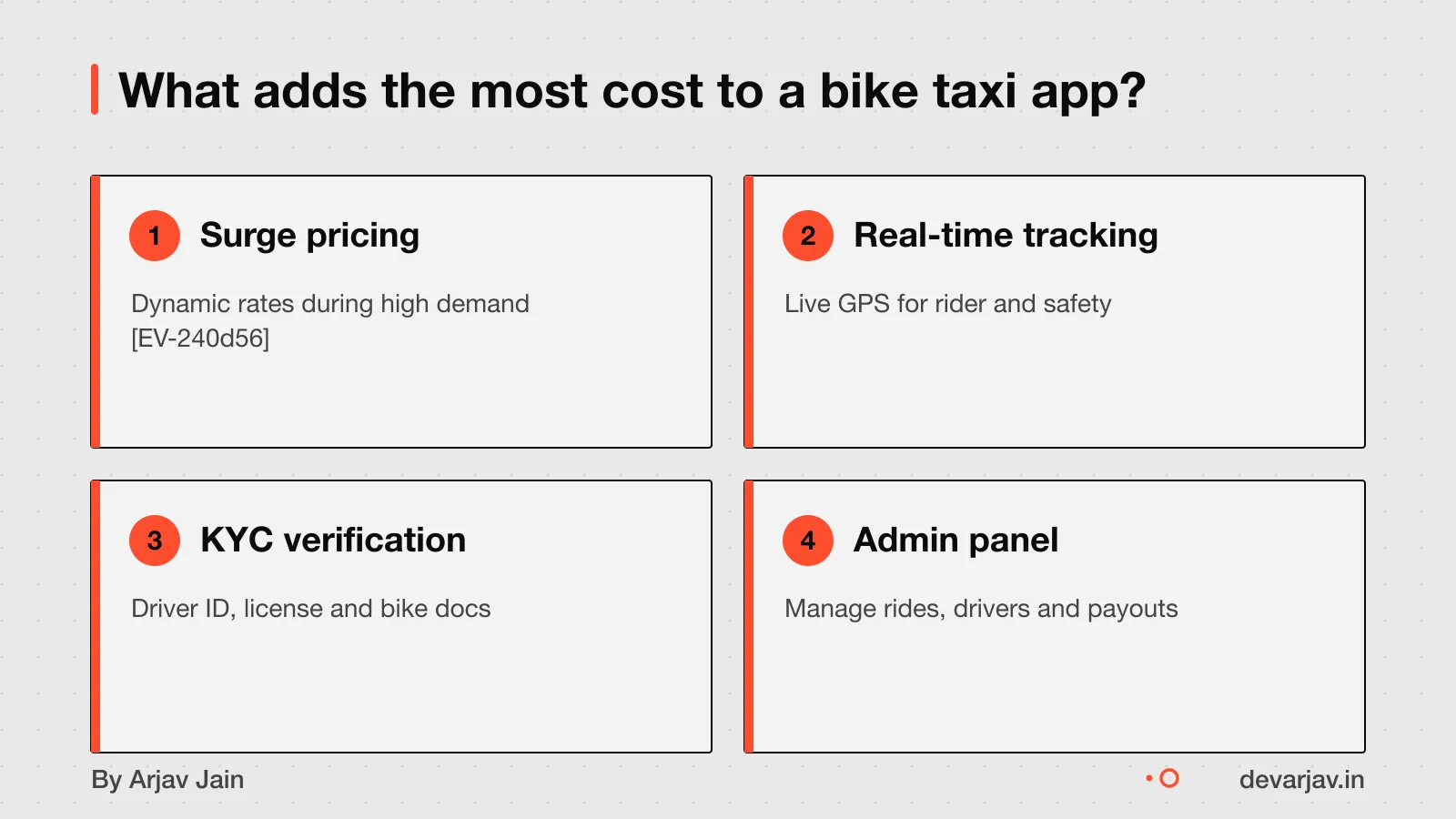
How much does driver onboarding cost?
Driver onboarding costs depend on document checks, training, and insurance. You must verify each driver’s KYC, including Aadhaar, driving licence, and police verification. These checks ensure only safe and verified drivers join your service. All drivers must complete a 40-hour induction training programme. Training takes five full days and helps drivers handle rides safely and professionally.
You must also provide health insurance of at least ₹5 lakh and term insurance of ₹10 lakh per driver. This is a legal requirement, not optional. While the exact cost per driver depends on your insurer, the minimum cover is fixed. Fast onboarding matters because more drivers mean more rides and faster service in your city. Delays in training or verification can slow your launch and reduce early income. A smooth, fast process keeps drivers engaged and ready to work.
How much does real-time pricing add to the cost?
Real-time pricing, also called surge pricing, raises your fare when demand is high.
State rules limit how high surge prices can go. As of 2025-07-02, the Motor Vehicle Aggregator Guidelines allow up to 2x the base fare during peak hours. But as of 2026-07-16, Maharashtra’s rules say surge can go only up to 1.5x the base fare. Sources differ: CNBCTV18 says up to 2x base fare as of 2025-07-02, Economic Times says up to 1.5x as of 2026-07-16. You must check your state’s latest rule before setting your cap.
For example, if your base fare is ₹50 and demand spikes. You can charge up to ₹75 in Maharashtra but up to ₹100 under central guidelines. This affects how much extra money you can make during rush hours. Your app must follow the stricter local rule where you operate.
What safety features are required by law?
Your app must include vehicle tracking and passenger insurance by law. Vehicles must have a Vehicle Location and Tracking Device (VLTD) linked to both your system and the state command centre. You must also ensure passenger insurance of at least ₹5 lakh per ride. Drivers need medical fitness and psychological assessments, including an eye check-up, before they can join.
Helmet detection is not mentioned in any rule. A panic button linked to 112 is also not required by law. These features may improve safety but are not mandatory. Always check with your state transport department for local rules, as enforcement can vary.
For data privacy, your app must follow consent rules under India’s DPDP Act. This means clear permission for location and personal data use.
Not sure if your project has this risk? Tell me the plan in two lines and I will say yes or no.
Message me on WhatsApp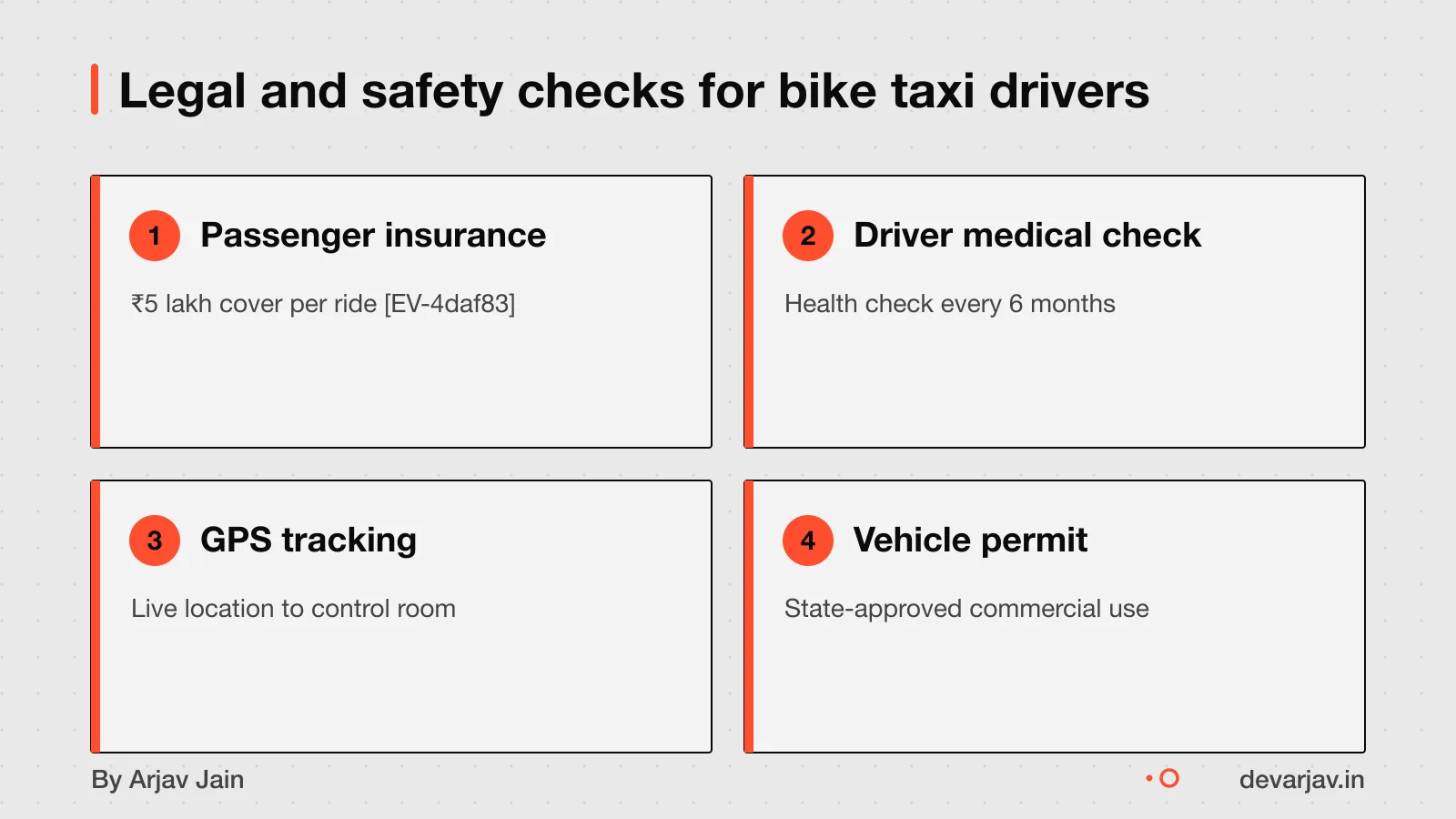
What third-party services will my app need?
Your app needs maps, payments, and SMS services to work. Google’s Navigation Connect API gives live locations, ETAs, and trip status updates. For payments, you must use a third-party app provider (TPAP) like Razorpay that supports UPI. You need approval from the National Payments Corporation of India (NPCI) to act as a TPAP. This means showing NPCI that your system can handle UPI securely and store data in India.
These services cost money every month. At scale, budget ₹15,000 to ₹50,000 per month for API use, transaction fees, and SMS packs. Costs go up with more rides and users. You also save time by not building these from scratch. Razorpay can link to tools like Zoho Books and Zoho Invoice for billing and records.
As an estimate, assuming 10,000 monthly rides and 30% UPI share, the main cost drivers are [assumption: 10,000 monthly rides, 30% UPI share]. - Google Maps APIs: ₹5,000 to ₹15,000 - UPI processing (via TPAP): ₹8,000 to ₹30,000 - SMS and OTP: ₹2,000 to ₹5,000
You cannot skip NPCI approval if you process UPI directly. If you use a partner gateway, they handle compliance but charge more. Check How to integrate Razorpay in a Flutter or Next.js app for technical steps.
How much GST applies to app development?
App development is taxed at 18% GST under Indian tax law. This tax applies to the entire software build, whether you use a freelancer or agency. However, this 18% cannot be reduced by input credit unless your business is registered and the developer gives you a proper GST invoice.
Ride fares are taxed at 5% GST if your app collects payments from riders. This means you must collect and deposit the tax to the government. If your app only connects riders and drivers but does not take payments or set fares, then 5% GST does not apply to rides. The West Bengal Authority of Advance Ruling confirmed that such platforms are not e-commerce operators and do not owe GST on fares.
You can claim input credit for the 18% GST paid on app development only. If your business is GST-registered and you use the app for further taxable supplies. Keep all invoices and consult a CA to confirm your eligibility.
Are bike taxi apps legal in my state?
Bike taxi apps are legal in some states but banned in others, so you must check your state’s transport department rules before starting. For example, Pune does not allow bike taxis as of 2026. You can check your state’s rules by visiting your Regional Transport Office (RTO) website or calling their office directly.
Penalties for breaking these rules can be severe. The Maharashtra Motor Vehicle Aggregator Rules 2026 set fines from ₹1 lakh to ₹1 crore, depending on the violation. These rules may influence other states, so even if your state allows bike taxis now, the rules could change. Always confirm the current status with your local transport authority before investing in app development.
Should I hire a freelancer, agency or in-house team?
Hiring a freelancer, agency, or in-house team depends on your budget, timeline, and how much control you want. Freelancers cost less upfront but need close oversight, and delays are common if they handle multiple clients. Agencies charge more, but deliver faster with tested workflows and backup developers. An in-house team gives you full control and faster updates, but salaries add up quickly.
Freelancers may cut corners without daily checks, and you risk losing progress if they disappear. Agencies reduce that risk with contracts and project managers, but some outsource work without telling you. In-house teams work only on your app, so fixes and updates are faster, but you must manage payroll, tools, and office space.
Starting with a trusted agency may be safer for some small businesses. If you have ongoing updates and want tighter control, build an in-house team after launch. A hybrid model, core team in-house, extra work with a known agency, also works well.
As of now, there is no public data on success rates or failure risks for each hiring model in bike taxi apps. To check which fits, ask: Can I manage a freelancer daily? Do I need the app live in under six months? Can I afford ₹30 lakh a year for staff? Answering these will guide your choice.
How do I verify a developer’s quote?
Check the feature list, third-party costs, team size, and delivery time. A clear quote breaks down each feature and its cost. If it does not, ask for a line-by-line list. Compare this list with your must-have features. Skip any quote that bundles vague items like “admin panel” or “user management” without detail.
Confirm the cost of third-party services. Your app needs maps, payments, and messaging. These use APIs like Google Maps or Razorpay. Ask the developer to show the monthly cost for each. A sudden jump in users can spike these bills. A honest quote includes buffer for that.
Team size and timeline affect cost. A small team may take longer, raising the total price. A large team finishes faster but charges more per month. Ask how many people will work on your app and for how long. A 6-month project with 4 developers at ₹1.5 lakh per month is ₹36 lakh in labour alone.
Ask to see proof of past work. If they built a ride app before, ask for a demo or user count. Do not trust names or logos without proof. A developer who hides past projects may not have real experience.
What we don’t know
Whether helmet detection is legally required is not specified in any available rules or evidence. You may check with your state transport department or a transport lawyer to confirm if it applies in your city.
If a panic button linked to 112 is mandatory is also not stated in the rules we have. Some cities may require it, but there is no published national or state-level rule confirming this as of now.
What documents are needed to launch legally is not fully listed in any public guideline. Each state may have different requirements for permits, insurance, and operator registration. Contact your local transport authority for a complete checklist.
Who owns the app code after development is not specified in standard contracts or laws. This must be clearly written in your agreement with the developer. Always ask for full ownership and source code handover before paying the final amount.
How much maintenance costs after launch is not published by any government or industry body. These costs depend on updates, server bills, and support staff. As an estimate, assuming 10% of the build cost per year, it could be ₹1.85 lakh or more. But this is not confirmed. Check with your developer for a detailed plan.
When is a bike taxi app not worth it?
- If your state bans bike taxi services, launching an app is not worth it. Some states allow them only under specific conditions, while others have imposed restrictions or outright bans. Check your state transport department’s latest rules before investing.
- If you cannot afford mandatory driver insurance, the app may not be viable. Aggregators must provide each driver with health insurance of at least ₹5 lakh and term insurance of ₹10 lakh as of 2025-07-02. This adds at least ₹15 lakh per 100 drivers to your annual cost.
- If you cannot onboard drivers at scale with full KYC, police verification, and training, the service will struggle. Each driver must be verified, insured, and trained on safety and service rules, a slow or flawed process breaks trust and compliance.
- If your city has no demand during non-peak hours, the business model may fail. Bike taxis rely on high ride volume to justify costs. Low or uneven demand makes it hard to cover insurance, maintenance, and tech upkeep.
Related reading: DPDP Act: consent flows an Indian app actually needs.
Next step: message me on WhatsApp with what you want to build. No forms, no sales team.
Message me on WhatsAppAssumptions behind the numbers
- Assumes 40 screens, one payment gateway, no AI features.
- Assumes ₹15k–₹50k/month for cloud, SMS, maps and payments.
- Assumes 3 developers, 1 designer over 23 weeks total.
Work out your own number
I won't hand you a number that pretends to be the market. Instead, here is the working: set the weeks, the people and the rate, and see where the money goes.
Your working total
₹9,20,00023 weeks × 2 people × 5 days × ₹4,000- Needs and planning13%
- Design17%
- Implementation70%
The weeks shown are an example of a small app, there to be changed. Fees you pay others (store accounts, cloud, SMS) are not in this total.
What moves the price
- Add surge pricing
Adds logic for dynamic pricing during demand spikes.
- Add driver onboarding
Includes KYC, document upload and OTP verification.
- More user roles
Each role (admin, rider, driver) adds design and testing time.
- Real-time features
Live tracking and notifications require more backend work.
- Multiple integrations
Maps, SMS, UPI and payments each add complexity.
- Cut to one platform
Start with Android or iOS only to halve the work.
- Use managed services
Pre-built auth and push systems reduce weeks.
- Lock scope early
Avoid changes once build starts to save cost.
Fees that go to someone else
Cloud, SMS, maps, payments
Usage-based, billed monthly by the provider.
Google Play or App Store
One-time and annual fees for listings.
Legal and compliance checks
State-specific rules may need lawyer time.
Ask for these before you sign
- How many weeks per phase, and with how many people?
- What is not included?
- Which fees do I pay to others directly?
- What happens to the price when I change my mind?
- What does the first month after launch cost?
Questions people ask
What is the minimum cost to build a bike taxi app in India?
As an estimate, the lowest cost to build a single-city ride-sharing MVP is $35,000 to $70,000. This assumes basic features and a skilled team. Costs rise with real-time tracking, custom design, or multi-city support. For your idea, get a tailored quote from a developer.
How long does it take to build a bike taxi app from scratch?
A bike taxi MVP takes 12 to 18 weeks to build with a team of 4 to 6 developers. This timeline assumes clear requirements and no major changes mid-project. Delays happen if testing, approvals, or integrations take longer. Speed depends on team size and feature scope.
What are the must-have features for a V1 bike taxi app?
Your first version must have ride booking with fare estimates, driver matching, real-time GPS tracking, secure payments, two-way ratings, and an admin panel. These six features form the core. Add more only after testing this base. See what features are essential versus optional.
Is a white-label script cheaper than a custom-built app?
No, a white-label script is not cheaper in practice. While it costs ₹4 lakh to ₹16 lakh upfront, customising it often takes 2 to 3 times more effort than building fresh. Teams usually abandon clones after overspending. Build custom for long-term savings.
What ongoing costs should I expect after launch?
Monthly third-party costs for maps, payments, SMS, and hosting range from $15,000 to $50,000 at scale. This does not include app updates, support, or team salaries. These fees grow with ridership. Budget for at least ₹1.5 lakh per month from day one.
How do I handle payments between riders and drivers?
The rider pays the app, and the platform settles the amount to the driver after deducting its commission. The platform supports adding UPI and processing payments for completed rides. Set up a payment gateway like Razorpay to automate this flow. This ensures trust and timely payouts.
What insurance do I need for a bike taxi service?
You must provide passenger insurance of at least ₹5 lakh, driver health insurance of at least ₹5 lakh, and term insurance of ₹10 lakh. Also, ensure third-party commercial insurance for all on-boarded vehicles. These are mandated by state rules. Check this for your case with an insurance broker.
How does the Motor Vehicle Aggregator Guidelines, 2025 affect my app?
The guidelines require aggregators to provide a facility for riders to select air-conditioned or non-air-conditioned rides and ensure the service matches the selection. State rules override central ones, so check your local transport department. Some cities may ban bike taxis outright. Check this for your case with a transport lawyer.
What data privacy rules apply under the DPDP Act, 2025?
You must get user consent before collecting data, protect personal data with security measures, notify users of breaches, and allow data deletion. These rules apply from 18 February 2025. Non-compliance risks penalties. Check this for your case with a data protection officer.
Can I start with a simpler version and add features later?
Yes, you can phase features, but core functions like booking, tracking, and payments must work fully at launch. Half-built systems lose trust fast. Start with a minimal set, test it, then add more. Use feedback to guide what comes next.