What is a quick commerce app?
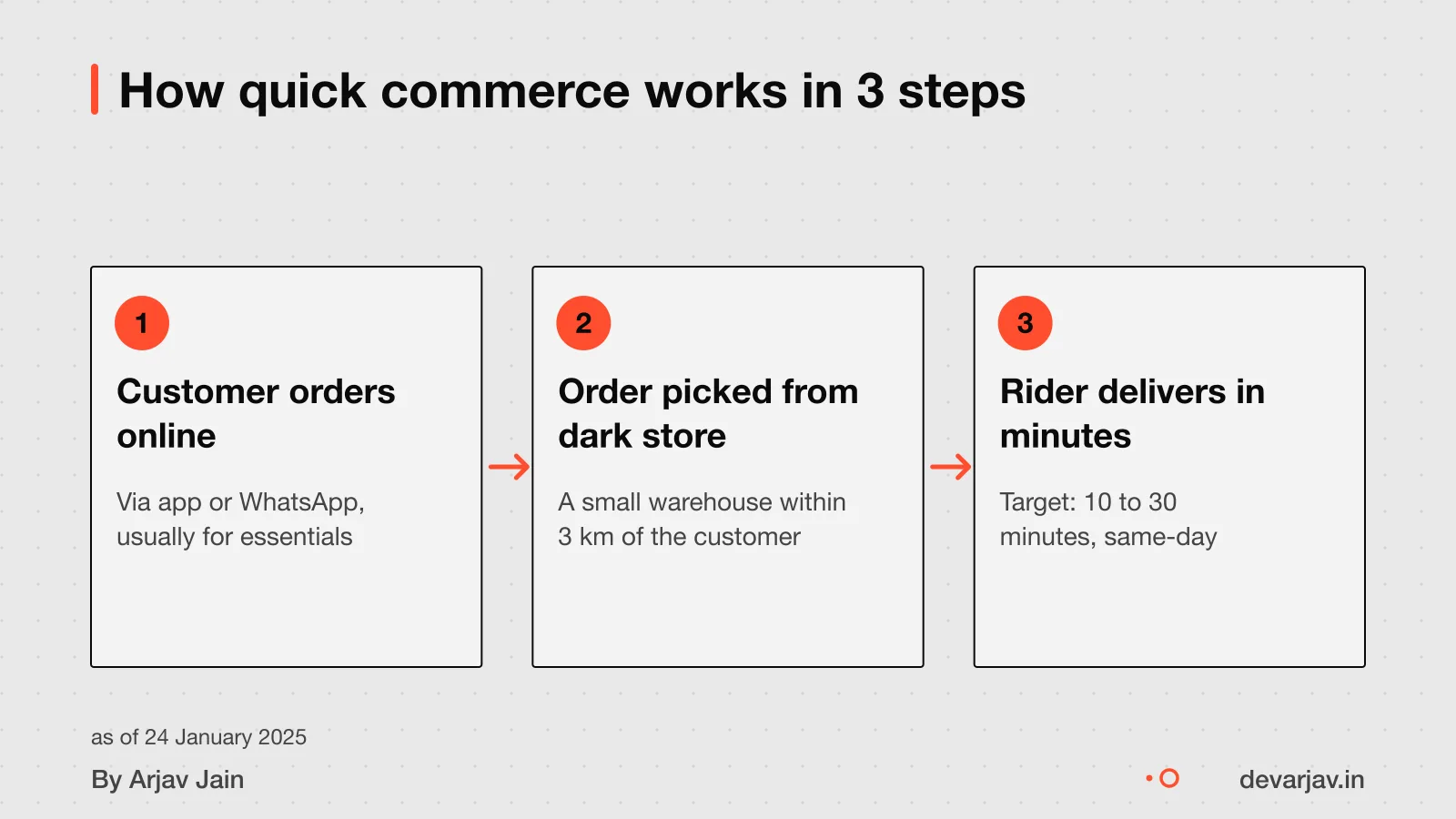
A quick commerce app delivers daily-use items like groceries, medicines and personal care products in 10 to 30 minutes. This is much faster than regular delivery, which can take hours or days. Speed is the main difference, not the product range.
These apps use small warehouses called dark stores that serve only online orders. No customers enter them. They are placed within 3 km of users, like a local kirana store with 2,000 items ready to go.
Deliveries aim for 10 to 30 minutes. Some, like Zepto, promise 10-minute delivery as a key advantage. They carry 1,500 to 4,000 SKUs, not everything, just what people need right now. This limited stock helps them deliver fast.
Should you build an app at all?
You do not need an app to start. Use WhatsApp or a website first to test demand. An app makes sense only when you have steady orders and want to scale fast.
Many small businesses begin with WhatsApp orders. You can list products, take orders, and share updates without any tech cost. A simple website works too. Both let you learn what customers want.
Build an app when you outgrow manual order tracking. For example, Swiggy Instamart scaled quickly because it used Swiggy’s existing delivery network. You need that kind of scale to justify an app.
Test demand by talking to 20 to 50 potential customers in your town. Ask what they buy, how often, and how they prefer to order. This step comes before any app or website.
Start by validating your idea. Do not spend on an app until you see real demand.
Build or buy a WhatsApp commerce app
Cost: custom vs white-label vs platform
A custom app for a single-city MVP costs $25,000 to $45,000. While a white-label solution starts at ₹1 to 5 lakh setup and monthly costs range from ₹10,000 to 1.5 lakh. You need this if you are comparing long-term ownership versus speed to market. A single-city MVP includes a customer app, rider app, basic admin panel, one payment gateway, and live tracking.
Monthly fees for white-label apps include the vendor’s license, app store accounts, and service charges. These run from ₹10,000 to ₹1.5 lakh, depending on order volume and features. Hidden costs include data migration and vendor lock-in. Switching vendors later may cost $20,000 to $40,000 and take 2 to 3 months of running both systems.
Maintenance for a white-label source code license costs 15 to 20% of the license fee each year. This covers updates, security patches, and minor fixes. The maintenance cost of a custom app in India is not published. [unknown]
Want a number for your idea? Send one line on WhatsApp. I reply with what drives the cost and what to cut.
Message me on WhatsAppHow long to launch each option?
A custom app takes 8 to 16 weeks to launch. A white-label app can go live in 2 to 4 weeks. The main delay for custom apps is building each feature from scratch. For white-label, delays come from how fast you provide your logo, menu, and delivery zones. Custom apps also need more testing before launch. White-label apps cut time by using pre-built screens and payment links.
Some sources say a custom MVP in India may take 12 to 20 weeks, especially for complex or regulated apps. This range is longer but overlaps with the 8 to 16 week estimate. The faster end likely applies to simpler apps with a clear scope.
For a full breakdown of each step, see the Full timeline to build a quick commerce app.
When is a custom app worth it?
This gives you full control over features, data and branding. Choose custom if you need unique tools like AI routing or multi-warehouse sync that off-the-shelf apps do not offer. For example, a multi-city quick commerce platform with AI routing and ERP integration costs $120,000 to $250,000+. It makes financial sense when your growth justifies this cost and you want to avoid monthly fees from white-label vendors. Custom apps are not for fast launches, they take longer than white-label options, which can go live in 2 to 4 weeks. You should choose custom over white-label only when long-term ownership, control and scalability matter more than speed and low upfront cost.
When is a platform the better choice?
A platform is better if you want to test demand fast and cheap. You can set up a store using built-in tools for layout, colours, fonts and basic functions without writing code. This lets you start in days, not weeks. You should avoid platforms if you plan to scale or build a brand, because they limit design and features. The main limits are no custom branding, restricted integrations and shared customer data. You cannot add unique features like loyalty programs or offline sync. Platforms work for trial runs but not for long-term growth. Use them only to check if customers want your service.
Build or buy a WhatsApp commerce app if you want a low-cost way to test demand without an app.
Risks of white-label apps: what vendors don’t say
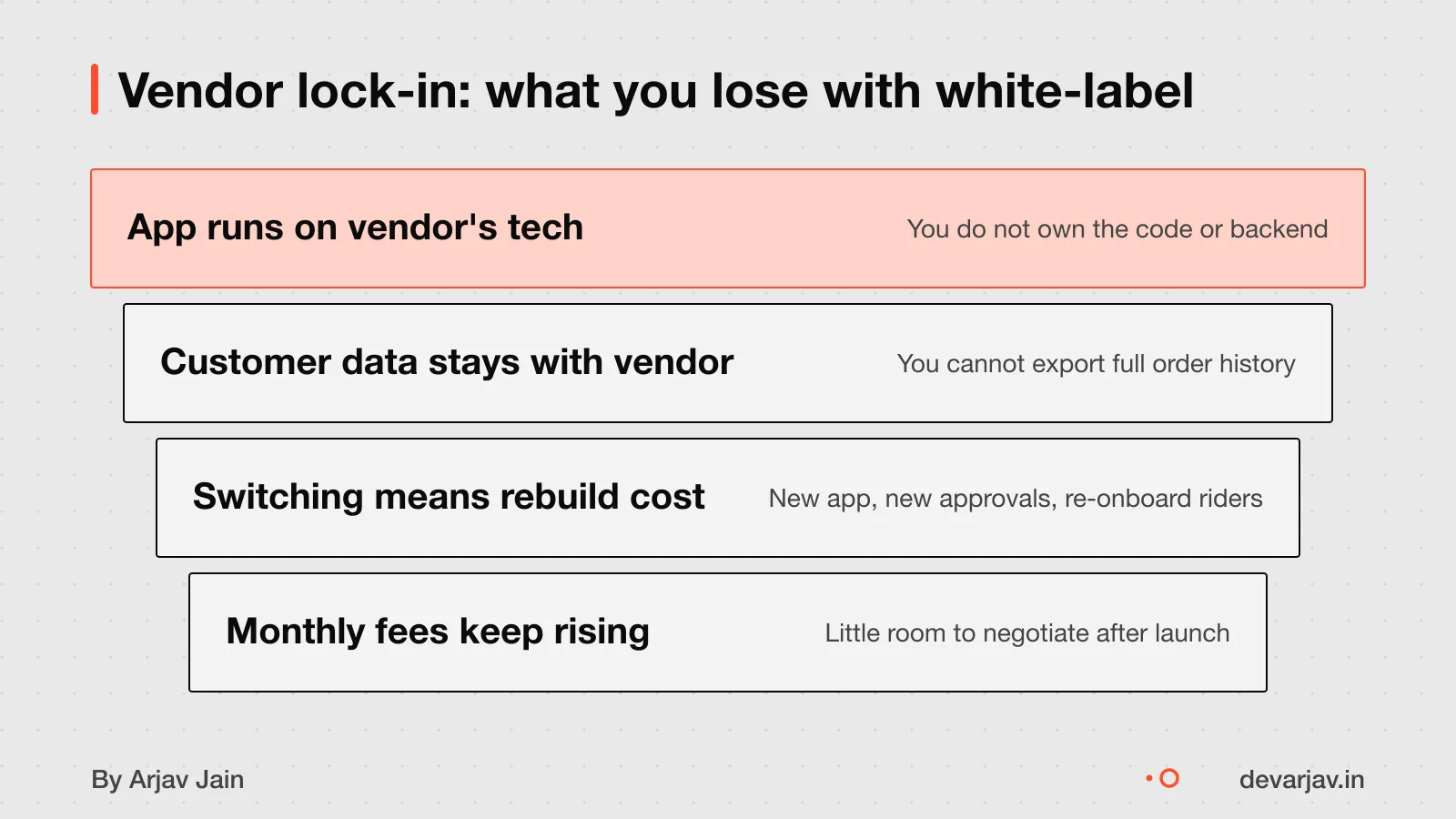
Vendor lock-in means you depend on one provider for updates, fixes and hosting. If they raise prices or shut down, you may not be able to move your app easily. This is common with white-label solutions.
App stores like Google Play and Apple’s App Store can reject your app if it looks too similar to others. A white-label app with just a new logo or colour scheme may be seen as a copy. You need real differences in features or design to get approved.
Performance can slow down when you grow beyond 50,000 to 100,000 users. Since many businesses share the same code and servers, heavy usage by one can affect others. This limit matters if you plan to scale fast.
To avoid these risks, check how much you can customise the app and ask for proof of other live apps on the same platform. Also, read the contract for exit terms and data access.
How to choose a reliable white-label vendor
Who owns the app and customer data?
You do not automatically own the app or customer data just because you paid for it. The developer who writes the code is the first legal owner of the copyright under Indian law. This means you could pay for the app but not have the right to change, copy or even use the code without permission.
To gain full control, you must get ownership in writing before work starts. Ask for a clear agreement that includes three things: you own the source code and copyright after payment, all accounts. Services will be in your name or transferred to you, and final handover is the last step before full payment.
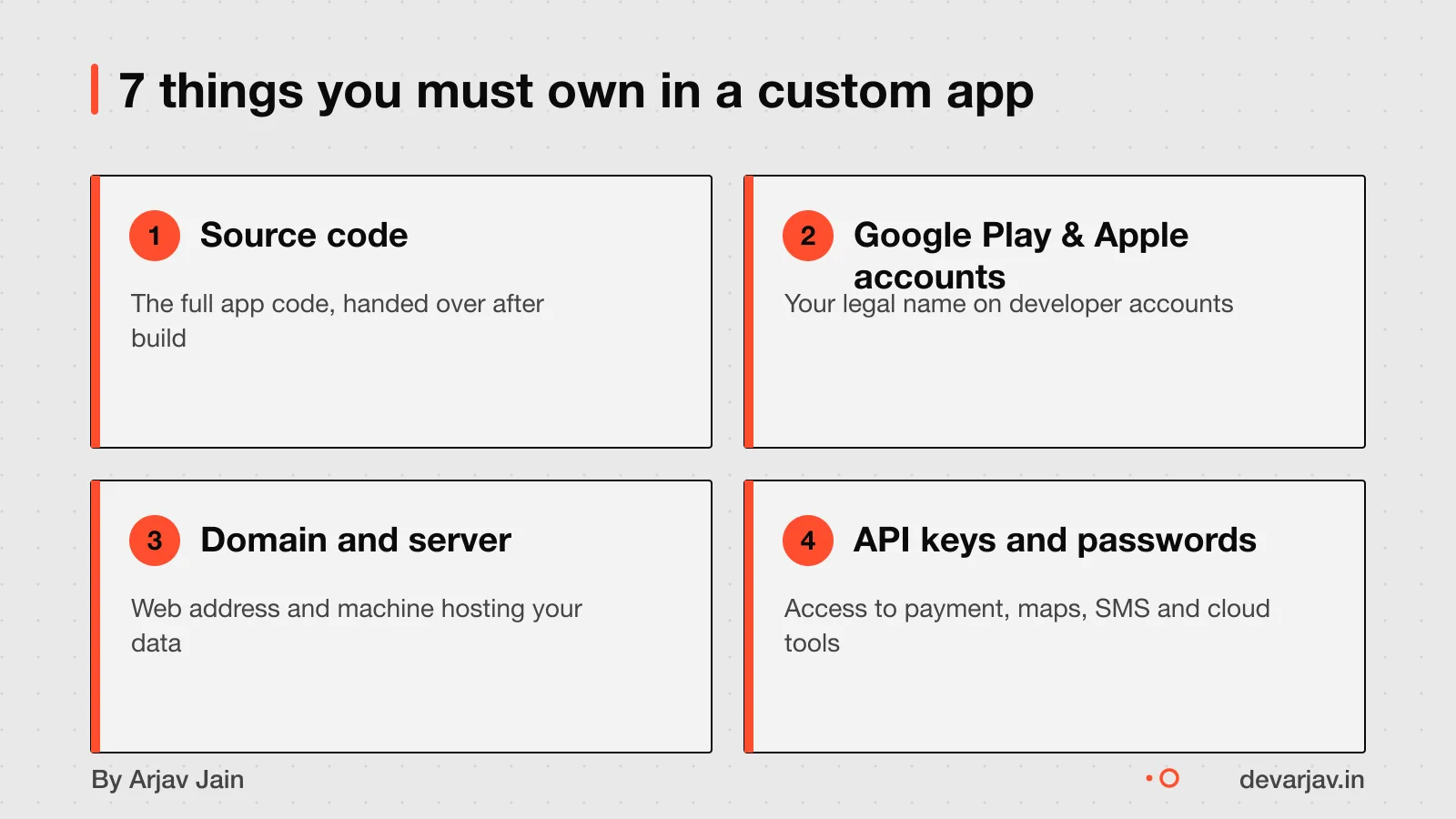
You need to own seven key things: the source code, the Google Play developer account, the Apple developer account, the domain name, the backend server. Database (where customer data lives), third-party accounts and API keys (for payments, SMS, maps), and the copyright or intellectual property (IP) itself. Without these, you cannot switch developers, update the app, or prove ownership.
If you plan to scale or protect your brand, owning these from day one is essential. For example, if your developer stops working with you and you do not own the Google Play account. You could lose the app on the store.
Can I get the source code of my app?
Can I switch from white-label to custom later?
Yes, you can move your data and brand from a white-label app to a custom one, but only if your vendor allows it. You must check that your contract includes data portability. This means you can export user details, order history and transaction records in a standard format like CSV or JSON.
As an estimate, data migration costs $3,000 to $10,000. This covers 2 to 5 days of developer work to clean, map and import the data into your new system.
The actual cost may be higher if the data is locked in proprietary formats or if the vendor does not provide full access. You should also check exit terms in the contract, such as notice periods, data deletion timelines and any early termination fees.
While the data can be moved, the app itself cannot. You will need to build a new custom app from scratch. Do not assume that parts of the white-label app can be reused.
How do customers pay in smaller towns?
You must offer UPI and cash on delivery to reach most customers in smaller towns. UPI is the most used payment method in India, with 21.7 billion transactions in January 2026. Credit, debit, and digital wallets are also used but less often. If you offer only a few payment options, some customers may leave without paying. Cash on delivery still works well in tier-2 and tier-3 towns where people trust it more than online payments. UPI helps speed up orders and cut failed deliveries. Buy Now, Pay Later (BNPL) is growing in India, with a market size of $37 billion as of 2026-01-01. For now, focus on UPI, cash, and cards. You can add BNPL later as your sales grow.
To accept UPI, you will need a payment gateway like Razorpay or PayU. These let you collect money and settle it to your bank daily. How to integrate Razorpay covers the steps for setting this up in your app.
Legal and tax rules for quick commerce in India
Yes, you need a GSTIN to issue valid tax invoices. Your app must generate GST-compliant invoices with fields like invoice number, date, customer name, billing and shipping address, GSTIN (if the buyer is registered). Place of supply, HSN code, item details, taxable value, tax rate and amount, and your signature. This applies whether you sell through a custom app, white-label solution or platform.
You must generate an e-Way Bill for any inter-state shipment where the consignment value exceeds ₹50,000. This rule applies even if you are delivering small orders across state lines. The system should flag such orders automatically to stay compliant.
Customer complaints must be resolved within 30 days of receipt. Your app should log complaints with timestamps and track resolution status. Delayed redressal can attract penalties under e-commerce rules.
For full compliance, consult a tax professional familiar with state-level trade laws, as local rules may add extra steps. Checklist for legal compliance in app development covers what developers should build in.
How to choose a white-label vendor
Ask if you own the code and what happens when the contract ends. Check how often they apply security updates and whether their app meets Google Play and Apple App Store rules. Ask for a written exit plan that includes data export and rebranding rights.
To check reliability, talk to two or three current clients and ask about downtime, support response time, and hidden costs. See if the vendor has handled a business like yours in your state.
Your contract must say you can export all customer, order and inventory data in a usable format. It should list what support includes and cap any price hikes. Include a 30-day notice clause if you want to leave.
Have a quote in hand? Send it to me and I will mark what is missing.
Message me on WhatsAppWorked example: 3-year cost comparison
Worked example: 3-year cost comparison
There is no known annual maintenance cost for a custom app in India, so this example assumes none.
A white-label app has two costs. First, deployment and rebranding cost ₹1 to 5 lakh. Second, a monthly license fee of ₹10,000 to ₹1.5 lakh. For this example, we assume ₹3 lakh setup and ₹1.5 lakh per year, or ₹4.5 lakh over three years. Total: ₹7.5 lakh.
A platform takes no setup cost but charges a fee of gross merchandise value (GMV). For ₹30 lakh in sales over three years, the fee is ₹4.5 lakh.
Over three years, the white-label and platform options cost ₹7.5 lakh each. The custom app costs ₹21 lakh. So the white-label and platform may be cheaper in the short term.
Assumptions:, Custom app cost based on $25,000 to $45,000. We use ₹21 lakh as a mid-range estimate at ₹75 per dollar. This conversion is an assumption. - White-label setup: ₹3 lakh as a mid-range estimate. - White-label annual fee: ₹1.5 lakh per year. - No annual maintenance cost for custom app (not known; this is an assumption). - Platform fee: 15% of ₹30 lakh GMV = ₹4.5 lakh. - GMV of ₹30 lakh over three years = ₹10 lakh per year, or about ₹83,000 per month.
When this advice is wrong
- You should not build a quick commerce app if there is no clear demand in your area. In rural towns, lower population density and poor delivery infrastructure can make fast delivery unworkable. Start with WhatsApp or a simple website to test interest first.
- A single-city MVP for a quick commerce app costs $25,000 to $45,000. Convert to INR based on current exchange rate. Custom apps take 8 to 16 weeks to build. Ongoing maintenance costs are not specified in evidence. If you need to launch in under 6 weeks, a custom app will not work for you.
- Avoid white-label if you want full control over your brand or plan to add unique features soon. Some vendors do not allow deep customisation or data portability. What happens if a vendor shuts down is not known.
Next step: message me on WhatsApp with what you want to build. No forms, no sales team.
Message me on WhatsAppAssumptions behind the numbers
- Monthly fees for white-label apps assume standard pricing models.
- Custom app cost assumes single-city MVP scope.
- Platform option is excluded from slider choices as per layout constraints.
Pick your situation
I build custom apps, so I benefit from that answer. That is why the table shows when white-label or platform win.
Pick your situation
White-label wins. White-label apps are pre-built and can go live in 2 to 4 weeks.
The whole comparison
| Custom | White-label | |
|---|---|---|
| Initial cost | $25,000 to $45,000 | ₹1,00,000 to ₹5,00,000 |
| Time to launch | 8 to 16 weeks | 2 to 4 weeks |
| Control over features | Full | Limited |
| Own the code | Yes (if written into contract) | No |
| Scalability | Unlimited | Up to 50k-100k users |
| Support after launch | Negotiable | Included in monthly fee |
Whichever you choose, ask these
- Who owns the code?
- Can I move off later?
- What is not included?
- How much for updates?
Questions people ask
Which option is cheaper: custom, white-label or platform?
White-label app deployment and rebranding costs ₹1,00,000 to ₹5,00,000. Custom apps cost $25,000 to $45,000 for an MVP. Compare first-year costs to decide what fits your budget.
Can I start with a platform and switch to custom later?
Yes, but you may lose customer data and branding. Platforms often do not allow full data export. Start with a white-label app if you want lower initial cost and can accept scalability limits of 50k-100k users. Check data portability before choosing any platform.
Do I need technical skills to run a white-label app?
No, you do not need technical skills. The vendor handles the tech. You manage orders, delivery, and inventory. Basic computer use is enough to run day-to-day tasks.
Is a white-label app allowed on Google Play and App Store?
Yes, if it has real branding and unique features. Apps that only change logo and colours may be rejected. Add custom workflows or local language support to avoid rejection.
What legal rules apply to customer data in quick commerce?
You must get consent before using customer data. Follow the DPDP Act 2023 when it starts. Do not share data without permission. Check this for your case with a chartered accountant or lawyer.
How do I protect myself from vendor lock-in?
Get data portability in writing. Ask for a tool to export your data. Limit contracts to 12 months. Know the migration cost, which can be ₹16 to 32 lakh and take 2 to 3 months.
What happens if my white-label vendor shuts down?
This is not known. Ask the vendor for their business continuity plan. Check if you can take the code and data.