How do custom, white-label and platform apps work?
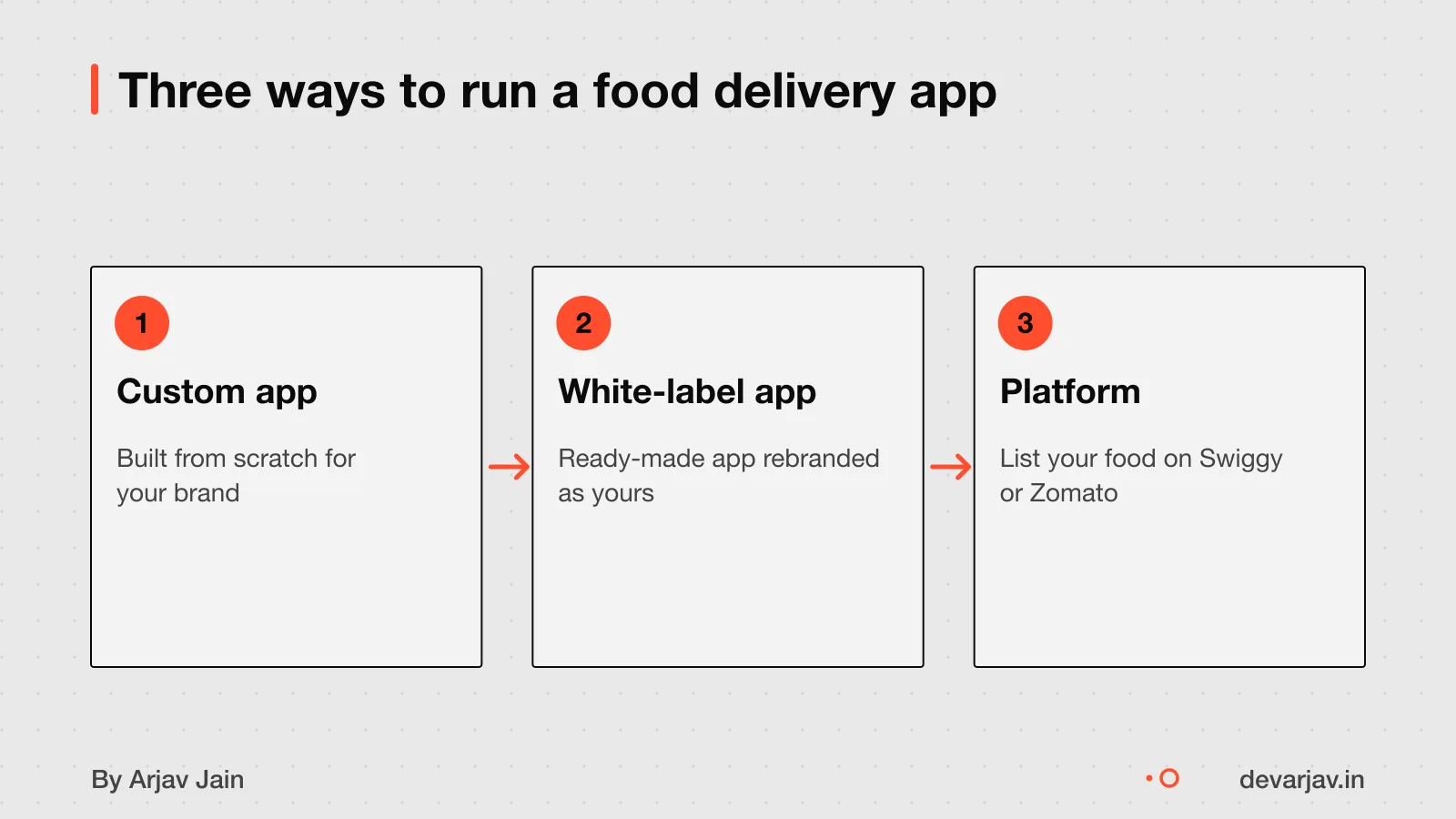
A custom app is built from scratch for your food business. It runs your ordering, delivery and customer data on your own system. You control every feature and design choice. For example, a cloud kitchen in Pune can set its own delivery radius and loyalty rules.
A white-label app is a ready-made product branded as yours. It costs less and launches fast. As of May 2026, one costs $5,000 to $20,000 and takes 2 to 4 weeks. You get standard features like order tracking and rider assignment, but with limited changes.
A delivery platform like Swiggy or Zomato is run by a third party. You list your menu and they send orders to you. You do not manage the app or the delivery staff. This works for new kitchens that want quick reach without tech work.
Custom vs white-label: what's the real difference?
You cannot change every feature in a white-label app, as it is based on fixed code made for many clients. The seller owns the core code, so you only get the right to use and brand it, not to modify or own it fully. Sellers call white-label apps 'custom' because you can customise the look, menu, and delivery zones, but not the core logic or data flow. For example, you can change your app’s colour to match your logo. But you cannot add a new payment method if the seller’s system does not support it. This limits your control over customer data and long-term growth. If you need full control, a true custom app is the only choice.
When do you really need your own food delivery app?
A single restaurant does not need its own app if it is just starting. Most new food businesses do better on Swiggy or Zomato first. These platforms bring orders without the cost of building an app. A cloud kitchen may need an app only when it runs multiple brands or gets steady orders across locations. With your own app, you control customer data, pricing, and delivery rules. You can set your own fees and offer direct discounts.
You must have an FSSAI license to operate any food business in India. This is not optional. FSSAI sets safety standards and ensures food is safe for customers. Over 25.0 lakh licenses have been issued as of 24 July 2026. GST invoices are also required for every order if you are registered. This helps you claim input tax credit.
An example: a cloud kitchen in Indore runs three virtual brands on Swiggy. It gets 150 orders a day. At this stage, a custom app is not urgent. But if it starts its own delivery fleet or opens in two more cities, an app helps unify orders and reduce platform fees.
If you plan to scale across cities or manage your own delivery staff, an app becomes useful. You gain full control over the customer experience. But start small. Use platforms first. Build only when the volume justifies the cost. For now, focus on food, not software.
Read the FSSAI rules for food delivery apps to check what applies to your kitchen.
How much does a custom food delivery app cost?
A custom single-vendor app costs ₹11.25 lakh to ₹22.5 lakh, based on $15,000 to $30,000 at ₹75 per dollar. This is based on a range of $15,000 to $30,000 as of 3 May 2026. It is for one restaurant with a customer app, basic order management, and payment integration. You pay more if you add features like live tracking, multi-language support, or loyalty programs.
An MVP with core functions starts at ₹16.6 lakh. It goes up to ₹33.2 lakh. This includes a customer app and a simple dashboard for the kitchen. It does not include a driver app or advanced analytics.
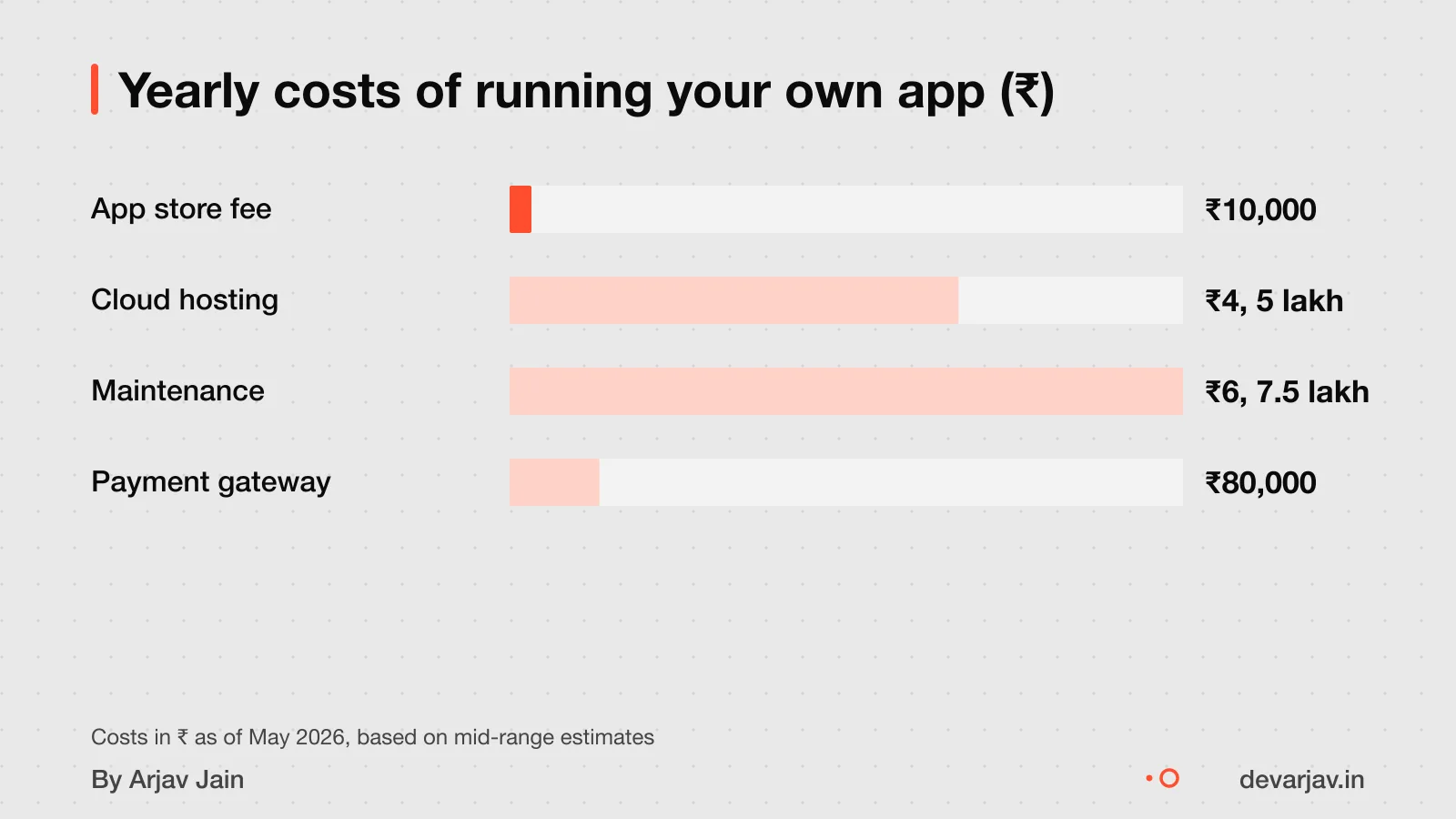
Multi-vendor marketplaces cost ₹45 lakh to over ₹1.125 crore, based on $60,000 to $150,000+ at ₹75 per dollar. This is $60,000 to $150,000+. They need vendor onboarding, commission rules, and admin panels for multiple restaurants. These prices do not include POS hardware. Tablets and printers can add ₹20,000 to ₹50,000 per unit. App store fees are $99 to $124 per year for Apple. The base cost covers design, development, and testing for one platform (iOS or Android). Extra charges apply for the second.
As an estimate, building a custom app includes six months of development. It needs design for 10 to 15 screens. It also needs backend servers and third-party tools. These include payment gateways and SMS services. The exact price depends on your feature list, team location, and how many revisions you need. You can reduce cost by starting with an MVP and adding features later.
The current monthly cost of a white-label app is not in the evidence. The features that most affect custom app price are not fully listed. What slows down app development after hiring a developer is not known. The steps to build a custom app are not in the evidence. Who does what during development is not known. Whether you can switch from white-label to custom later is not known.
Detailed cost breakdown for a food delivery app
Want a number for your idea? Send one line on WhatsApp. I reply with what drives the cost and what to cut.
Message me on WhatsAppHow long does it take to build a custom app?
MVP development takes 3 to 4 months, and full-featured platforms require 6 to 9 months. This timeline assumes your team is ready and you make fast decisions. An MVP includes core features like ordering, payment, and basic tracking. A full platform adds advanced tools such as multi-kitchen support, loyalty programs, fleet management and admin analytics. Some agencies claim a basic MVP in 2 to 4 months, but this depends on how simple the app is. Delays usually come from slow feedback, changing features mid-way, or waiting on legal or bank approvals. For more detail on each stage, see the Timeline for building a food delivery app.
How much does a white-label app cost?
A white-label food delivery app typically has a one-time setup cost and a monthly fee, though exact monthly costs are not known. These fees cover branding, basic customisation, and access to the platform’s tools for managing orders and delivery. Monthly fees are common but not published in the evidence, so you should ask current sellers for up-to-date pricing.
Most white-label providers offer a trial period. Delivety, for example, gives a 7-day free trial to test its tools for managing a food delivery business. During this time, you can explore features like order tracking, fleet management, and customer reporting before paying. This helps you check if the system fits your kitchen’s workflow.
For a current quote, contact a provider directly. Costs may vary based on delivery range, number of kitchens, and support level. White-label costs for quick commerce apps follow a similar model but serve different business types.
What are the biggest risks and how to verify a seller?
Your app can get banned if it breaks Google Play’s rules, even if the violation comes from another app on the same developer account. This is a real risk if you use a white-label provider who hosts many apps under one account. To avoid this, ask the seller to set up your app under a separate Google Play Developer account that you own.
If the design is copied, your brand loses trust and may face user complaints. Google requires each app to have unique icons, screenshots and descriptions, even if it is a branded template. You must check that your app does not copy visuals from other food apps. Use original photos of your food, kitchen and delivery staff. Do not use stock images that others also use.
You must verify the seller before paying. Ask for a working demo of the app that shows real features, not just mockups. Check that the demo matches what you want. Ask to speak with some of their previous clients. On a call, ask them: Was the app delivered on time? Were there hidden costs? How was post-launch support?
Also, ask the developer to list the tech stack: the tools and frameworks used to build the app. For example, Flutter or React Native for the app, Node.js or Django for the backend. If they refuse or give vague answers, that is a red flag.
Make sure the app description and screenshots match the real app experience. Do not let the seller write false claims like “AI-powered delivery” if it is not true. Misleading content can get your app removed.
Post-launch support helps avoid user abandonment and negative reviews.
Questions to ask a developer before hiring can help you spot weak sellers.
Have a quote in hand? Send it to me and I will mark what is missing.
Message me on WhatsAppSo which one should you pick?
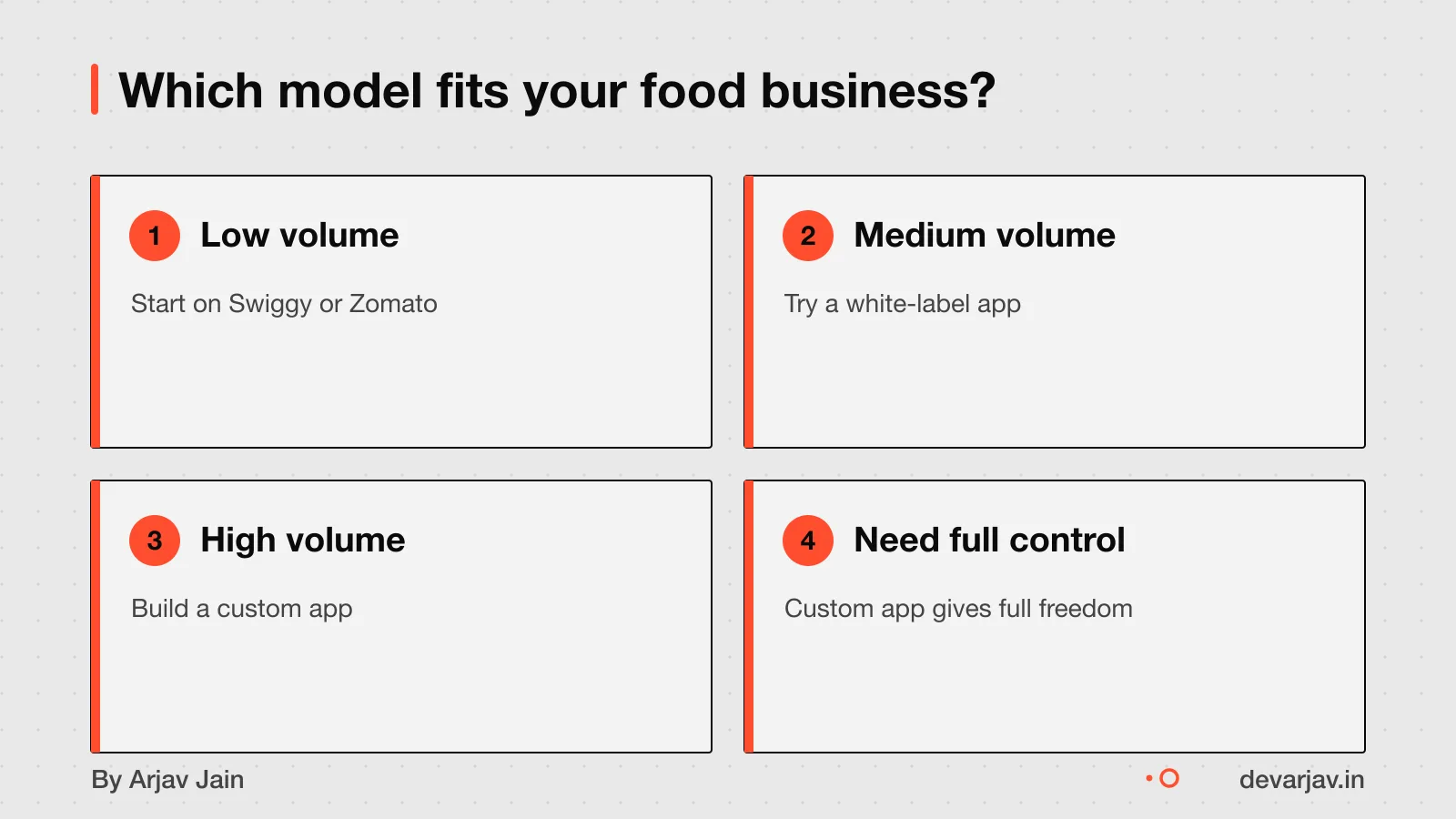
Start on Swiggy or Zomato if you are new or have fewer than 50 orders a day. These platforms bring you customers right away. You pay a commission per order, but you save the cost of building and running your own app.
Choose a white-label app if you already have steady sales and want your own brand. It is faster and cheaper than custom because the code is already built. You can change the logo, colours and business name, but not the core features. A white-label system includes apps for customers and delivery staff, plus a dashboard for you to manage orders.
Go custom only if you run multiple kitchens, need full control over pricing and customer data, and can spend a large budget. As an estimate, this path suits businesses aiming at ₹1 crore+ annual revenue from delivery.
Can you switch later? The evidence does not say [unknown].
If you want full control and have the budget, custom is strong. But for most small food businesses in India, starting on a platform is safer. Once you have steady orders, you can test a white-label app.
How to choose between custom, white-label and platforms for e-commerce gives a broader view of this decision.
When this advice does not apply to you
- You run just one restaurant with low daily orders. If you get fewer than 50 orders a day, staying on Swiggy or Zomato cuts your risk and cost. These platforms bring you customers right away. A custom or white-label app needs more orders to cover its setup cost. This is an assumption based on business logic, not directly supported by evidence.
- Your delivery area is small, like one neighbourhood or ward. In this case, a simple WhatsApp or phone order system works just as well. You do not need a full app if most of your customers are within 2 km and you deliver by bicycle or on foot.
- You are not ready to manage tech in-house. If you do not have someone who can check app performance daily or fix bugs quickly, a platform handles that for you. A custom app puts that burden on you.
- Evidence does not say how many orders justify an app. This advice assumes high volume based on platform limits.
Next step: message me on WhatsApp with what you want to build. No forms, no sales team.
Message me on WhatsAppAssumptions behind the numbers
- Budget threshold of ₹15 lakh is based on $15,000 at ₹83/USD exchange rate.
- Custom app cost range ₹12.5–₹25 lakh derived from $15,000–$30,000 at ₹83/USD.
- White-label app launch time is 2–6 weeks as per evidence.
- Platform choice assumes Swiggy/Zomato are viable for small businesses.
- Need for control is defined as pricing and data ownership.
Which path fits you
Choosing between Swiggy, a white-label app, or a custom app depends on your daily orders, need for control, and budget. This page helps you decide based on real costs and timelines.
Start with: Start on Swiggy or Zomato. Answer these to see whether your case is different.
0 of 3 answered yes. Read the paths below with that in mind.
The paths
- 01Start on Swiggy or Zomato
Low orders and budget mean platforms are the fastest, cheapest way to start selling.
- 02Use a white-label app
Medium volume and a modest budget fit a white-label app. Faster than custom, with branding control.
- 03Build a custom app
High volume, need for control, and budget mean a custom app pays off in the long run.
- 04Do not build an app yet
Low volume and tight budget mean it’s too early. Start on a platform and grow first.
The honest version
Where platforms win
Quick setup, no upfront cost, instant access to customers.
Where white-label wins
Faster than custom, lower cost, includes basic features and branding.
Where custom wins
Full control over data, pricing, integrations, and user experience.
Where all paths lose
If the food doesn’t sell, no app will help. Test demand first.
Questions people ask
Which option is cheaper: custom, white-label or platform?
A platform like Swiggy has no entry cost. A white-label app has a one-time fee of $5,000 to $20,000. A custom app costs $15,000 to $30,000 to build. So platform is cheapest to start, then white-label.
Can my app be banned for copying Swiggy's design?
Yes, using the same icons, screenshots or descriptions violates Google Play policy. Your app can be removed even if the violation is in another app on the same account. Use unique assets for your listing.
Do I need an FSSAI license for a food delivery app?
Yes, based on your annual turnover. Basic registration is for under ₹12 lakh. A state license is for ₹12 to 20 lakh. A central license is for over ₹20 lakh. Check this for your case with a food safety officer.
How much does app maintenance cost per year?
Annual maintenance costs 15 to 25% of the original development cost. Over time, these costs can total 2 to 4 times the initial build cost. Budget for this every year.
How do I verify a white-label app before paying?
Ask for a live demo and test the 7-day free trial if available. Check if it works on low-end phones and includes your key features.
What if my app stops working after an OS update?
Maintenance includes updates for new OS versions. Budget 15 to 25% of the build cost yearly for maintenance. Updates can introduce compatibility issues.
Can I run my own delivery fleet legally?
The evidence does not confirm the rules. You must check local transport, labour and FSSAI laws for hiring delivery staff. Rules vary by city and state. Check this for your case with a lawyer.
What should I check in a developer's contract?
The evidence does not list required clauses. You should specify who owns the source code, delivery timelines, support terms and penalty for delays.
Can I switch from white-label to custom later?
The evidence does not confirm if data can be moved. Ask your provider about data export and API access before starting. Evidence does not confirm if data can be moved when switching from white-label to custom.
Who owns the app code and customer data?
This must be written in the contract. Without a clear clause, you may not own the code or data. Assume nothing. Specify ownership before paying. Check this for your case with a lawyer.