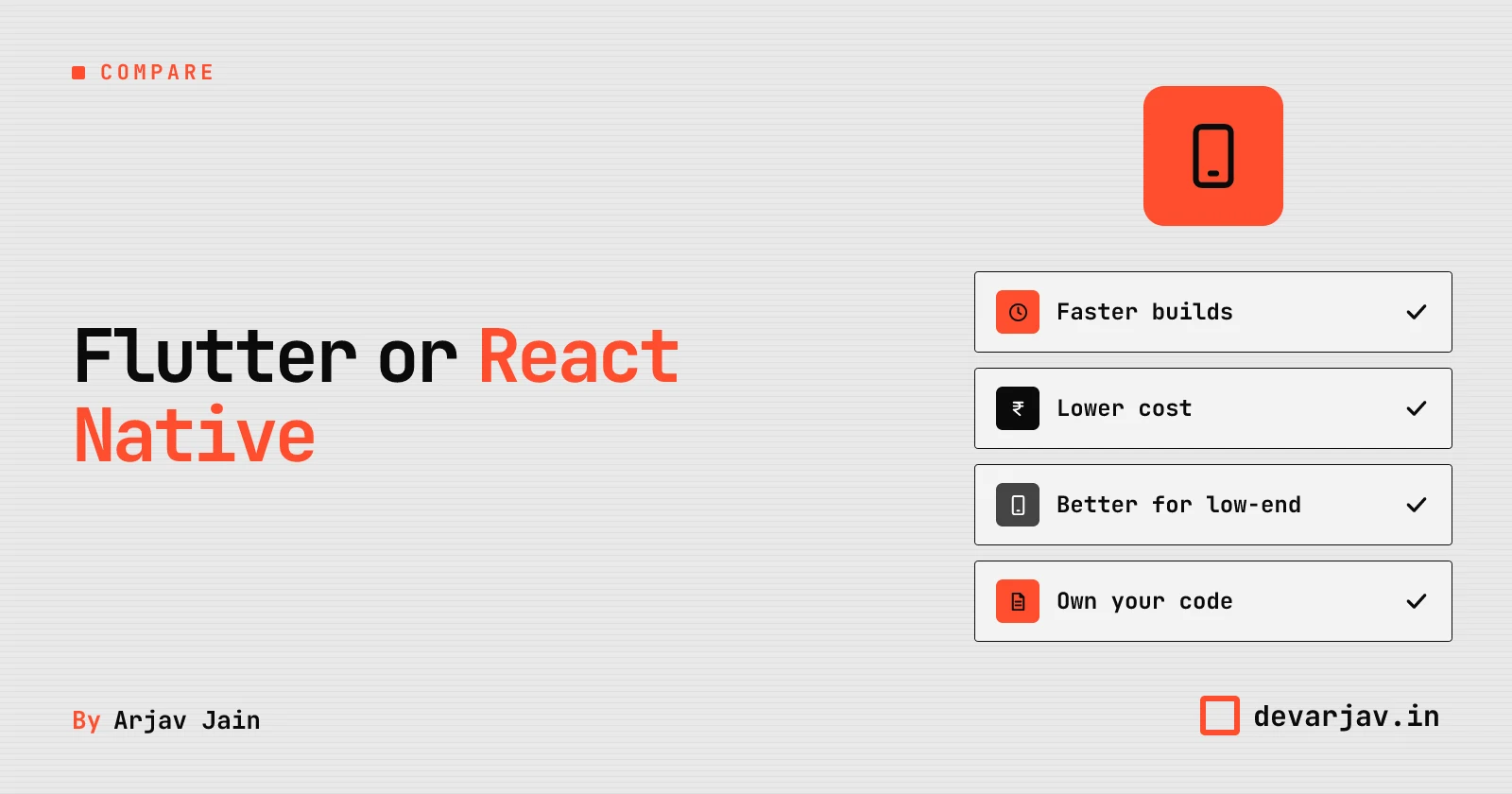
What are Flutter and React Native?
Cross-platform development means building one app that works on both Android and iPhone using a single codebase. This saves time and money for small businesses.
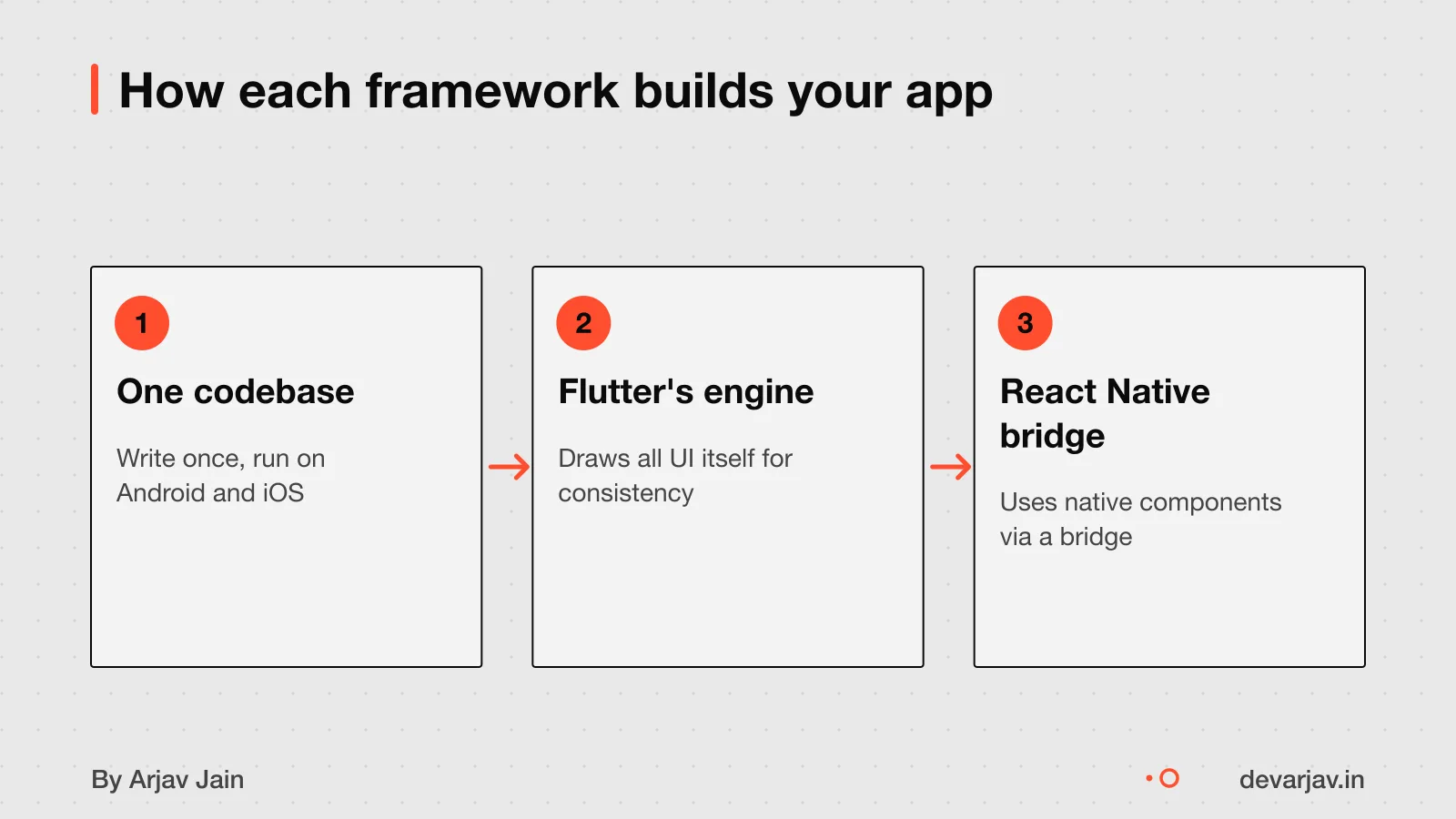
Flutter uses the Dart programming language and draws its own user interface (UI) components. It does not rely on the phone’s built-in buttons and menus. Instead, it creates them from scratch, which makes the app look the same on all devices. Flutter code runs fast because it compiles directly to machine code.
React Native uses JavaScript and wraps native Android and iOS components. This means it uses the phone’s own buttons and menus, so it feels more like a regular app. However, it depends on the phone’s system more closely.
Both are good choices if you want one app for two platforms. For most small businesses in India, this is the best way to start. See how they compare to building two separate native apps native vs cross-platform apps.
Which one costs less: Flutter or React Native?
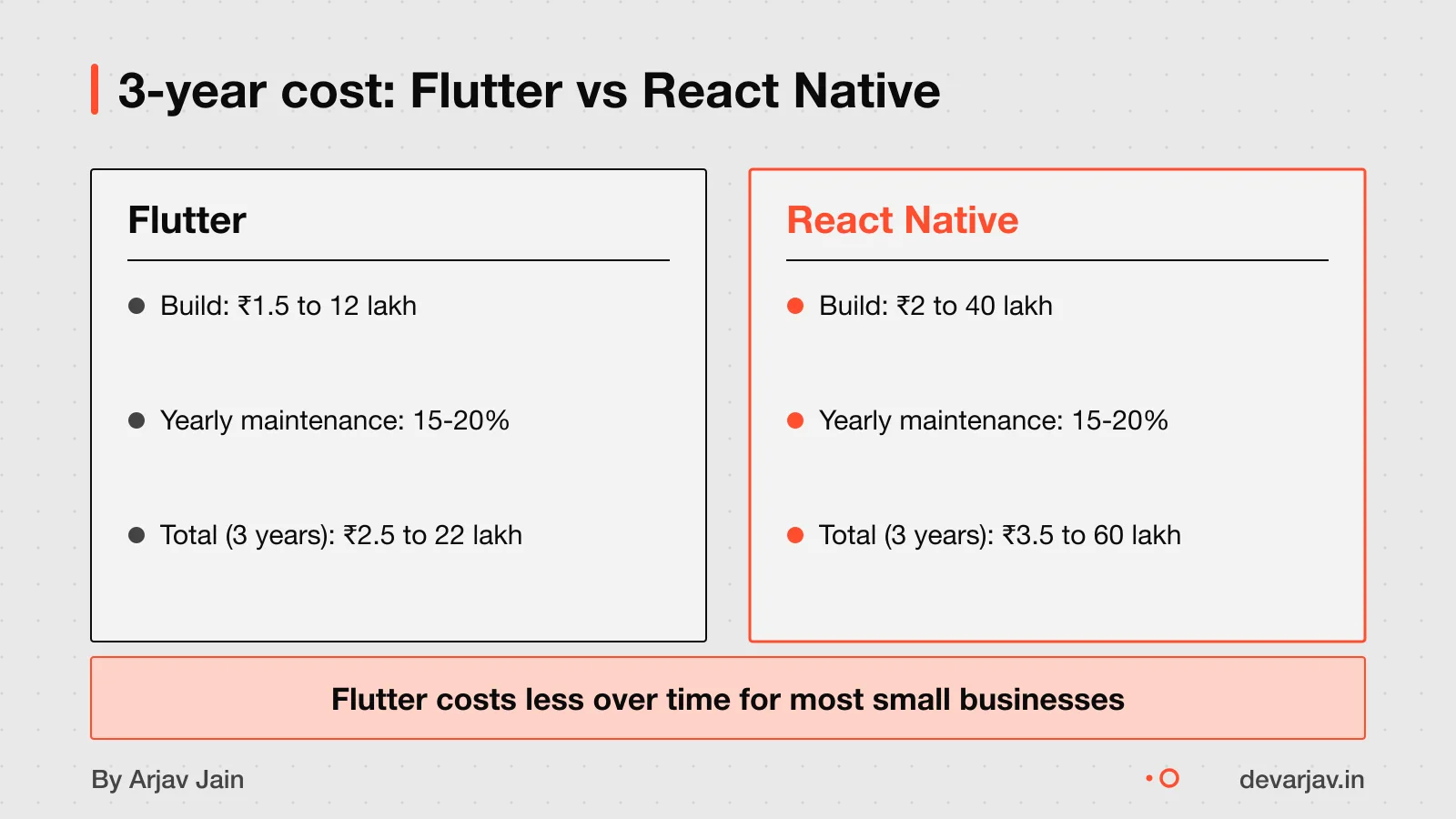
Flutter apps cost ₹1.5 to 12 lakh in India. Flutter is often cheaper because it uses one codebase for both Android and iOS, saving up to 40% compared to building two native apps.
Indian pricing shows Flutter as more cost-effective long-term. Though React Native has more developers, Flutter’s single codebase cuts testing and update time. Complex React Native apps cost more due to extra fixes and native modules.
Hidden costs are the same for both: annual maintenance (15 to 20% of build cost). Backend hosting, and third-party services like SMS or payment gateways. These are not optional.
As an estimate, assuming a mid-range app with user accounts, forms and offline access. Flutter would cost less over two years due to fewer updates and consistent behaviour across devices.
Want a number for your idea? Send one line on WhatsApp. I reply with what drives the cost and what to cut.
Message me on WhatsAppHow long does each one take to build?
A simple app in Flutter usually takes 6 to 10 weeks. A mid-complexity app, with a backend and tools like payment or login, often takes 3 to 5 months. Big, complex apps can take 6 months or more.
React Native can help deliver apps faster than native development in some cases. There is no evidence provided on whether React Native is faster than Flutter for small-business apps.
For example, a clinic app with patient booking, doctor profiles, and payment would be mid-complexity. In Flutter, expect 3 to 5 months. The same app in React Native may take about the same time.
What slows down a Flutter or React Native project is not known [unknowns]. Delays often come from unclear features, slow feedback, or late decisions on design and content.
You should plan for at least 6 weeks even for a simple app. Rushing too much can lead to bugs or a poor user experience.
Which one runs better on low-end phones?
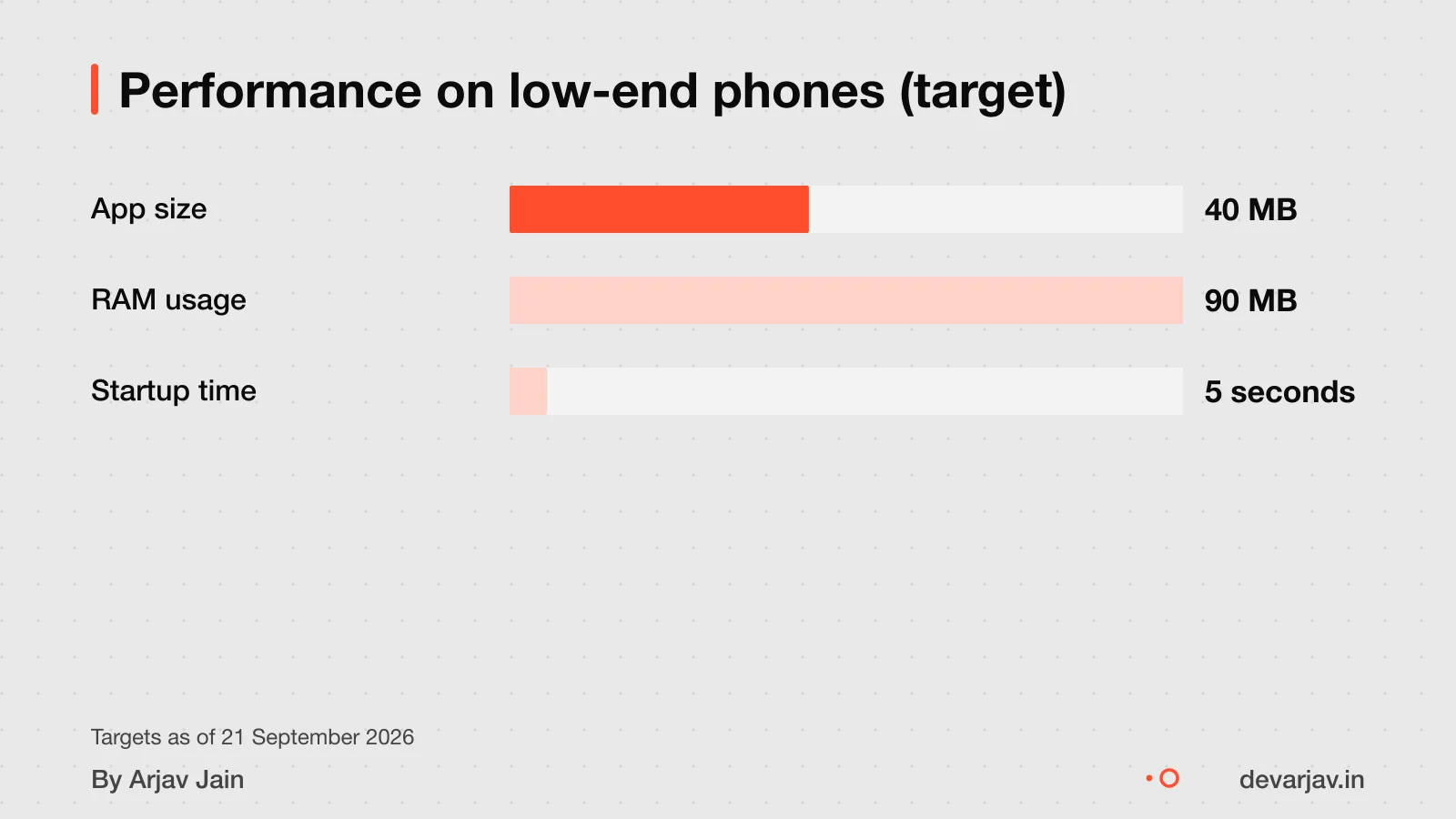
Flutter compiles to machine code, which makes it fast on any device. Flutter apps start in under 5 seconds, stay under 90MB of RAM. Keep the total size below 40MB, key for users with old phones or slow internet.
This matters because many of your customers in smaller towns may use phones with 1GB of RAM or less. Flutter handles this better by doing more work ahead of time, so the phone does not struggle while the app runs. React Native relies more on the device's JavaScript engine, which can slow things down on weaker hardware.
For example, a clinic app in Bhopal built with Flutter would load fast even on a ₹8,000 phone. Patients could book slots without waiting long, and the app would not crash when switching between screens. This kind of smooth experience builds trust and keeps users coming back.
How to find and check a good developer
React Native has more developers than Flutter, so you can hire faster, especially in smaller towns. To check a developer’s quality, ask for live app links on the Google Play Store or Apple App Store and test them yourself. Look at their GitHub profile for open-source work or sample projects, which shows real coding skill.
A strong React Native developer knows JavaScript, TypeScript, and React concepts like state and props. They should also understand native Android and iOS features and how to connect to them. Avoid developers who use only third-party templates or won’t sign over full code ownership after delivery.
Red flags include no portfolio, refusal to share past app links, or quotes that are much lower than average. Also avoid those who do not explain how they will handle updates or security. A real developer will let you test their apps and answer technical questions simply.
how to hire a React Native developer in Raipur if you want local support with fewer communication gaps.
Have a quote in hand? Send it to me and I will mark what is missing.
Message me on WhatsAppWhat are the hidden and long-term costs?
Yearly maintenance costs 15 to 20% of the original build cost. This covers bug fixes, OS updates, security patches, and small feature tweaks. Google Play charges a one-time registration fee of 25 US dollars. Apple charges $99 per year for the Apple Developer Program, which you must pay every year to keep your app live.
Hosting, third-party APIs, analytics, and cloud functions add extra costs. For example, Firebase hosting and database for a medium app can cost ₹3,000 to ₹10,000 per year. Payment gateway APIs like Razorpay or Paytm may charge per transaction. Flutter apps may need fewer updates over time because they run consistently across devices, which can lower long-term costs. However, you still need to budget for annual renewals, monitoring, and occasional rewrites.
When is Flutter the better choice?
E-commerce, healthcare, fintech, education, and logistics businesses across India are building Flutter apps for cost-effective cross-platform delivery. One codebase works on both Android and iPhone, which can save time and money. You also spend less on fixes, as Flutter apps need fewer platform-specific bug fixes. For example, a clinic app with patient records and appointment booking runs smoothly on low-end phones and stays consistent across devices. Flutter works well with Firebase, Google Pay, Google Maps, and other Google tools, making it easier to add features like payments or location tracking. This cuts development time and reduces the chance of errors. If your app must look unique and work reliably across many phone types, Flutter gives a better user experience.
When is React Native the better choice?
React Native is easier if your team already knows JavaScript or uses React for web apps. You can start building the mobile app right away without learning a new language. This also means fewer new skills are needed, which saves training time and cost.
It may launch faster when you need many third-party tools. React Native has a larger ecosystem of plugins and libraries than Flutter. For example, if your app must connect to 10 different payment or analytics services, you are more likely to find ready-made tools for React Native.
More than 18,800 production companies actively use React Native for large-scale applications. So if you want to follow what many others do, or hire developers who already know the framework, it can be a practical pick.
Still unsure between Flutter and React Native? Tell me your budget and timeline and I will say which fits.
Message me on WhatsAppDo I own the app code after it is built?
Yes, but only if you get it in writing. By default, the developer who writes the code owns the copyright under Indian law, not you. This means even if you pay for the app, the code legally belongs to them unless they sign it over to you.
To fully own your app, get these seven things in writing before the final payment: the source code, Google Play developer account. Apple developer account, domain name, backend server and database access, third-party accounts and API keys, and the copyright or intellectual property rights. Without all of them, you could lose control later.
For example, if your developer leaves and you do not have the Google Play account, you cannot update the app. Always sign a handover agreement that lists each item. Own the accounts your app needs. Do not let the developer hold them.
Example: a clinic app in Bhopal
Example: a clinic app in Bhopal
As an estimate, a medium-complexity Flutter app for a clinic in Bhopal, handling patient bookings, digital records, and reminders, would cost ₹5 lakh to build. This assumes a single codebase for both Android and iPhone, with basic features like login, forms, and notifications.
As an estimate, the same app built in React Native would cost ₹6 lakh. This is based on React Native’s typical starting range and added integration effort for native modules on Android.
For Flutter, at 15% per year, maintenance is ₹75,000 per year, or ₹2.25 lakh over three years.
Over three years, the total cost for Flutter is ₹7.25 lakh (₹5 lakh + ₹2.25 lakh). For React Native, it is ₹8.7 lakh (₹6 lakh + ₹2.7 lakh). As an estimate, Flutter saves ₹1.45 lakh over three years for this clinic app.
Assumptions: - Build cost based on medium complexity and single codebase. - Maintenance at 15% per year. - Five updates over three years included in maintenance. - No major redesign or feature overhaul.
This does not include backend hosting, third-party APIs, or marketing.
When this advice is wrong
Do not use Flutter if you are building a 3D game or need maximum performance from the device. As it is not designed for those tasks. Also avoid it for apps that must follow one platform’s strict guidelines, like a deeply custom iOS-only tool.
Do not choose React Native if your app relies on complex native features or heavy animations. Since it can struggle with performance in those cases. It also demands native coding knowledge when adding custom modules, which can slow down development.
Do not build a mobile app at all if your customers are already using WhatsApp, Instagram, or your website to do business. Many small businesses in India save time and money by starting with a simple website or WhatsApp order system instead. Ask yourself: does your customer really need to install an app?
Related reading: app or website first, Freelancer or agency for a first app?, Best React Native developer in Raipur: how to choose, in 8 checks.
Next step: message me on WhatsApp with what you want to build. No forms, no sales team.
Message me on WhatsAppAssumptions behind the numbers
- Cost ranges are for India in 2026
- Time ranges assume clear scope and no major delays
- Low-end phone support is needed
Pick your situation
I build apps in Flutter, so I benefit from this recommendation. But the data shows Flutter is also the better value for most small businesses.
Pick your situation
React Native wins. If your team already works in JavaScript, React Native lets you reuse skills and hire faster.
The whole comparison
| Flutter | React Native | |
|---|---|---|
| Base language | Dart | JavaScript |
| Performance | Near-native, compiled | Bridge-based, can lag |
| Developer count in India | Fewer, but growing | More, easier to hire |
| Average cost | ₹1.5L to 12L | ₹2L to 40L |
| Main risk | Smaller library set | Library conflicts, native leaks |
| Best for | Smooth, low-maintenance apps | Fast launch, deep OS access |
Whichever you choose, ask these
- Can I see a demo on a low-end phone?
- Who will own the code after launch?
- What is not included in your quote?
- Do you test on real devices or simulators?
Questions people ask
Which one is cheaper for a small business?
Flutter is usually cheaper for small businesses. It costs ₹1.5 to 12 lakh, while React Native costs ₹2 to 40 lakh. Flutter can be 30-40% cheaper than building separate iOS/Android apps by using one codebase.
Which one is faster to build?
Flutter has more predictable timelines. A simple app takes 6 to 10 weeks. React Native may be faster only if your team already knows JavaScript. Mid-complexity apps take 3 to 5 months in either framework.
Which one runs better on cheap phones?
Flutter runs better on low-end phones. It compiles directly to machine code, making it more responsive. Both frameworks should keep app size under 40MB and RAM use under 90MB.
Do I own the app code with either framework?
You do not automatically own the app code. Under Indian law, the developer owns the copyright unless it is signed over to you in writing. Make sure your contract includes ownership transfer of source code, accounts, and IP.
Which one needs more developers?
React Native has a larger developer pool and may offer faster hiring availability. Flutter also has strong support, but React Native leads in community size.
How much does maintenance cost per year?
Maintenance costs 15 to 20% of the original build cost each year. This covers updates, bug fixes, and security patches. Flutter apps tend to require fewer platform-specific bug fixes because the UI is consistent across devices.
When is React Native a better choice?
React Native is better if your team already uses JavaScript or React for web apps. It also has more third-party tools and plugins. This can speed up development for certain features.
When is Flutter a better choice?
Flutter is better for custom designs and apps that use Google services like Firebase or Google Pay. It also has fewer platform-specific bugs, so it runs more smoothly across devices.
Should I build an app at all?
You may not need an app if you only want to share contact details, post updates, or show a product catalog. A WhatsApp business account or a simple website might be cheaper and easier to manage. See if an app or website should come first.