What kinds of app developers can you hire in India?
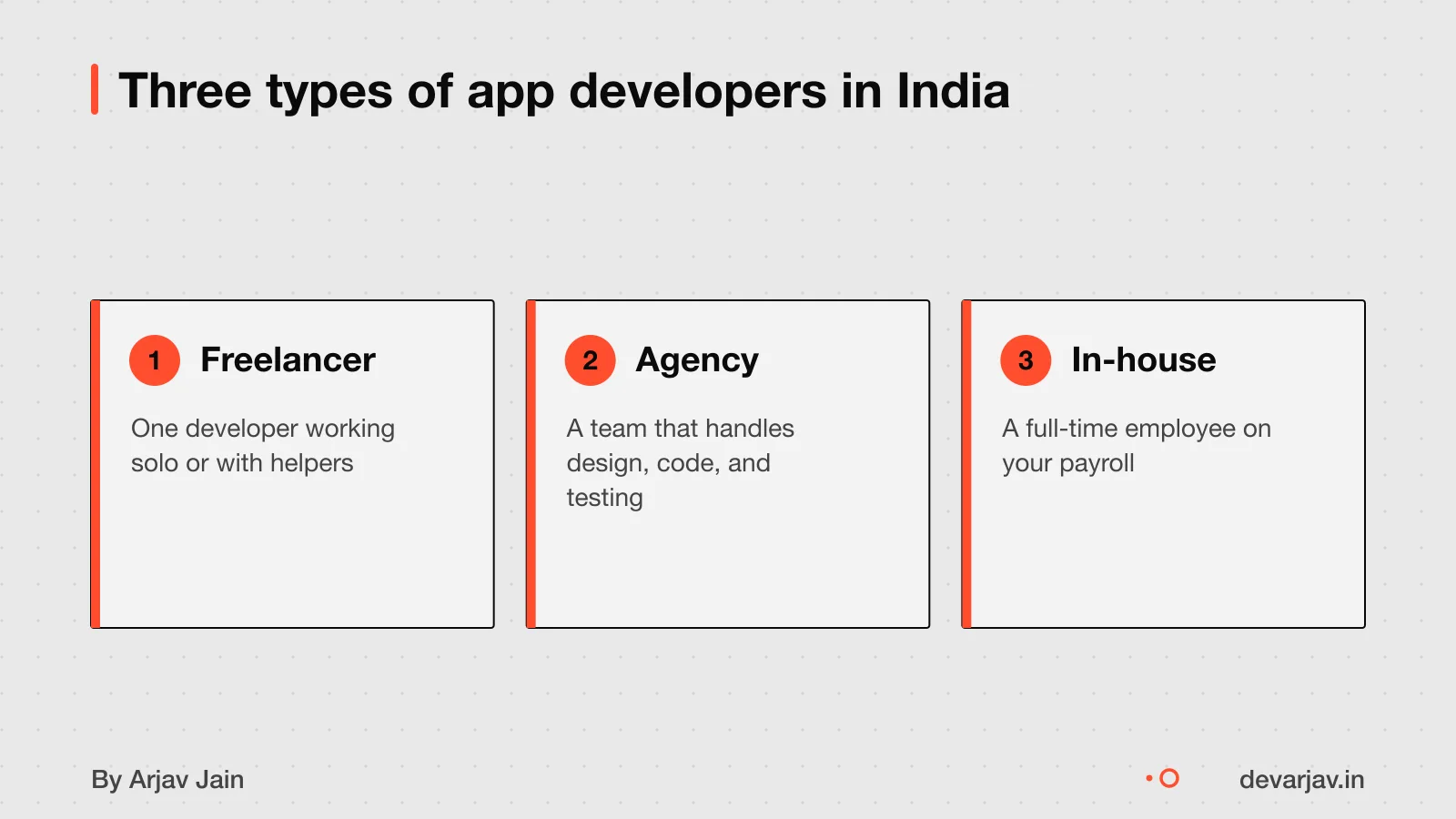
A freelance developer is a single skilled person you hire directly for your app project. They handle coding, testing and delivery without middlemen. Think of them like a local electrician who fixes your shop's wiring, focused, fast and accountable.
An agency is a company with a team of developers, designers and project managers. They take on big projects needing many skills. It is like hiring a construction firm to build a new floor on your building, structured but slower.
An in-house hire is a full-time or part-time employee you add to your team. They work only for you and are best when your app needs daily updates and long-term care.
You save money, move faster, and keep full control, if you pick someone skilled and trustworthy. Agencies suit larger, complex projects with deep funding. In-house hires make sense only after launch, when work is ongoing.
How much does a freelancer cost vs an agency?
Freelancers charge $10 to $80 per hour based on skill level. Agency pricing for a full app is not in the evidence. GST adds 18% to both.
As an estimate, a 6-month project at 20 hours per week with a mid-level freelancer (₹3,600/hour) totals ₹29.2 lakh before GST. With 18% GST, the final cost is ₹34.4 lakh. This assumes no scope changes or hidden fees.
Agency prices are not in the evidence, so the full difference is not known. But agencies often include project managers and designers, which adds cost. Freelancers bill only for dev time.
You pay GST on all IT services in India. The developer must issue a GST invoice if they are registered. Ask for it to claim input credit.
Want a cost for your app idea? Send one line on WhatsApp. I reply with what drives the price and what to cut.
Message me on WhatsApp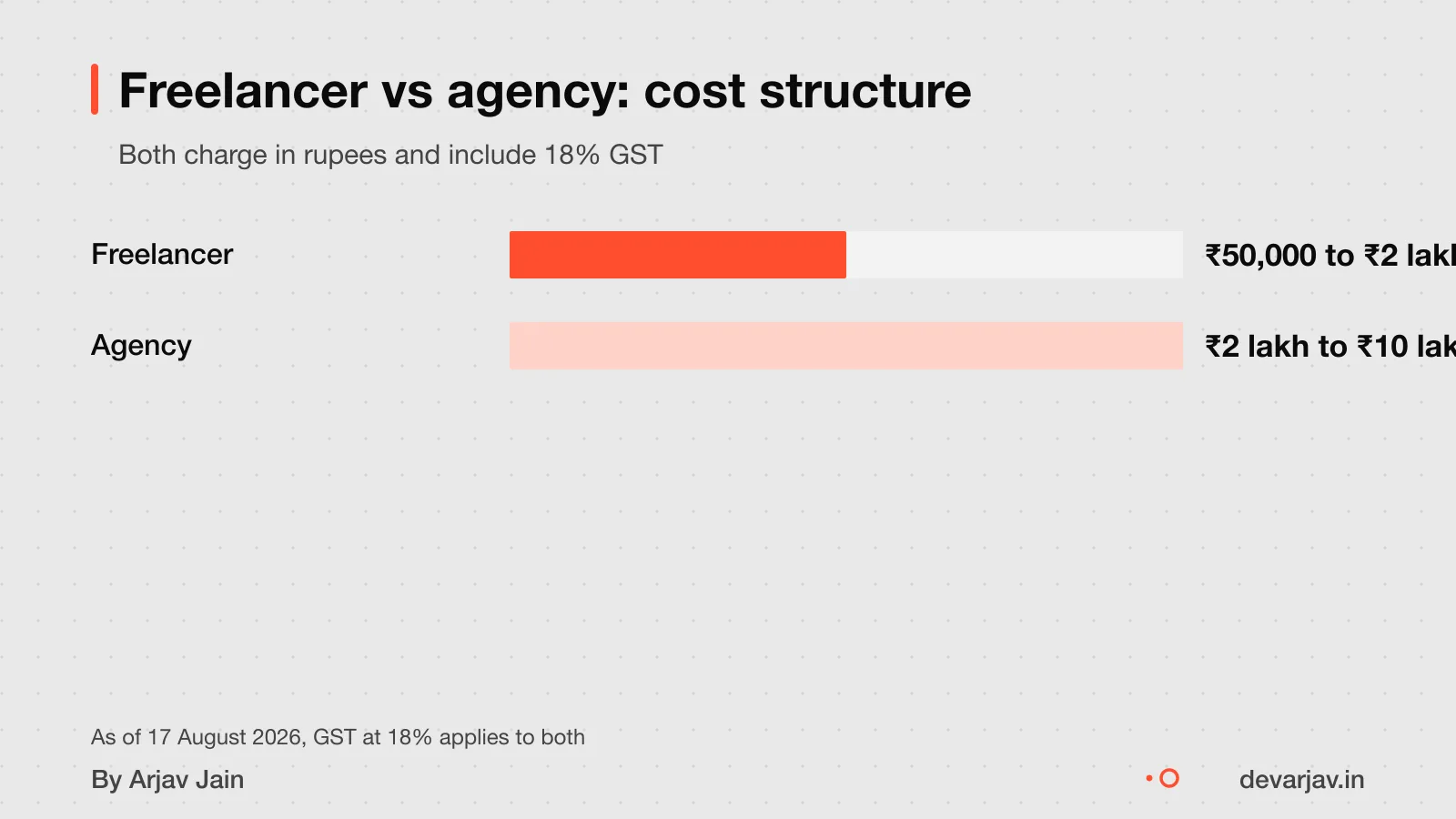
How long does it take to build a startup app?
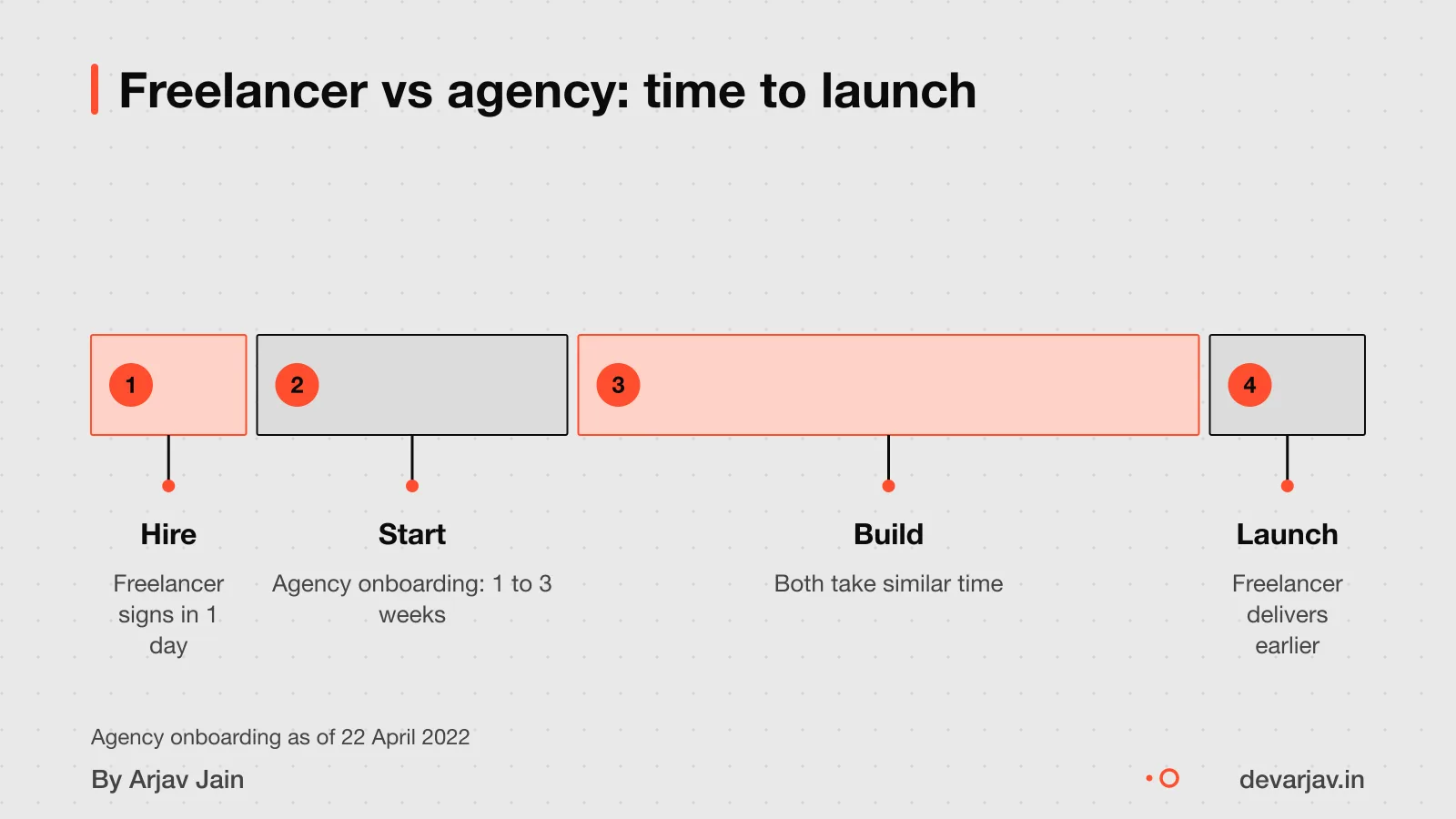
The total time to build a startup app is not known. A mobile app design took 20 days as one example. A freelancer can start fast, often within days, because there is no big team to coordinate. An agency mentions project starts in its description. But agencies often take longer to begin because of onboarding steps, contracts and handovers between roles. Remote work can speed things up. Teams in India can be hired fast, avoiding months of local hiring. What affects the total time includes how clear your idea is, how fast you give feedback, and how complex the app is. Design, testing and approvals add time. No evidence says how long full development takes. Ask each developer for their timeline and check past projects for delays.
What skills should your startup's developer have in 2026?
Your developer should know cross-platform tools like Flutter, and modern workflows such as Agile. These skills let them build fast, test early, and cut costs, key for early-stage startups.
They must also understand UI/UX design to create simple, intuitive screens that users like. A good app is not just functional, it feels right. For databases, they should manage tools like MongoDB.
AI, quantum computing, and cloud-native technology are becoming more common in the software industry. Your developer should use AI to speed up coding or add smart features, and know cloud platforms like AWS or Azure for hosting.
Most importantly, they should think like a product manager. This means asking: Who is the user? What problem are we solving? How do we test this fast? I work this way on my own apps like Loopin and Legease.
If you want to build fast and stay lean, look for a developer with Flutter, Firebase, AI, and product thinking.
hire a Flutter developer for your first app if you are starting with a mobile app.
Is hiring a freelancer risky for your startup?
Yes, hiring a freelancer can be risky, but most risks can be managed with simple checks. A freelancer might disappear, deliver poor quality, or face personal issues like illness. You can reduce these risks with clear agreements and regular checks.
A freelancer can disappear mid-project if there is no contract or milestone tracking. Use a written agreement that includes delivery dates and payment terms tied to progress. For example, pay 30% upfront, 40% after a working prototype, and 30% on delivery.
Poor quality can happen if you do not review work early. Ask for a live demo or test build every two weeks. Check that the code runs smoothly on a basic phone or laptop. A skilled freelancer will welcome feedback and fix issues fast.
Your idea is safe if you use a non-disclosure agreement (NDA) before sharing details. This is a one-page document that stops them from sharing your idea. Many freelancers agree to this without delay.
If a freelancer gets sick or quits, your project can stall. To avoid this, choose someone who documents their work or uses shared tools like GitHub. You can then hand the project to another developer. Always own the source code from day one, even during development.
These steps do not remove all risk, but they make it manageable, like hiring any key person in your startup.
How to check a developer's portfolio like a pro
A good portfolio should show live apps or websites you can test, not just pictures. It must list the developer’s exact role and the tech used. To verify their claims, go to the app store or website and check if it works as shown. Look for updates over time, which prove ongoing support.
Proof of real work is a working product you can use, user reviews, or a public code repository. Case studies help, but only if they explain the problem, the solution, and the results clearly. Be cautious if all proof is hidden behind NDAs.
Some platforms now offer verified, cryptographically-signed credits for contributions. These let you audit work instantly, like a digital receipt for coding work. This is stronger than a PDF case study.
For example, a developer who built a clinic app should let you see the live app. Explain how it handles patient bookings, and prove they wrote the code. If they can’t show this, treat their claims as unverified.
when a developer beats an AI app builder
How to protect your startup when hiring a developer
You do not always need an NDA when hiring a developer. Most freelancers and agencies in India work without one, especially for standard app types. But if your idea is unique, like a new algorithm or a data source, an NDA can help stop misuse. Still, an NDA is only as strong as the law behind it, and enforcing it can be slow and costly.
Your contract should say the work is “made for hire” and that you own all code, designs and data. It should also state the deliverables, timeline, payment schedule and what happens if the project stops. Since evidence does not confirm who owns the code by default, assume you do not own it unless the contract says so.
If the developer uses your idea, legal action may be your only fix. But courts need proof of agreement and misuse. To stay safe, share only what is needed and pick developers who respect boundaries.
Assume you do not own the code unless the contract says so. So always get a signed agreement that transfers IP to you. For full safety, ask a lawyer to review the contract.
Have a developer quote or contract? Send it to me and I will mark what is missing or risky.
Message me on WhatsAppWhat are the tax rules for paying a developer in India?
You pay 18% GST on developer fees in India. This GST is charged by the freelancer if they are registered. If they are not registered, you may still need to account for it under Reverse Charge in some cases.
Reverse Charge applies when you, the buyer, are a registered business and the freelancer is unregistered. In this case, you must report and pay the GST on their behalf. This rule protects tax revenue when small service providers do not meet the registration threshold.
A freelancer in Delhi does not need GST registration if their annual turnover is less than ₹20 lakh. So, if the freelancer works only with local clients and stays under this limit, they can charge without GST. But if they cross ₹20 lakh, they must register and charge 18% GST on future invoices.
You may need to deduct TDS under Section 194J for professional fees above ₹30,000 in a year. But the rate and applicability are not confirmed by evidence. This applies to both registered and unregistered freelancers. Deposit the TDS and file returns on time to avoid penalties.
Always consult a chartered accountant for your specific case. Tax rules depend on your business type, location, and the developer’s status. A professional can help you apply Reverse Charge and TDS correctly.
How to check a developer’s work if you’re not technical
You can verify code quality by asking for a third-party code review or testing a live build before launch. A third-party code review means an independent developer checks the code for errors, security gaps and best practices. This gives you expert insight even if you do not understand code. You can also test a build on your phone or browser to see how smooth and stable it feels in real use. Tools like GitHub show a developer’s real work history, including how often they code and how others contribute. Look for regular updates and clean project logs. A developer who shares their work openly makes it easier for you to verify their skill. As one platform notes, verified proof of work can be audited instantly by others. This helps you trust the work without needing to read the code yourself.
When you should not hire a freelancer
- You have raised funding and need to move fast with a large team. An agency can start quickly because their team is already built and ready.
- Your app is highly complex, like a food delivery system with real-time tracking, driver apps and payment routing. These need many specialists working together from day one.
- You expect to scale fast across cities or add new features every few weeks. Agencies offer long-term support and can handle multiple updates at once.
- Yes, you can switch from a freelancer to an agency later. But it adds cost and delay. Plan your choice based on your next 12 months, not just the first version.
Related reading: how to choose the best app development company, best way to build a food delivery app, Best way to build a quick commerce app: custom, white-label or platfor.
Still unsure between freelancer and agency? Tell me your budget and timeline and I will say which fits.
Message me on WhatsAppAssumptions behind the numbers
- Project scope maps qualitatively to small/medium/large based on features and complexity
- Budget levels reflect realistic spending power of Indian startups
- Team size reflects number of concurrent roles needed, not just developers
Pick your situation
I am a solo developer, so I benefit from the first answer. That is why the table below also tells you when an agency is the better pick.
Pick your situation
Freelancer wins. A single skilled developer can deliver faster when the scope is narrow and clear. Less coordination means fewer delays.
The whole comparison
| Freelancer | Agency | |
|---|---|---|
| Who writes the code | The person you speak to | Often someone you never meet |
| Cost shape | Day rate or fixed price, little overhead | Higher rates carry the team and process |
| Time to start | Quick, if they have capacity | Slower to staff, steady once started |
| Main risk | One point of failure | Hand-offs and who is really on it |
| Breadth | Deep in a few things | Many specialisms available |
| Accountability | One name | A company and a contract |
Whichever you choose, ask these
- Who exactly will write my code?
- What happens to my code if we stop midway?
- What is not included?
- What does support cost after launch?
Questions people ask
Which one is cheaper: a freelancer or an agency?
A freelancer is often cheaper than an agency due to lower overhead. For example, a mid-level freelancer charges ₹1,800 to ₹3,600 per hour, while Add 18% GST on top if the freelancer is registered.
When is an agency better than a freelancer?
An agency is better for large, complex projects needing multiple skills like design, backend, and testing. They can start fast because their team is already assembled. This suits businesses with tight deadlines and in-house coordination.
Can I switch from a freelancer to an agency later?
Yes, you can switch, but only if the freelancer’s code is clean and well documented. Poor code or missing documentation can make handover hard and costly. Define code ownership and handover terms in your contract from the start.
What should I ask a developer before hiring?
Ask to see past projects with your own eyes, check if they signed NDAs, and confirm the tech stack they will use. A strong portfolio shows live apps and your developer’s exact role. Always clarify IP rights.
Is Flutter good for a startup app in India?
Yes, Flutter is good for startups because it builds apps for Android, iOS, and web from one codebase. This saves time and cuts cost. The U.S. VA saved 30% of development time using Flutter.
Do I need to pay upfront?
No, you do not need to pay upfront. Use milestone payments instead. Freelancer platforms support flexible contracts with staged payments. This protects you if the work slows or stops.
How do I manage a developer if I’m not technical?
Join their daily standups, use progress tools like Trello, and set clear weekly goals. Developers from agencies like ValueCoders work as part of your team. This keeps you in the loop without needing tech skills.
What support should I expect after launch?
Support after launch depends on your contract. Ask for bug fixes, update frequency, and response time in writing. Without a clause, you may get no free support. Define these terms before signing.
Can a single developer handle security and data privacy?
Yes, a single developer can handle security if they follow best practices. They must store user data securely and provide a clear privacy notice. Check this for your case with a data protection lawyer.